Striking the Right Balance
Climate, Temperature Key Aspects to Setting a Proper Heat Pump Balance Point
|
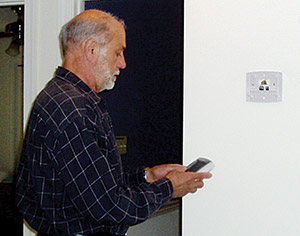
| Peter Kusterer, owner, Air Comfort For Homes, Raleigh, North Carolina, sets a customer’s heat pump balance point as part of his checklist for a homeowner. |
Traditionally popular in warmer climates, air-source heat pumps (ASHPs) are now being installed in just about every climate zone in the U.S., as consumers have often found them to be a cost-effective way to supply the majority of their heating and cooling needs. That being said, many ASHPs can struggle to provide a comfortable level of heating when the outside temperature falls below freezing, which is why units are often equipped with a backup or supplemental heat source — typically electric resistance heat (strip heat).
Supplemental heat is usually activated when the thermostat senses the outside air temperature is decreasing, and the ASHP can no longer keep up with the heat loss from the home. Backup heat can be expensive to use, which is why it’s important to find the right temperature — the balance point — at which compressor operation stops and supplemental heat is activated. However, that specific temperature can vary, depending on the cost of electricity in a particular location as well as the homeowner’s preference for lower energy costs or better comfort. As such, it’s up to contractors to figure out which balance point will work best for their customers.
Finding the Answer
Living in a somewhat temperate climate, Peter Kusterer, owner, Air Comfort for Homes, Raleigh, North Carolina, didn’t think too much about balance points until this past winter, when temperatures routinely dropped below 20°F.
“For the most part, winter in the Carolinas is pretty mild, except for this year, when we had temperatures hovering in the mid-teens. With rates rising, our electricity becomes pretty expensive, so, if you move someone over to using strip heat, there had better be a good reason. But, customers were complaining their heat pumps never stopped running this winter, which is a good thing because it meant the equipment was fighting to hold the set point; I started wondering about what the correct balance point should be.”
To find that answer, Kusterer contacted various thermostat, compressor, and equipment manufacturers and received recommendations ranging from 35° to 40°F, 10° to 15°F, and even to not setting a balance point at all. In general, the consensus seemed to be that 35°F was the right balance point for typical ASHPs, but, based on his own experience, Kusterer thought that may be too high.
“Most thermostats have a default balance point setting around 35°F, and contractors usually just leave it there,” said Kusterer. “But, I’ve found a balance point of 20°F makes sense in our area of the country. Older heat pumps will often struggle below 35°F, but daytime temps often rise above that, which takes care of the problem. I have three heat pumps, and I’ve found that 20°F is a reasonable balance point. Fortunately, most controls allow us to make adjustments in the field.”
Chip Cochran, owner, Mowery Heating and Cooling, Brownsburg, Indiana, finds the balance point of 35°F to be perfect for his region. “Finding the right balance point depends on the utility costs in the region. Based on that information, we routinely set it to 35°F in the field. But we will raise the balance point if the customer feels like the air coming out of the registers is too cool.”
Looking for quick answers on air conditioning, heating and refrigeration topics? Try Ask ACHR NEWS, our new smart AI search tool. Ask ACHR NEWS
To determine the balance point for their particular regions, Mark Freund, senior manager — field services, unitary products, building efficiency, Johnson Controls Inc., recommends contractors perform a heat loss calculation in accordance with ACCA Manual J for light commercial and residential equipment. “The heat loss information can then be compared to the heat pump’s heating capacity chart to determine at what point the heat pump will not be able to supply enough heat to satisfy the structure’s requirement.”
Still, balance points can be a little subjective, because they can depend on whether the contractor uses an application or economic balance point, which can vary based on location and equipment type, said Bryan Rocky, director, residential product management, unitary products, building efficiency, Johnson Controls Inc. “Application balance points are set depending on units’ performance versus structure requirements. Economic balance points are set based on the operating cost of the heat pump versus the backup heat source, in which case the SEER rating may have an impact on the balance point setting. If an application balance point is being used, changes in structure load can affect the balance point; if an economic balance point is being used, changes in utility rates can affect the balance point setting. The age of the unit usually only has an impact on older systems that are not maintained are not applied with two-stage equipment or with indoor air handlers or furnaces that do not have ECM [electronically commutated motors], which provide more options for controlling airflow.”
Heed Guidelines for Heat
While most heat pumps have a coefficient of performance (COP) of 3.0 to 4.0, electric heat has a COP of 1.0, which means it’s best to keep the heat pump running and only use the more expensive supplemental heat when the heat pump cannot heat the home on its own, said Tim Storm, heat pump product manager, Trane, an Ingersoll Rand brand. “When the balance point is set incorrectly (above the thermal balance point), the heat pump will shut off and switch over to the backup heating source at an outdoor temperature at which the heat pump was fully capable of heating the home, which ends up increasing operating costs.”
In addition to impacting energy consumption, an incorrect balance point may cause comfort concerns because the supply air temperature will drop as the heat pump loses capacity at lower outdoor temperatures, said Storm, but it won’t affect the equipment itself. “Heat pumps are designed to run at all outdoor temperatures, so an incorrect balance point will not normally damage the equipment, void the warranty, or affect the defrost cycle.”
Most heat pump thermostats have default balance point settings, but contractors should seek guidance from the OEMs when it comes to calculating the correct setting, said Rocky. “The instructions we provide are used to accurately determine the balance point the system needs to maintain comfort for the occupants, which is why contractors should always follow the heat pump equipment manufacturer’s instructions.”
Trane thermostats, for example, have several options that allow compressor operation to be restricted below a certain outdoor temperature (ideally below the thermal balance point). The use of electric heat when above the thermal balance point is optimized for both comfort and efficiency, said Storm. “Our XL950 control has an integrated economic calculator or wizard that will automatically determine the most economical balance point by simply entering the system type, efficiency, and cost of electricity, gas, propane, or fuel oil.”
Johnson Controls offers a range of smart thermostats, including the York Affinity, Coleman Echelon, and Luxaire Acclimate touchscreen communicating controls. These units provide information, details, and more options when it comes to properly setting the balance point.
“These options include modifying airflow and changing the delta between the balance set point and the low-temperature cutoff set point,” said Freund.
And, while there are numerous aftermarket thermostats available — including the ubiquitous Nest thermostat, which offers a heat pump balance feature — most OEMs believe optimum system performance can only be achieved when their controls are used.
“Most thermostats or system controls designed by HVAC manufacturers have proprietary control algorithms that have been perfected over the course of many years to deliver enhanced comfort and control of their systems, thus ensuring equipment reliability is not negatively impacted,” said Storm. “Even though there are many third-party controls on the market, they are not responsible for warranty costs or repairs of the HVAC equipment they are controlling, which today have limited warranties of up to 12 years.”
Regardless of the thermostat chosen for a particular application, contractors should make sure to properly perform a load calculation and consult with the OEM in order select the proper balance point for their customers.
Publication date: 5/25/2015
Want more HVAC industry news and information? Join The NEWS on Facebook, Twitter, and LinkedIn today!
Finding the Answer
Looking for a reprint of this article?
From high-res PDFs to custom plaques, order your copy today!