ACHR News
search
Ask ACHR NEWS AI
cart
facebook twitter instagram linkedin youtube
  • Sign In
  • Subscribe
  • Sign Out
  • My Account
ACHR News
  • NEWS
    • Breaking News
    • New HVAC Products
    • Featured Products
    • Manufacturer Reports
    • HVAC Data
    • Legislation
    • ACHR NEWS Centennial
  • RESIDENTIAL
    • Air Conditioners
    • Furnaces
    • Residential Heat Pumps
    • Ductless
    • Residential IAQ
    • Testing, Monitoring, Tools
    • Components & Accessories
  • COMMERCIAL
    • Air Handlers
    • Rooftop Units
    • Chillers and Cooling Towers
    • Commercial Heat Pumps
    • Boilers and Hydronics
    • VRF/Ductless
    • Commercial IAQ
  • REFRIGERATION
    • Refrigerants
    • Refrigerant Regulations
    • Leak Management
  • CONTRACTOR PRO
    • Geothermal
    • Homeowner Study
    • VRF and VRV Ductless
    • Unitary Trends
  • EDUCATION
    • Training and Education
    • Business Management
    • Service and Maintenance
    • Continuing Education
    • Market Research >
      • HVAC Brand Awareness Report
      • VRV, VRF, VRVZ Report
      • Unitary Trends Report
      • Water Heat Professionals Report
    • Webinars
    • Sponsor Insights
    • eProducts Info
    • White Papers
  • EVENTS
    • HVAC Contractor Forum
    • Industry Events and Webinars
  • MEDIA
    • Videos
    • AHR Expo 2025 Videos
    • Podcasts >
      • ACHR News Podcast
      • HARDI Podcasts
      • AHR Expo Podcasts
      • ACCA Podcasts
    • Interactive Spotlights
    • Quizzes
    • eBooks
    • HVAC Talkback
  • HVAC GROUP
    • ACHR NEWS >
      • Current Issue
      • Digital Edition
      • Subscribe
    • Distribution Trends
    • SNIPS NEWS >
      • Join SNIPS NEWS
    • Engineered Systems News >
      • Join ES News
    • HVACR Directory
    • Contests
    • Newsletters
    • Contact
    • Advertise
    • My Account
HVAC Residential MarketHVAC Commercial MarketBoilers and Hydronics

Designing Efficient Boiler Systems

Heat Load, Operating Temp, Piping Are Top Concerns

By Kimberly Schwartz
October 27, 2014

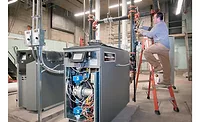
When it comes to designing and installing boiler systems that take advantage of the efficiency promised by newer condensing models, there are a lot of factors to take into account. According to the experts, the most common mistake made by designers and installers is failing to calculate the correct heat load. Other common errors occur when system operating temperature and piping are not properly considered.

Stop Oversizing

Although it’s an often-repeated refrain in the HVAC world “bigger isn’t better,” experts say oversizing boilers is still one of the most common mistakes made by designers. Oversizing occurs when designers fail to obtain a proper heat load calculation, said Gerry Hogan, director of training and applied technology, PB Heat LLC, Bally, Pennsylvania. “A designer may assume that matching the capacity of the boiler being replaced is accurate enough,” Hogan said.

David Hansen, product marketing manager, U.S. Boiler Co., added that designers frequently oversize “based on existing radiation or boilers.”

But making these assumptions instead of properly calculating heat loss is the wrong way to start out. “Oversizing leads to short cycling, decreased efficiency, increased operating costs, and equipment wear,” said Don DeCarr, hydronic/warm air product manager, ECR Intl. “Swapping Btu for Btu is probably the worst way to size a boiler. It is not uncommon to find 20- to 30-year-old equipment that is 50 percent oversized. And, even if it wasn’t grossly oversized when installed, over the years building envelope improvements, such as insulation, windows, etc. may have drastically reduced the heat loss.”

Rather, DeCarr said, designers must start with an accurate Manual J calculation.

Once heat loss has been accurately calculated, Hansen warned designers should not “underemphasize” it. Instead, Hogan said designers must “match the boiler capacity to the load.” And, he noted, they should consider providing additional capacity for domestic hot water (DHW) production, if needed.

Design for Lower Temps

Hydronic designers must also have the right mindset when it comes to system operating temperature in order to take advantage of the efficiency offered by condensing boilers.

Looking for quick answers on air conditioning, heating and refrigeration topics? Try Ask ACHR NEWS, our new smart AI search tool. Ask ACHR NEWS →

According to Matthew Freeman, boilers product manager, Bosch Thermotechnology Corp., “With a conventional boiler, the installer wants to be sure to protect the cast iron heat exchanger from thermal shock, which occurs when cold return water enters the hot cast iron boiler. Expanding or contracting too quickly may cause the cast iron sections to crack and leak. With condensing boilers, installers are encouraged to bring low return water temperature supply back to the boiler for condensing.”

And the reason for that encouragement is, of course, tied to the system’s efficiency. Freeman explained, “For every 3°F that supply temperature is reduced, there is a 1 percent savings in fuel. Utilizing 160° and 140° supply water encourages condensing and thus reduces energy consumption.”

Yet Joel Southwell, director of commercial heating, The Fulton Cos., noted, “Hydronic designers may not be selecting coils or heating elements that allow for lower operating temperatures of the system.”

He continued: “A slight increase in surface area can lower the hydronic loop temperature, thereby increasing the condensing boiler efficiency and lowering gas usage. Designing the hydronic system around a higher Delta T [30°-40°] decreases system pump kW requirements and allows colder return water temperatures to the condensing boiler.”

Read the Piping Directions

Another common source of errors is found in the near-boiler piping for condensing boilers. A lot of potential mistakes can be avoided by simply reading the manual.

For instance, Hogan has seen “near-boiler piping that is too small to carry the heat out of the boiler.”

In these cases, he said: “A designer may simply match the tappings on the boiler, especially on condensing boilers. When the piping is too small, the boiler reaches the target quickly and will short-cycle, with the burner starting and stopping frequently. This effect is often compared to ‘city driving’ of a car with a resulting lower efficiency.”

To prevent this problem, Hogan said near-boiler piping should be modified to ensure proper system water flow to the boiler.

Freeman stressed these kinds of mistakes occur when the manufacturer’s instructional literature is ignored. “Each manufacturer has its own heat exchanger design. With that comes different pressure drops and flow rate capabilities. It is important to consider this when selecting a piping arrangement,” he said. “Cast iron boilers typically were large-mass, high-volume vessels that could be piped in a supply/return header configuration. Condensing boilers have much less mass and volume, requiring primary secondary piping or the use of a low loss header.”

DeCarr agreed that many problems can be avoided by slowing down and looking at the manual first.

“The most common installation errors occur because the technician isn’t familiar with the equipment,” he said. “Particularly, if it is your first time with a brand or model, take some time to read through the installation manual and pay close attention to venting requirements, fuel supply pressure/line sizing, any special piping arrangements required or recommended, etc., your profits will go out the window if you have to redo the vent or re-pipe the boiler, and the customer won’t be too pleased you have to return to tear something out.”

Publication date: 10/27/2014

Want more HVAC industry news and information? Join The NEWS on Facebook, Twitter, and LinkedIn today!

KEYWORDS: boilers condensing boilers hydronics load reduction

Share This Story

Looking for a reprint of this article?
From high-res PDFs to custom plaques, order your copy today!


Kimberly Schwartz is Contributing Editor. She can be contacted at 248-703-3278 or kimberlyschwartz@achrnews.com. Prior to joining The NEWS in 2010, Kimberly worked on other BNP Media publications. She writes cover stories and focus articles. She holds a bachelor's degree in English from Brigham Young University.

Recommended Content

JOIN TODAY
To unlock your recommendations.

Already have an account? Sign In

  • HVAC-enrollment

    The Trades Are Back: HVACR Programs See Nearly 30% Enrollment Spike

    A new wave of future technicians is entering the pipeline.  
    News
    By: Matt Jachman
  • 2025 Top 40 Under 40

    2025 Top 40 Under 40 HVACR Professionals List

    The 11th annual Top 40 Under 40 list highlights those...
    HVAC Commercial Market
    By: Hannah Belloli-Oster
  • LG Ductless Mini-Split Systems

    The 9 Types of Heat Pumps

    As the U.S. moves toward electrification, heat pumps are...
    Ground Source Heat Pumps
    By: Joanna R. Turpin
Subscription Center
  • Create an Account
  • Start a Subscription
  • Manage My Account
  • Sign Up for Newsletters
  • Visit Customer Service
  • Update Preferences

More Videos

Sponsored Content

Sponsored Content is a special paid section where industry companies provide high quality, objective, non-commercial content around topics of interest to The News audience. All Sponsored Content is supplied by the advertising company and any opinions expressed in this article are those of the author and not necessarily reflect the views of The News or its parent company, BNP Media. Interested in participating in our Sponsored Content section? Contact your local rep!

close
  • Piggy Bank
    Sponsored byWatercress Financial

    Energy Prices, Inflation, and HVAC: What Today’s Homeowners Care About

  • Refrigerated Food
    Sponsored bySolstice Advanced Materials

    R-455A Refrigeration: A Cold Storage Solution for the Future

  • Airex Rooftop Units
    Sponsored byAirex Manufacturing Inc

    Consolidating Roof Penetrations: A Growing Trend in Multifamily HVAC Design

Popular Stories

HVAC-Price-Increase-graphic

HVAC Price Increase List: June 2026

Trump-Section-232.jpg

Trump Reduces Section 232 Tariffs on HVAC Equipment to 15%

Heat-pump-cutaway.jpg

PFAS Rules and A2L Building Codes Continue to Evolve

Midea-training.jpg

HVAC Workforce Crisis Expands Beyond Technicians to Instructor Shortages

Refrigerants-and-gauge.jpg

HVAC Industry Warns of Counterfeit Refrigerants Entering U.S. Supply Chain

View The ACHR NEWS
Centennial Anniversary Timeline

The ACHR News Timeline Chart
Submit a Letter
Submit a letter to our editors.

Events

November 6, 2025

Next-Gen Data Center Cooling: HVAC Innovation and Real-World Solutions

On Demand As AI workloads and high-density computing push traditional cooling methods to their limits, the data center industry is accelerating the adoption of next-generation HVAC technologies.

June 17, 2026

Decarbonization Without Disruption

This webinar will explore practical HVAC decarbonization strategies that minimize disruption while maximizing long-term performance and ROI.

View All Submit An Event

Poll

Summer Staff

Are you fully staffed for the summer season?
View Results Poll Archive

Products

BNI Mechanical/Electrical Square Foot Costbook, 2026 Edition

BNI Mechanical/Electrical Square Foot Costbook, 2026 Edition

See More Products
Decarbonization Without Disruption - Free Webinar - 6/17/2026

Related Articles

  • bwbrute

    Optimizing Commercial Boiler Systems

    See More
  • Brewery

    Brewery Boiler Systems: Sanitation, Sterilization, and Customer Satisfaction

    See More
  • Triad Boiler Systems Inc.: Boiler

    See More

Related Products

See More Products
  • Lessons Learned in a Boiler Room: A common sense approach to servicing and installing commercial boilers

  • 9781482253894.jpg

    Boiler Operator's Handbook, Second Edition

  • understandingD.jpg

    Understanding Manual D® — Residential Duct Systems

See More Products
×

Sign Up. Stay Informed.

The #1 trusted source for the HVACR industry since 1926

SUBSCRIBE
  • RESOURCES
    • Advertise
    • Contact Us
    • Advisory Board
    • Classifieds
    • Submit a Letter
    • Directories
    • Store
  • ACCOUNT CENTER
    • Create an Account
    • Start a Subscription
    • Manage My Account
    • Sign Up for Newsletters
    • Visit Customer Service
    • Update Preferences
  • SERVICES
    • Marketing Services
    • Reprints
    • Market Research
    • List Rental
    • Survey/Respondent Access
  • STAY CONNECTED
    • LinkedIn
    • Facebook
    • Instagram
    • YouTube
    • X (Twitter)
  • PRIVACY
    • PRIVACY POLICY
    • TERMS & CONDITIONS
    • DO NOT SELL MY PERSONAL INFORMATION
    • PRIVACY REQUEST
    • ACCESSIBILITY

Copyright ©2026. All Rights Reserved BNP Media, Inc. and BNP Media II, LLC.

Design, CMS, Hosting & Web Development :: ePublishing