ACHR News
search
Ask ACHR NEWS AI
cart
facebook twitter instagram linkedin youtube
  • Sign In
  • Subscribe
  • Sign Out
  • My Account
ACHR News
  • NEWS
    • Breaking News
    • New HVAC Products
    • Featured Products
    • Manufacturer Reports
    • HVAC Data
    • Legislation
    • ACHR NEWS Centennial
  • RESIDENTIAL
    • Air Conditioners
    • Furnaces
    • Residential Heat Pumps
    • Ductless
    • Residential IAQ
    • Testing, Monitoring, Tools
    • Components & Accessories
  • COMMERCIAL
    • Air Handlers
    • Rooftop Units
    • Chillers and Cooling Towers
    • Commercial Heat Pumps
    • Boilers and Hydronics
    • VRF/Ductless
    • Commercial IAQ
  • REFRIGERATION
    • Refrigerants
    • Refrigerant Regulations
    • Leak Management
  • CONTRACTOR PRO
    • Geothermal
    • Homeowner Study
    • VRF and VRV Ductless
    • Unitary Trends
  • EDUCATION
    • Training and Education
    • Business Management
    • Service and Maintenance
    • Continuing Education
    • Market Research >
      • HVAC Brand Awareness Report
      • VRV, VRF, VRVZ Report
      • Unitary Trends Report
      • Water Heat Professionals Report
    • Webinars
    • Sponsor Insights
    • eProducts Info
    • White Papers
  • EVENTS
    • HVAC Contractor Forum
    • Industry Events and Webinars
  • MEDIA
    • Videos
    • AHR Expo 2025 Videos
    • Podcasts >
      • ACHR News Podcast
      • HARDI Podcasts
      • AHR Expo Podcasts
      • ACCA Podcasts
    • Interactive Spotlights
    • Quizzes
    • eBooks
    • HVAC Talkback
  • HVAC GROUP
    • ACHR NEWS >
      • Current Issue
      • Digital Edition
      • Subscribe
    • Distribution Trends
    • SNIPS NEWS >
      • Join SNIPS NEWS
    • Engineered Systems News >
      • Join ES News
    • HVACR Directory
    • Contests
    • Newsletters
    • Contact
    • Advertise
    • My Account
HVAC ContractingTechnical

Four Steps to Reduce HVAC Energy Cost

March 6, 2006
Despite the economic advantages and significant energy savings available by using AC variable frequency drives (VFDs) in HVAC applications, many building operators do not repair or replace drives when they fail since the motors can easily continue to run through a bypass contactor. While this is a great solution for short-term outages, continued operation in this mode quickly becomes a very expensive way to operate a fan.

THE CHALLENGE

Budget cuts and competitive pressures have reduced building maintenance staffs in many public and private enterprises. This frequently results in a reprioritization of activities, forcing concentration on addressing issues which are required to be fixed at the moment. Repair items such as an HVAC drive system operating in bypass mode may be considered only a nuisance, to be dealt with as time permits. And, of course, time seldom does so permit.
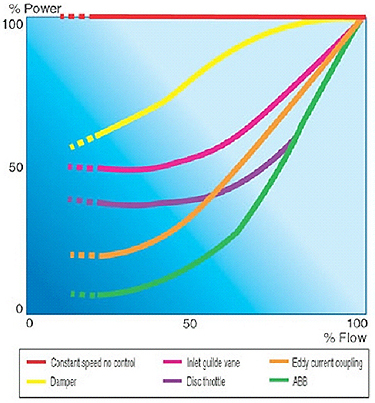
Comparison of power vs. flow for constant speed, damper, inlet guide vane, disc throttle, eddy current coupling, and ABB variable frequency drive systems.

HISTORICAL PERSPECTIVE

Consider the rationale for installing HVAC variable frequency drives over the past 10-15 years to control the airflow in buildings. These drives were originally installed to replace the throttling systems designed to regulate flow of air in the system. While throttling reduced the flow, the motor still ran at nearly full load speed and in some cases worked even harder to overcome the added system restriction. By reducing the speed of the motor, the variable speed drive ensures no more energy than necessary is used to achieve the required flow.

For example, in theory, a fan running at half speed consumes only one-eighth of the energy compared to one running at full speed. Field experience has shown that when the effect of static back pressure is factored in, the relationship is somewhere between 1/4 and 1/8 of the energy consumed at full speed depending on the application.

BYPASS FAILURES

Recent studies indicate that 8-12 percent of HVAC drive systems are running in a bypass mode due to a drive fault. The intent of a bypass contactor is for use in case of a drive failure for short-time emergency service. It was never intended to be a long-term solution to a drive malfunction. While the misapplication of long-term use is understandable due to increased pressures on typically under-manned building maintenance organizations, there are proven approaches to solving this pressing problem.

Why worry about this now? Energy costs continue to soar. Between 1999 and 2004, electricity costs increased by nearly 15 percent (source: Department of Energy). When VFDs were purchased for the application, the additional costs were justified based on saving money and improving profitability by using less energy for HVAC air handling in the building. As an example of how long-term use of bypass contactors affects energy costs, if 10 percent of the drives are in bypass mode, up to 56 percent more energy can be consumed by the HVAC air handling system. This is based on the assumption of all motors being the same size and all HVAC systems operating on average at 50 percent flow.

NEXT STEPS

The path forward presents two clear choices. First, do nothing and continue to lose increasing amounts of money every day as additional VFD systems periodically fail and go into bypass operation. Second, develop a program which will change the way drives are proactively maintained.

A typical preventative maintenance program is centered around the following activities:

1. Review your situation. Utilize either an outside or internal resource person to inventory the drives in the building or complex to gather the following information:

  • The number of installed drives and the make and model of each unit.

  • Age of the drives and how long they actually have been in service.

  • The hp of each drive.

  • The duty cycle of each drive. Note that load-level vs. length-of-time data may be difficult to determine, so this will often be an estimate.

  • The number of drives operating in the bypass mode.

  • Existing replacement drive inventory and on-hand spare parts to support downtime.

    2. Replace or repair all of the drives operating in the bypass mode to begin realizing the original energy savings. It is important to work with a supplier that demonstrates the capability to easily replace or repair drives. Select one that will assist in the maintenance and support on an ongoing basis.

    3. Create or contract a preventative maintenance program which focuses on the specific issues of drives and how to keep them up and running. These activities typically include, but are not limited to:

    With the VFD deenergized

  • Inspection of the environmental conditions on each drive.

  • Inspection of power components and circuit boards for deterioration.

  • Inspection for loose connections.

  • Cleaning interior components of the drives.

    With the VFD reenergized

  • Simulation or variation of signals from the control system to verify that the VFD is responding properly.

  • Calibration of the drive to original factory settings.

  • Review of the drive application for possible upgrades and operational enhancements.

    4. Replace older and highly critical drives before they fail. When a drive is over 10 years old and/or in a demanding and highly critical application, consideration should be given to replacing it before failure. Even with the cost of a new drive and installation, the benefits will include lower operating costs and improved client comfort. Simple payback, 10-year-life-cycle costing, or other financial analysis techniques may be performed to formally evaluate the economics for drive change out.

    CONCLUSION

    VFD systems installed in the facility have a proven track record of saving energy and improving client comfort. The ability to keep drives running as designed will assure continued savings and comfortable clients.

    A number of significant improvements have been made to present-day VFD systems compared to what was available 10 years ago. Drive size and parts count have been reduced along with cost, while increasing performance, quality, and warranty periods. Commonly available features include embedded PI control functions which eliminate the need for closed loop output signals from the building automation system (BAS). The PI controller typically includes feedback inverse, square root, and differential control functions on-board which lower costs of HVAC control systems installation and wiring.

    VFD units now typically combine sophisticated IGBT power switching with advanced microprocessor logic to reduce audible motor noise and meet accepted power quality standards. A number of communication options are available which can be tailored to a wide variety of BAS data and control formats. On-board metering of electrical kW and kWh information provides data useful in efficiency and billing calculations.

    Reprinted with permission from the ABB white paper "Four Steps to Reduce Your HVAC Energy Cost." For more information, visit www.abb.us.

    Publication date: 03/06/2006

  • Looking for quick answers on air conditioning, heating and refrigeration topics? Try Ask ACHR NEWS, our new smart AI search tool. Ask ACHR NEWS →

    Share This Story

    Looking for a reprint of this article?
    From high-res PDFs to custom plaques, order your copy today!


    Recommended Content

    JOIN TODAY
    To unlock your recommendations.

    Already have an account? Sign In

    • HVAC-enrollment

      The Trades Are Back: HVACR Programs See Nearly 30% Enrollment Spike

      A new wave of future technicians is entering the pipeline.  
      News
      By: Matt Jachman
    • 2025 Top 40 Under 40

      2025 Top 40 Under 40 HVACR Professionals List

      The 11th annual Top 40 Under 40 list highlights those...
      News
      By: Hannah Belloli-Oster
    • LG Ductless Mini-Split Systems

      The 9 Types of Heat Pumps

      As the U.S. moves toward electrification, heat pumps are...
      HVAC Residential Market
      By: Joanna R. Turpin
    Subscription Center
    • Create an Account
    • Start a Subscription
    • Manage My Account
    • Sign Up for Newsletters
    • Visit Customer Service
    • Update Preferences

    More Videos

    Sponsored Content

    Sponsored Content is a special paid section where industry companies provide high quality, objective, non-commercial content around topics of interest to The News audience. All Sponsored Content is supplied by the advertising company and any opinions expressed in this article are those of the author and not necessarily reflect the views of The News or its parent company, BNP Media. Interested in participating in our Sponsored Content section? Contact your local rep!

    close
    • Piggy Bank
      Sponsored byWatercress Financial

      Energy Prices, Inflation, and HVAC: What Today’s Homeowners Care About

    • Refrigerated Food
      Sponsored bySolstice Advanced Materials

      R-455A Refrigeration: A Cold Storage Solution for the Future

    • Airex Rooftop Units
      Sponsored byAirex Manufacturing Inc

      Consolidating Roof Penetrations: A Growing Trend in Multifamily HVAC Design

    Popular Stories

    HVAC-Price-Increase-graphic

    HVAC Price Increase List: June 2026

    Trump-Section-232.jpg

    Trump Reduces Section 232 Tariffs on HVAC Equipment to 15%

    Refrigerants-and-gauge.jpg

    HVAC Industry Warns of Counterfeit Refrigerants Entering U.S. Supply Chain

    Heat-pump-cutaway.jpg

    PFAS Rules and A2L Building Codes Continue to Evolve

    Midea-training.jpg

    HVAC Workforce Crisis Expands Beyond Technicians to Instructor Shortages

    View The ACHR NEWS
    Centennial Anniversary Timeline

    The ACHR News Timeline Chart
    Submit a Letter
    Submit a letter to our editors.

    Events

    November 6, 2025

    Next-Gen Data Center Cooling: HVAC Innovation and Real-World Solutions

    On Demand As AI workloads and high-density computing push traditional cooling methods to their limits, the data center industry is accelerating the adoption of next-generation HVAC technologies.

    June 17, 2026

    Decarbonization Without Disruption

    This webinar will explore practical HVAC decarbonization strategies that minimize disruption while maximizing long-term performance and ROI.

    View All Submit An Event

    Poll

    Summer Staff

    Are you fully staffed for the summer season?
    View Results Poll Archive

    Products

    BNI Mechanical/Electrical Square Foot Costbook, 2026 Edition

    BNI Mechanical/Electrical Square Foot Costbook, 2026 Edition

    See More Products
    Decarbonization Without Disruption - Free Webinar - 6/17/2026

    Related Articles

    • Comcast and Earth Networks Partner to Help Reduce HVAC Energy Use

      See More
    • Four Steps to Controlling Legionella Growth in Cooling Towers

      See More
    • Duct Dynasty

      Four Steps to Determine the Correct Mixed Air Temperature

      See More

    Related Products

    See More Products
    • Using Schematic Diagrams to Troubleshoot HVAC/R Electrical Circuits

    • front cover only.jpg

      How to Market Your HVAC Business

    • HVAC/R Electrical Troubleshooting: Deciding where to begin DVD

    See More Products

    Related Directories

    • Alliance to Save Energy

      Coalition of business, government, environmental, consumer leaders promoting the efficient and clean use of energy worldwide to benefit consumers, the environment, the economy, national security.
    • Energy Recovery

      Energy Recovery's PX G1300 pressure exchanger for CO2 refrigeration systems lowers operating costs and energy consumption, increases efficiency, and reduces emissions.
    • Encentiv Energy

      Incentive Experts! Are you looking for an incentive to lower your product cost? Reach out to us!
    ×

    Sign Up. Stay Informed.

    The #1 trusted source for the HVACR industry since 1926

    SUBSCRIBE
    • RESOURCES
      • Advertise
      • Contact Us
      • Advisory Board
      • Classifieds
      • Submit a Letter
      • Directories
      • Store
    • ACCOUNT CENTER
      • Create an Account
      • Start a Subscription
      • Manage My Account
      • Sign Up for Newsletters
      • Visit Customer Service
      • Update Preferences
    • SERVICES
      • Marketing Services
      • Reprints
      • Market Research
      • List Rental
      • Survey/Respondent Access
    • STAY CONNECTED
      • LinkedIn
      • Facebook
      • Instagram
      • YouTube
      • X (Twitter)
    • PRIVACY
      • PRIVACY POLICY
      • TERMS & CONDITIONS
      • DO NOT SELL MY PERSONAL INFORMATION
      • PRIVACY REQUEST
      • ACCESSIBILITY

    Copyright ©2026. All Rights Reserved BNP Media, Inc. and BNP Media II, LLC.

    Design, CMS, Hosting & Web Development :: ePublishing