ACHR News
search
Ask ACHR NEWS AI
cart
facebook twitter instagram linkedin youtube
  • Sign In
  • Subscribe
  • Sign Out
  • My Account
ACHR News
  • NEWS
    • Breaking News
    • New HVAC Products
    • Featured Products
    • Manufacturer Reports
    • HVAC Data
    • Legislation
    • ACHR NEWS Centennial
  • RESIDENTIAL
    • Air Conditioners
    • Furnaces
    • Residential Heat Pumps
    • Ductless
    • Residential IAQ
    • Testing, Monitoring, Tools
    • Components & Accessories
  • COMMERCIAL
    • Air Handlers
    • Rooftop Units
    • Chillers and Cooling Towers
    • Commercial Heat Pumps
    • Boilers and Hydronics
    • VRF/Ductless
    • Commercial IAQ
  • REFRIGERATION
    • Refrigerants
    • Refrigerant Regulations
    • Leak Management
  • CONTRACTOR PRO
    • Geothermal
    • Homeowner Study
    • VRF and VRV Ductless
    • Unitary Trends
  • EDUCATION
    • Training and Education
    • Business Management
    • Service and Maintenance
    • Continuing Education
    • Market Research >
      • HVAC Brand Awareness Report
      • VRV, VRF, VRVZ Report
      • Unitary Trends Report
      • Water Heat Professionals Report
    • Webinars
    • Sponsor Insights
    • eProducts Info
    • White Papers
  • EVENTS
    • HVAC Contractor Forum
    • Industry Events and Webinars
  • MEDIA
    • Videos
    • AHR Expo 2025 Videos
    • Podcasts >
      • ACHR News Podcast
      • HARDI Podcasts
      • AHR Expo Podcasts
      • ACCA Podcasts
    • Interactive Spotlights
    • Quizzes
    • eBooks
    • HVAC Talkback
  • HVAC GROUP
    • ACHR NEWS >
      • Current Issue
      • Digital Edition
      • Subscribe
    • Distribution Trends
    • SNIPS NEWS >
      • Join SNIPS NEWS
    • Engineered Systems News >
      • Join ES News
    • HVACR Directory
    • Contests
    • Newsletters
    • Contact
    • Advertise
    • My Account
HVAC ContractingTechnical

Help Customers Reduce Heating Bills This Winter

January 21, 2005
Imagine your customer leaving a window open all winter long - the resulting heat loss, cold drafts, and wasted energy. Well if the home has a folding attic stair, a fireplace, and/or a clothes dryer, that may be just what is occurring in the home.

These often overlooked sources of heat loss and air leakage can cause heat to pour out and the cold outside air to pour in - costing the homeowner higher heating bills, causing cold drafts, and wasting energy.

Air leaks are the largest source of heating and cooling loss in the home. Air leaks occur through the small cracks around doors, windows, pipes, etc. We can apply caulk and weatherstripping to these areas to minimize heat loss and cold drafts.

But what can you do about the three largest "holes" in the home - the folding attic stair, the fireplace, and the clothes dryer? Here are some tips and techniques that can easily, quickly, and inexpensively seal and insulate these holes.
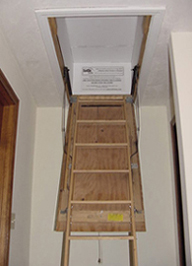
An attic stair cover can be used to seal a folding attic stairway.

Attic Stairs

Does your customer's home have a folding attic stairway? When attic stairs are installed, a large hole (approximately 10 square feet) is created in the ceiling. The ceiling and insulation that were there have to be removed. And what is installed to cover this opening? A thin, unsealed, uninsulated sheet of plywood.

The attic space is ventilated directly to the outdoors. In the winter, the attic space can be very cold, and in the summer it can be very hot. And what is separating the conditioned house from the unconditioned attic? That thin sheet of plywood.

Often a gap can be observed around the perimeter of the door. Try this yourself: turn on the attic light and shut the attic stairway door. Do you see any light coming through? These gaps can add up to a significant opening where heated/cooled air leaks out 24 hours a day, 7 days a week, 52 weeks a year. This is like leaving a window open all year round.

An easy, low-cost solution to this problem is to add an attic stair cover. An attic stair cover provides an air seal, reducing the air leaks. Add the desired amount of insulation over the cover to restore the insulation removed from the ceiling.
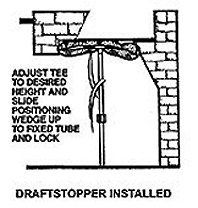
A fireplace draftstopper is an inflatable pillow that seals the damper, to eliminate air leaks.

Fireplaces

Approximately 100 million homes in North America are constructed with wood or gas burning fireplaces. Unfortunately, there are negative side effects that the fireplace brings to a home, especially during the winter home heating season. Fireplaces are energy losers.

Researchers have studied this to determine the amount of heat loss through a fireplace, and the results are surprising. One research study showed that an open damper on an unused fireplace in a well-insulated house can raise overall heating energy consumption by 30 percent.

Looking for quick answers on air conditioning, heating and refrigeration topics? Try Ask ACHR NEWS, our new smart AI search tool. Ask ACHR NEWS →

A recent study showed that, for many consumers, their heating bills may be more than $500 higher per winter just due to the air leakage and wasted energy caused by fireplaces.

Why does a home with a fireplace have higher heating bills? Hot air rises. Heated air leaks out any exit it can find, and when warm heated air is drawn out of the home, cold outside air is drawn in to make up for it. The fireplace is like a giant straw, sucking the heated air from a house. Again, this is like leaving a window open year round.

A simple solution to this problem is to add a fireplace draftstopper. A fireplace draftstopper is an inflatable pillow that seals the damper, eliminating air leaks. The pillow is removed whenever the fireplace is used, and reinserted when the fireplace is not in use.
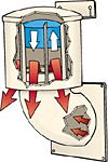
A dryer vent seal helps to reduce air infiltration.

Clothes Dryer Exhaust Ducts

Have you ever noticed that the room containing the clothes dryer is the coldest room in the house? Ever wonder why? The clothes dryer is connected to an exhaust duct that is open to the outdoors. In the winter, cold air leaks in through the duct, through the dryer, and into the house, while heated air just pours right out.

Dryer vents use a sheet metal flapper to try to reduce this air leakage. This is very primitive technology that does not provide a positive seal to stop the air leakage. Compounding the problem is that, over time, lint clogs the flapper valve causing it to stay open. Once again, this is like leaving a window open.

An inexpensive solution to this problem is to add a dryer vent seal. A dryer vent seal will reduce unwanted air infiltration, and keep out pests, bees, and rodents as well. The vent will remain closed unless the dryer is in use. When the dryer is in use, a floating shuttle rises to allow warm air, lint, and moisture to escape.

Mark D. Tyrol is a professional engineer specializing in the cause and origin of construction defects. He has developed several residential energy conservation products including an attic stair cover and a fireplace draftstopper. For more information, visit www.batticdoor.com.

Publication date: 01/24/2005

Share This Story

Looking for a reprint of this article?
From high-res PDFs to custom plaques, order your copy today!


Recommended Content

JOIN TODAY
To unlock your recommendations.

Already have an account? Sign In

  • HVAC-enrollment

    The Trades Are Back: HVACR Programs See Nearly 30% Enrollment Spike

    A new wave of future technicians is entering the pipeline.  
    News
    By: Matt Jachman
  • 2025 Top 40 Under 40

    2025 Top 40 Under 40 HVACR Professionals List

    The 11th annual Top 40 Under 40 list highlights those...
    HVAC Commercial Market
    By: Hannah Belloli-Oster
  • LG Ductless Mini-Split Systems

    The 9 Types of Heat Pumps

    As the U.S. moves toward electrification, heat pumps are...
    News
    By: Joanna R. Turpin
Subscription Center
  • Create an Account
  • Start a Subscription
  • Manage My Account
  • Sign Up for Newsletters
  • Visit Customer Service
  • Update Preferences

More Videos

Sponsored Content

Sponsored Content is a special paid section where industry companies provide high quality, objective, non-commercial content around topics of interest to The News audience. All Sponsored Content is supplied by the advertising company and any opinions expressed in this article are those of the author and not necessarily reflect the views of The News or its parent company, BNP Media. Interested in participating in our Sponsored Content section? Contact your local rep!

close
  • Piggy Bank
    Sponsored byWatercress Financial

    Energy Prices, Inflation, and HVAC: What Today’s Homeowners Care About

  • Refrigerated Food
    Sponsored bySolstice Advanced Materials

    R-455A Refrigeration: A Cold Storage Solution for the Future

  • Airex Rooftop Units
    Sponsored byAirex Manufacturing Inc

    Consolidating Roof Penetrations: A Growing Trend in Multifamily HVAC Design

Popular Stories

HVAC-Price-Increase-graphic

HVAC Price Increase List: June 2026

Trump-Section-232.jpg

Trump Reduces Section 232 Tariffs on HVAC Equipment to 15%

R410A-Refrigerant-Cylinder.jpg

Refrigerant Recovery is a Revenue Opportunity

Heat-pump-cutaway.jpg

PFAS Rules and A2L Building Codes Continue to Evolve

Kroger.jpg

Kroger to Spend $100 Million to Reduce Refrigerant Leaks

View The ACHR NEWS
Centennial Anniversary Timeline

The ACHR News Timeline Chart
Submit a Letter
Submit a letter to our editors.

Events

November 6, 2025

Next-Gen Data Center Cooling: HVAC Innovation and Real-World Solutions

On Demand As AI workloads and high-density computing push traditional cooling methods to their limits, the data center industry is accelerating the adoption of next-generation HVAC technologies.

June 17, 2026

Decarbonization Without Disruption

This webinar will explore practical HVAC decarbonization strategies that minimize disruption while maximizing long-term performance and ROI.

View All Submit An Event

Poll

Summer Staff

Are you fully staffed for the summer season?
View Results Poll Archive

Products

BNI Mechanical/Electrical Square Foot Costbook, 2026 Edition

BNI Mechanical/Electrical Square Foot Costbook, 2026 Edition

See More Products
Decarbonization Without Disruption - Free Webinar - 6/17/2026

Related Articles

  • Oct. 12, 2009: Energy Information Administration Forecasts Lower Heating Bills This Winter

    See More
  • Oct. 18, 2004: Home Heating Bills To Go Up 15 Percent This Winter

    See More
  • Oct. 22, 2007: ACEEE Offers Tips to Reduce High Heating Bills

    See More

Related Products

See More Products
  • ghpm.png

    Gas Heating: Furnaces, Boilers, Controls, Components

See More Products

Related Directories

  • Winters Instruments

    Winters Instruments is a manufacturer of quality pressure and temperature instrumentation, with distribution in over 90 countries. Visit www.winters.com for more information.
  • Johnstone Supply Billings

×

Sign Up. Stay Informed.

The #1 trusted source for the HVACR industry since 1926

SUBSCRIBE
  • RESOURCES
    • Advertise
    • Contact Us
    • Advisory Board
    • Classifieds
    • Submit a Letter
    • Directories
    • Store
  • ACCOUNT CENTER
    • Create an Account
    • Start a Subscription
    • Manage My Account
    • Sign Up for Newsletters
    • Visit Customer Service
    • Update Preferences
  • SERVICES
    • Marketing Services
    • Reprints
    • Market Research
    • List Rental
    • Survey/Respondent Access
  • STAY CONNECTED
    • LinkedIn
    • Facebook
    • Instagram
    • YouTube
    • X (Twitter)
  • PRIVACY
    • PRIVACY POLICY
    • TERMS & CONDITIONS
    • DO NOT SELL MY PERSONAL INFORMATION
    • PRIVACY REQUEST
    • ACCESSIBILITY

Copyright ©2026. All Rights Reserved BNP Media, Inc. and BNP Media II, LLC.

Design, CMS, Hosting & Web Development :: ePublishing