Preseason Checkup For Centrifugal Chillers
The overall goals of planned preventive maintenance for centrifugal chillers are to improve chiller reliability, increase equipment life, and maintain peak energy efficiency. A well-organized schedule of routine checkups and minor repairs reduces the frequency of unscheduled, often expensive, service calls.
It also minimizes the risk of catastrophic equipment failures and the associated potential for downtime, injuries, and unbudgeted equipment replacement.
Thorough inspection and service of the chiller system will keep it humming all summer long, while helping achieve those longer-term operating goals. This article discusses the key components of a basic spring maintenance program.
Daily Log
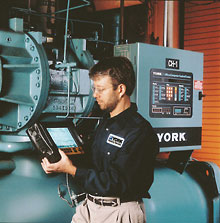
Perhaps one of the most effective tools in a preventive maintenance program is keeping a permanent daily log of operating conditions, recorded at regular intervals throughout a 24-hour operating period.When you are starting up a chiller in the spring, it is important to record temperature readings, fluid levels, pressure readings, and flow rates. Comparing them to earlier readings enables building owners and facility managers to pinpoint problems and identify energy-saving opportunities.
Graphic control panels - standard equipment on many chillers since 1999 - virtually eliminate the need to manually record many of these statistics. These panels provide user-friendly logs on one large, active-matrix screen, enabling operators to view multiple related parameters simultaneously on a single screen. They can quickly generate on-screen graphs of daily, weekly, and monthly trends for analysis.
An important part of preventive maintenance, then, is to regularly inspect the chiller's control center. Most control centers use two kinds of controls: safety and operating. Although checks on safety cutouts and operating checkpoints may be performed automatically, it's still important to check them manually before the start of the cooling season.
At the same time, it's a good idea to ensure proper calibration of the control panel, transducers, and thermistors, and to ensure that the leaving chilled water temperature (LCHWT) is set to the proper temperature. A 1 degree F increase in LCHWT can result in a 2-percent to 3-percent decrease in energy consumption.
Looking for quick answers on air conditioning, heating and refrigeration topics? Try Ask ACHR NEWS, our new smart AI search tool. Ask ACHR NEWS
Similarly, it's important to confirm that condenser inlet water temperature is set to the minimum level recommended by the manufacturer. Energy savings at full load are about 1.5 percent for every 1 degree reduction of the entering condenser water temperature (ECWT).
Mechanical Components
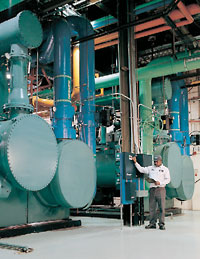
Vibration analysis is an important tool. It enables a technician to determine the condition of bearings, gears, and other rotating compressor components. Worn bearings and components emit a distinct signal that corresponds to the severity of the damage and the rotational speed. Sensitive vibration equipment can detect the signal and record it; a vibration engineer analyzes it.Vibration analysis should be scheduled during seasonal start-up to determine component condition. Compare these readings to baseline readings established at system commissioning.
In addition to component analysis, the compressor presents a host of other springtime preventive maintenance procedures. Take the oil filter; not only should it be replaced, but the used filter also needs to be inspected for metal particles.
Checking compressor oil levels is just as important. Taking frequent readings via sight glasses can provide valuable information about oil levels and contamination.
Oil samples also need to be sent out for analysis. Oil that appears dark or cloudy should be analyzed for the presence of harmful acids, corrosion-causing water, corrosion products, and metal particles indicating abnormal parts wear.
The compressor motor needs to be checked to ensure the tightness of the motor mounting screws. Examine the motor alignment and coupling for wear and make sure the bolts are tight. Use a megohmmeter to check the motor for moisture or deterioration of the winding insulation.
A spring preventive maintenance program should also ensure the proper operation of the oil return system. You can do this by verifying the oil return flow to the compressor sump and looking for excessive levels of oil in the refrigerant charge. It's also a good idea to check the eductor for foreign particles that could obstruct the jet, and to change the dehydrator and strainer. The purge unit dehydrator should also be changed. In addition, clean and inspect the purge unit's valves, orifices and drain, and flush oil and refrigerant from the purge unit shell.

Tube Failures, Leaks
Tube failure is the single most costly failure in a water chiller. Condenser tubes should be cleaned annually before seasonal startup.In addition, corrosion, scale, or algae buildup in the tubes can be minimized by employing a good water treatment program. Scale buildup can foul a chiller's condenser tubes, increasing the thermal resistance in the heat exchanger and as a result, increasing energy consumption.
The refrigerant system also presents a number of opportunities to practice good preventive maintenance and ensure energy-efficient chiller operation. As part of your spring checkup, check refrigerant charge levels via the sight glass or, preferably, by comparing the temperature difference between the LCWT and the evaporator refrigerant.
This is a good time to repair leaks in the refrigerant system. In high-pressure chillers, leaking refrigerant can limit the chiller's heat transfer capacity. In low-pressure chiller systems, air can leak into the chiller, displacing refrigerant vapor and causing higher condenser pressure, increasing energy use.
Lab analysis of refrigerant can also identify the presence of rust, sludge, and harmful acids in a chiller system. The condition of the refrigerant can lead you to diagnose other problems, which, left unattended, could reduce operating efficiency and cause chiller failure.
Follow Recommendations
It is important to consult and follow seasonal recommendations from the chiller manufacturer that are specific to a model.Additionally, some chillers are equipped with onboard computers that aid in troubleshooting and problem identification. In most cases, these chillers tie into facility-wide computer systems to assist in remote monitoring and diagnosis of equipment problems.
Whether or not your chiller is equipped with such a system, an effective preventive maintenance program requires familiarity with the operating-maintenance manual, and it needs to be carried out by qualified personnel.
The result is well-maintained equipment that efficiently and safely delivers comfort to building occupants, consumes less energy, and creates fewer headaches for facility managers.
Tom Brown is a training manager for York International (www.york.com), where he is responsible for training the company's field service organization. He can be reached at 717-771-7890 or thomas.brown@york.com.
Sidebar: Variable-Speed Drives Generate Savings
The precooling season is a good time to consider retrofitting a chiller with equipment that promotes efficient chiller operation and reduces energy consumption. Installation of variable-speed drive technology is one proven option.Chillers typically operate at off-design conditions 95 percent of the time, the result of low load and/or low entering condenser water temperatures (ECWTs). The resulting energy inefficiencies are motivating building owners and facility managers to explore whether chiller plants can be operated more efficiently during these conditions. The variable-speed drive is emerging as a solution to the energy inefficiencies associated with off-design conditions.
Conventional chillers reduce capacity at off-design conditions by maintaining a constant motor speed and restricting the flow of refrigerant by closing the compressor's inlet guide vanes. This closure induces flow losses that reduce compressor efficiency.
On a variable-speed chiller, the drive motor slows down or speeds up depending on the operating conditions. The drive monitors several operating conditions, including chilled water temperature, chilled water temperature set point, evaporator and condenser pressures, inlet vane position, and motor speed. Then it determines the optimal motor speed and inlet vane position in order to consume the least amount of energy.
Variable-speed control of a centrifugal chiller can produce energy savings of as much as 30 percent annually when compared to a constant-speed chiller; savings can reach 75 percent at lighter loads. With energy savings of this magnitude, the added cost of the variable-speed drive for the chiller can be paid off quickly. Additionally, the use of a variable-speed drive may lower maintenance costs because it soft starts the chiller, reducing wear on the driveline and extending its life for years.
It is not unusual, then, that a seasonal preventive maintenance program that seeks to improve chiller efficiencies, reduce energy consumption, and extend equipment life considers the addition of a variable-speed drive. The resulting off-design energy savings ensure a quick payback on the drive, often as little as one to three years.
- Tom Brown
Publication date: 05/02/2005
Looking for a reprint of this article?
From high-res PDFs to custom plaques, order your copy today!


