ACHR News
search
Ask ACHR NEWS AI
cart
facebook twitter instagram linkedin youtube
  • Sign In
  • Subscribe
  • Sign Out
  • My Account
ACHR News
  • NEWS
    • Breaking News
    • New HVAC Products
    • Featured Products
    • Manufacturer Reports
    • HVAC Data
    • Legislation
    • ACHR NEWS Centennial
  • RESIDENTIAL
    • Air Conditioners
    • Furnaces
    • Residential Heat Pumps
    • Ductless
    • Residential IAQ
    • Testing, Monitoring, Tools
    • Components & Accessories
  • COMMERCIAL
    • Air Handlers
    • Rooftop Units
    • Chillers and Cooling Towers
    • Commercial Heat Pumps
    • Boilers and Hydronics
    • VRF/Ductless
    • Commercial IAQ
  • REFRIGERATION
    • Refrigerants
    • Refrigerant Regulations
    • Leak Management
  • CONTRACTOR PRO
    • Geothermal
    • Homeowner Study
    • VRF and VRV Ductless
    • Unitary Trends
  • EDUCATION
    • Training and Education
    • Business Management
    • Service and Maintenance
    • Continuing Education
    • Market Research >
      • HVAC Brand Awareness Report
      • VRV, VRF, VRVZ Report
      • Unitary Trends Report
      • Water Heat Professionals Report
    • Webinars
    • Sponsor Insights
    • eProducts Info
    • White Papers
  • EVENTS
    • HVAC Contractor Forum
    • Industry Events and Webinars
  • MEDIA
    • Videos
    • AHR Expo 2025 Videos
    • Podcasts >
      • ACHR News Podcast
      • HARDI Podcasts
      • AHR Expo Podcasts
      • ACCA Podcasts
    • Interactive Spotlights
    • Quizzes
    • eBooks
    • HVAC Talkback
  • HVAC GROUP
    • ACHR NEWS >
      • Current Issue
      • Digital Edition
      • Subscribe
    • Distribution Trends
    • SNIPS NEWS >
      • Join SNIPS NEWS
    • Engineered Systems News >
      • Join ES News
    • HVACR Directory
    • Contests
    • Newsletters
    • Contact
    • Advertise
    • My Account
HVAC ContractingTechnical

Understanding Solenoid Valves

July 25, 2003
Solenoid valves are highly engineered products that can be used in many diverse and unique system applications. A brief overview of the components and functional varieties of solenoid valves follows.

General Information:
Valve Construction And Basic Operation

A solenoid valve is an electronically operated device. It is used to control the flow of liquids or gases in a positive, fully-closed or fully-open mode. The valve is commonly used to replace a manual valve or where remote control is desirable. A solenoid is operated by opening and closing an orifice in a valve body that permits or prevents flow through the valve. The orifice is opened or closed through the use of a plunger that is raised or lowered within a sleeve tube by energizing the coil. The bottom of the plunger contains a compatible sealing material, which closes off the orifice in the body, stopping flow through the valve.

The solenoid assembly consists of a coil, plunger, and sleeve assembly. In a normally closed valve, a plunger return spring holds the plunger against the orifice, preventing flow through the valve. When the coil is energized, a magnetic field is produced, raising the plunger and allowing flow through the valve. In a normally open valve, when the coil is energized, the plunger seals off the orifice, stopping flow through the valve.

Diagram 1. Two-way solenoid valve. A two-way valve controls flow in one direction. It may be direct operated or pilot operated.


Direct Operated Solenoid Valves

Direct operated solenoid valves function to directly open or close the main valve orifice, which is the only flow path in the valve. Direct operated valves are used in systems requiring low flow capacities or in applications with low pressure differential across the valve orifice. The sealing surface that opens and closes the main valve orifice is connected to the solenoid plunger. The valve operates from zero pressure differential to maximum rated pressure differential (MOPD) regardless of line pressure. Pressure drop across the valve is not required to hold the valve open.
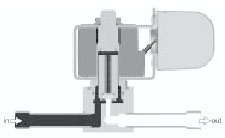
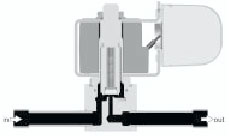
Diagram 2. Coil de-energized, valve closed.


Diagram 3. Coil energized, valve open.


Pilot Operated Valves

Pilot operated valves are the most widely used solenoid valves. Pilot operated valves utilize system line pressure to open and close the main orifice in the valve body. In a piston-style valve, the main orifice is held closed with a piston seal pressed against the main orifice by the combined fluid pressure and spring pressure. In a normally closed valve, the piston is shifted or opened when the pilot operator is energized. This allows fluid behind the piston to evacuate through the valve outlet. At this point, the system line pressure moves the piston, opening the main orifice of the valve allowing high capacity flow through the valve. When energizing the coil of a normally open valve, fluid pressure builds up behind the piston, forcing the piston to seal the main orifice of the valve.
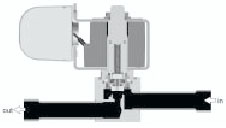
Diagram 4. Coil de-energized, valve closed.


Diagram 5. Coil energized, valve open.


Design Terminology

  • Continuous Duty — A rating given to a valve that can be energized continuously without overheating.

  • Correction Factor — A mathematical relationship related to a fluid’s specific gravity used to convert specific flows from a standard media to the media in question.

  • Current drain — The amount of current (expressed in amperes) that flows through the coil of a solenoid valve when it is energized.

  • Cv Factor — A mathematical factor that represents the quantity of water, in gallons per minute, that will pass through a valve with a 1 psi pressure drop across the valve.

  • Flow — Movement of fluid created by a pressure differential.

  • Flow Capacity — The quantity of fluid that will pass through a valve under a given set of temperature and pressure conditions.

  • Manual Stem — A mechanical device that permits the manual opening or closing of a valve in the case of emergency or power failure. A manual stem is available on all normally closed valves.

  • Maximum Operating Pressure Differential (MOPD) — The maximum pressure difference between the inlet and outlet pressures of the valve must not be exceeded, allowing the solenoid to operate in both the energized and de-energized positions.

  • Minimum Operating Pressure Differential — The minimum pressure difference between the inlet and outlet pressures required for proper operation. This minimum operating pressure differential must be maintained throughout the operating cycle of pilot operated valves to assure proper shifting from the closed position to the open position and visa versa. In the absence of the minimum operating pressure, the valve may close or will not fully open.

  • Orifice — The main opening through which fluid flows.

  • Safe Working Pressure — The maximum pressure a valve may be exposed to without experiencing any damage. The valve does not have to be operable at this pressure, but merely withstand the pressure without damage.

    Solenoid Valve Applications:
    Evaporator Temperature Control

    A solenoid valve installed in the liquid line as close to the evaporator as possible, in conjunction with a narrow differential thermostat, is an excellent temperature control. By mounting the thermostat bulb in the supply or discharge air across the evaporator, the temperature swing is limited only by the differential of the thermostat.
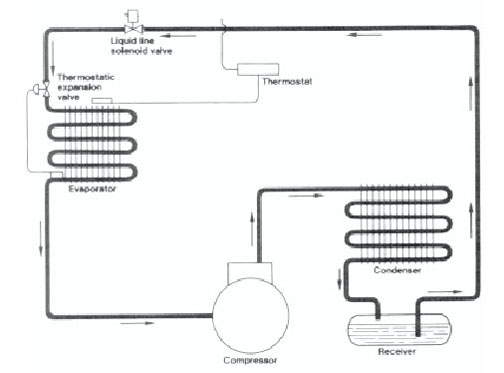
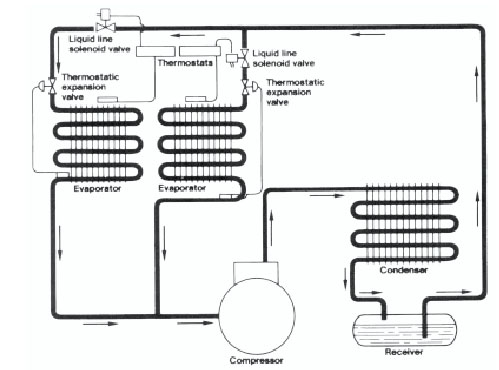
    Drawing 1. Thermostatic control of evaporator temperature.


    Drawing 2. Thermostatic control of two separate evaporators.


    This type of temperature control can be used on a single or multiple evaporator system and is particularly useful on multiplexed systems with evaporators at different temperatures.

    Defrost Pump Down

    In situations where the condensing unit is installed in a low ambient, such as on a rooftop in northern climates, and the evaporator is operating at a temperature above the ambient, a pump down solenoid valve should be used. This allows the pressure control to be set at a cut out of 1 to 2 psi and the cut in to be set at a pressure below the pressure corresponding to the ambient temperature. This will ensure that the condensing unit will start after cooling down during the defrost.
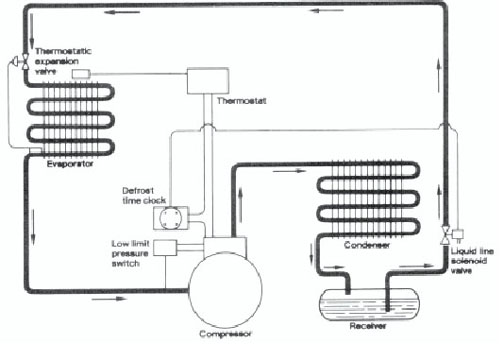
    Drawing 3. Pump down defrost with low ambient conditions.


    When a system has a defrost pump down solenoid valve, a thermostat should be used in series with the defrost time clock to control the temperature of the space or fixture. An alternative to the thermostat would be an evaporator pressure regulator.

    Note: System diagrams are for illustrative purposes and are intended to show application of solenoid valves only.

    Heat Reclaim Systems

    Basically, there are two types of heat reclaim systems: the series system and the parallel system.

    In the series system, during normal operation, the discharge gas is condensed completely in the condenser. During the heating mode, the normally opened solenoid valve closes off the condenser and the normally closed solenoid opens to allow the discharge gas to flow into the heat reclaim coil. Complete condensation can occur in the heat reclaim coil if so designed, but manufacturers often prefer to take advantage of all the sensible heat available but only part of the latent heat, depending on the condenser for complete condensation.
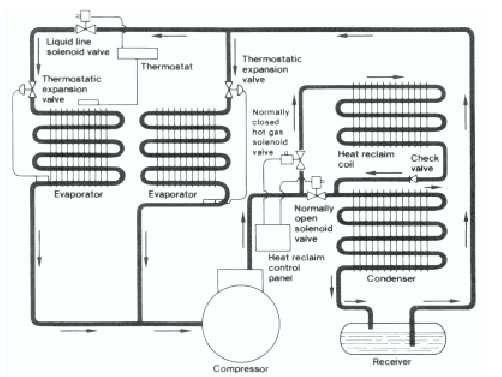
    Drawing 4. Heat reclaim system (series).


    In the parallel systems there are, in effect, two separate condensers. During normal operation, the condenser is used for complete condensation of the discharge gas. In the heat reclaim mode the discharge gas is completely condensed in the heat reclaim coil, thus maximizing the use of both sensible and latent heat. Some manufacturers recommend installing a 1/4-inch line from the heat reclaim coil, at its lowest point, back to the receiver to ensure the proper drainage of oil and liquid refrigerant during the off cycle. Other manufacturers suggest the installation of a pressure control, to ensure that the system will switch from the heat reclaim mode to the condenser in the event of fan stoppage or clogged filters.
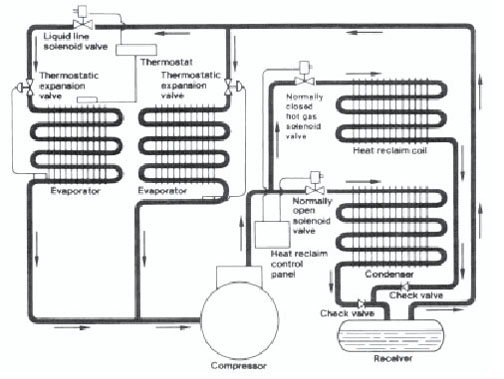
    Drawing 5. Heat reclaim system (parallel).


    Split Evaporator — Humidity Control

    There are often times when the air temperature is satisfactory but the humidity level is too high. This can be remedied by using only half the evaporator to dehumidify the air without excessive cooling and the addition of auxiliary heat. This can best be accomplished by using a normally open solenoid valve on one half of the evaporator controlled by a humidistat.
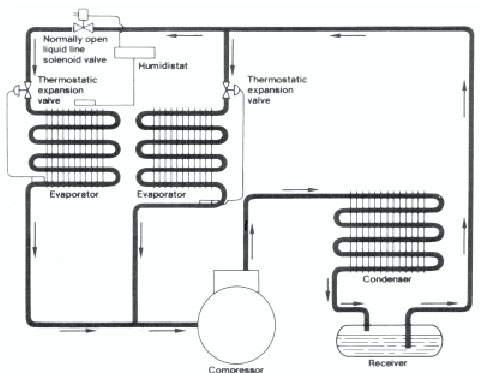
    Drawing 6. Split coil air conditioning dehumidification system.


    Hot Gas Defrost System

    Hot gas defrost offers an excellent alternative to electric or air defrost. In this system the hot compressor discharge gas is routed to the outlet of the evaporator. This hot gas warms the evaporator, thaws any frost that has accumulated, condenses into a liquid, and flows into the common liquid line to feed the other evaporators.

    In order for this system to work properly, check valves must be installed to allow flow around the expansion valves. A pressure reducing valve should be used in the liquid line to provide a pressure differential between the condensed refrigerant leaving the defrosting evaporator and the common liquid line.

    The system shown is drawn with only two evaporators but it is recommended that only 25 percent of any multiplexed system be hot gas defrosted at any given time.

    An alternative to the hot gas defrost system is the cool gas defrost, which uses the gas from the top of the receiver to defrost the evaporators. Because the cool gas defrost operates at a lower temperature, the thermal expansion of the refrigeration lines is reduced. This often eliminates the need for special piping techniques and leaks caused at line connections by excessive thermal flexing.
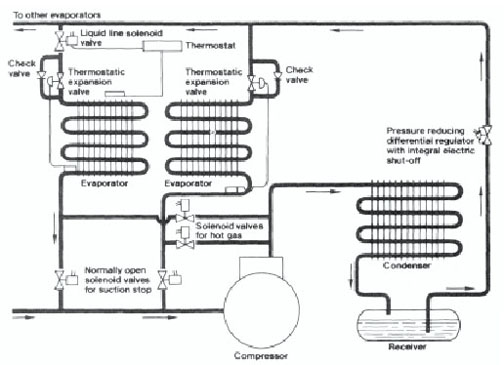
    Drawing 7. Hot gas defrost system.


    Capacity Control System

    A simple method of providing compressor unloading is to use a solenoid valve connecting the discharge and suction lines of the compressor. The solenoid valve is controlled by a pressure control which responds to suction pressure. When the switch closes, it opens the normally closed solenoid valve and discharge gas is short circuited back to the suction side of the compressor.

    In order to prevent overheating of the compressor, a thermostatic expansion valve should be installed to provide cooling to the compressor suction gas. An alternative method consists of injecting hot gas into the evaporator inlet. This prevents overheating of the compressor and increases the velocity of the gas through the evaporator.

    This type of unloading should not be attempted without thorough analysis of solenoid valve and expansion valve sizing.

    Drawing 8. Capacity control system.


    Liquid Line Shut-Off

    In an effort to obtain a higher efficiency rating on residential and commercial air conditioning systems, a normally closed solenoid valve typically is installed in the liquid line located near the air handler or furnace. In this case, the solenoid valve is wired in parallel with the contactor circuit (24 VAC) and may require a larger transformer to accommodate the valve.

    As an alternative method, a normally closed solenoid valve may be located in the liquid line near the condensing unit and wired directly to the compressor motor terminal box. This solution improves system efficiency and maintains the refrigerant charge in the condenser coil during the off-cycle of the compressor which prevents refrigerant migration when long piping runs are used.

    If the application requires a fail-safe or open mode, a normally open solenoid valve may be used. In this instance, the valve may also be located in the condensing unit and wired in series with the compressor crankcase heater.
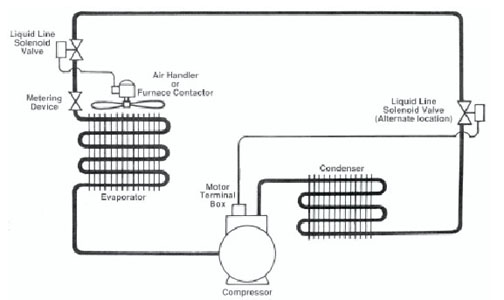
    Drawing 9. Liquid line shut-off.


    Compiled by the Parker Hannifin Corporation Engineering Staff, New Britain, Conn. For more information, visit www.parker.com/skinner/rseries.

    Publication date: 07/28/2003

  • Looking for quick answers on air conditioning, heating and refrigeration topics? Try Ask ACHR NEWS, our new smart AI search tool. Ask ACHR NEWS →

    Share This Story

    Looking for a reprint of this article?
    From high-res PDFs to custom plaques, order your copy today!


    Recommended Content

    JOIN TODAY
    To unlock your recommendations.

    Already have an account? Sign In

    • HVAC-enrollment

      The Trades Are Back: HVACR Programs See Nearly 30% Enrollment Spike

      A new wave of future technicians is entering the pipeline.  
      News
      By: Matt Jachman
    • 2025 Top 40 Under 40

      2025 Top 40 Under 40 HVACR Professionals List

      The 11th annual Top 40 Under 40 list highlights those...
      HVAC Light Commercial Market
      By: Hannah Belloli-Oster
    • LG Ductless Mini-Split Systems

      The 9 Types of Heat Pumps

      As the U.S. moves toward electrification, heat pumps are...
      Air Source Heat Pumps
      By: Joanna R. Turpin
    Subscription Center
    • Create an Account
    • Start a Subscription
    • Manage My Account
    • Sign Up for Newsletters
    • Visit Customer Service
    • Update Preferences

    More Videos

    Sponsored Content

    Sponsored Content is a special paid section where industry companies provide high quality, objective, non-commercial content around topics of interest to The News audience. All Sponsored Content is supplied by the advertising company and any opinions expressed in this article are those of the author and not necessarily reflect the views of The News or its parent company, BNP Media. Interested in participating in our Sponsored Content section? Contact your local rep!

    close
    • Piggy Bank
      Sponsored byWatercress Financial

      Energy Prices, Inflation, and HVAC: What Today’s Homeowners Care About

    • Refrigerated Food
      Sponsored bySolstice Advanced Materials

      R-455A Refrigeration: A Cold Storage Solution for the Future

    • Airex Rooftop Units
      Sponsored byAirex Manufacturing Inc

      Consolidating Roof Penetrations: A Growing Trend in Multifamily HVAC Design

    Popular Stories

    HVAC-Price-Increase-graphic

    HVAC Price Increase List: June 2026

    Trump-Section-232.jpg

    Trump Reduces Section 232 Tariffs on HVAC Equipment to 15%

    R410A-Refrigerant-Cylinder.jpg

    Refrigerant Recovery is a Revenue Opportunity

    Heat-pump-cutaway.jpg

    PFAS Rules and A2L Building Codes Continue to Evolve

    Midea-training.jpg

    HVAC Workforce Crisis Expands Beyond Technicians to Instructor Shortages

    View The ACHR NEWS
    Centennial Anniversary Timeline

    The ACHR News Timeline Chart
    Submit a Letter
    Submit a letter to our editors.

    Events

    November 6, 2025

    Next-Gen Data Center Cooling: HVAC Innovation and Real-World Solutions

    On Demand As AI workloads and high-density computing push traditional cooling methods to their limits, the data center industry is accelerating the adoption of next-generation HVAC technologies.

    June 17, 2026

    Decarbonization Without Disruption

    This webinar will explore practical HVAC decarbonization strategies that minimize disruption while maximizing long-term performance and ROI.

    View All Submit An Event

    Poll

    Summer Staff

    Are you fully staffed for the summer season?
    View Results Poll Archive

    Products

    BNI Mechanical/Electrical Square Foot Costbook, 2026 Edition

    BNI Mechanical/Electrical Square Foot Costbook, 2026 Edition

    See More Products
    Decarbonization Without Disruption - Free Webinar - 6/17/2026

    Related Articles

    • valves

      Cold Rooms: Thermostatic Expansion Valves and Solenoid Valves

      See More
    • Literature: Pipe Insulation, Solenoid Valves, Welding Helmets, Industrial Motors, Valves, Actuators, Distribution Management, Duct Connectors, Tax Deduction Guide, Fans and Blowers, Vacuum Valves, Multiple Chiller Systems and Climate Controls

      See More
    • Parker Fluid Control Div.: Solenoid Valves

      See More

    Related Products

    See More Products
    • basicelectricty_cover.jpg.jpg

      Understanding Basic Electricity - A Companion Guide

    • Understanding TXV Refrigeration Systems: Superheat and Subcooling DVD

    • compressormotorwindingsdvd.jpg

      UNDERSTANDING COMPRESSOR MOTOR WINDINGS

    See More Products
    ×

    Sign Up. Stay Informed.

    The #1 trusted source for the HVACR industry since 1926

    SUBSCRIBE
    • RESOURCES
      • Advertise
      • Contact Us
      • Advisory Board
      • Classifieds
      • Submit a Letter
      • Directories
      • Store
    • ACCOUNT CENTER
      • Create an Account
      • Start a Subscription
      • Manage My Account
      • Sign Up for Newsletters
      • Visit Customer Service
      • Update Preferences
    • SERVICES
      • Marketing Services
      • Reprints
      • Market Research
      • List Rental
      • Survey/Respondent Access
    • STAY CONNECTED
      • LinkedIn
      • Facebook
      • Instagram
      • YouTube
      • X (Twitter)
    • PRIVACY
      • PRIVACY POLICY
      • TERMS & CONDITIONS
      • DO NOT SELL MY PERSONAL INFORMATION
      • PRIVACY REQUEST
      • ACCESSIBILITY

    Copyright ©2026. All Rights Reserved BNP Media, Inc. and BNP Media II, LLC.

    Design, CMS, Hosting & Web Development :: ePublishing