Btu Buddy 15: Quickly Cooling A Hot Hermetic Compressor
The dispatcher calls Bob and tells him that a very good customer is without air conditioning. It is a restaurant and must have cooling. The lunch hour is coming up in three hours and the owner wants it repaired as soon as possible.
Bob arrives at the job and goes onto the roof for a look at the rooftop unit for the large dining room. The condenser fan is running, but the compressor is not.
Bob takes the compressor compartment door off and looks inside. He tries to touch the compressor and quickly pulls his hand back. It is really hot. He notices that the compressor contactor is humming, so the control circuit is calling for cooling.
He then checks the voltage at the outlet to the compressor contactor and finds it has line voltage from L1 to L2; it is a single-phase compressor. There is power to run the compressor, but it is not running. Bob steps back and scratches his head.
Btu Buddy asks Bob, "What do you think is wrong?"
Bob says, "It looks like the compressor is burned up. It is too hot to touch."
Btu Buddy asks, "What are you going to do now?"
Looking for quick answers on air conditioning, heating and refrigeration topics? Try Ask ACHR NEWS, our new smart AI search tool. Ask ACHR NEWS
Bob says, "Take down the model and serial numbers and order a compressor."
Btu Buddy then asks, "What if it is just hot? If you change it out, when you get back to the shop, the compressor will have cooled and will then run."
Bob asks, "What do you suggest?"
Btu Buddy explains, "Suppose you give the compressor an electrical check. It will only take a few minutes and it may tell you something. If the compressor is burned, it will likely have a circuit to ground. If it has an open winding, it may be the internal overload that has it off. If that is the case, you can cool the compressor and start it back up. If the compressor is hot, it may be a result of operating with a low charge. Remember, the suction gas cools the compressor; reduced suction gas results in a hot compressor."
Making The Electrical Checks
To check the compressor:1. Bob turns off the power and locks the panel. He then checks the compressor from the terminals to ground and there is no circuit. The compressor is not grounded.
2. He then checks from common to run. The circuit is open.
3. He checks from common to start. That circuit is open.
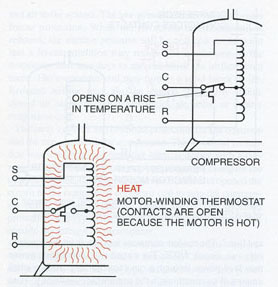
Btu Buddy notes, "You didn't do the next and most important test at this time, from run to start."
"Why is that so important?" asks Bob.
Btu Buddy says, "Suppose the compressor is hot because of some other reason; it has an internal overload that may be open. If so, you would get the readings that you have already noticed, then from run to start, there would be a circuit through those windings." Figure 1 shows a hot compressor with an open internal overload.
Btu Buddy asks Bob, "So now we have discovered a hot compressor. What are our options to get the system operating for the lunch hour for your customer?"
Bob says, "We could come back late this afternoon after the compressor has cooled down, but that would leave the customer without cooling for a busy lunch hour. I don't think they would be happy. What do you suggest?"
Btu Buddy says, "Why don't you do a quick cool down with water? It would be cool enough to start in about 30 minutes. While it is cooling, you can put gauges on the unit and see if you can find the problem."
CAUTION: Make sure the water does NOT come into contact with any of the electrical components. Use some dry timber to stand on while completing the rest of the work with power on the unit.
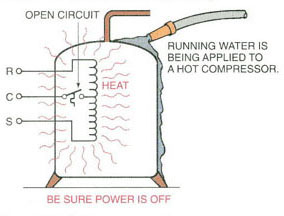
Bob then fastens gauges on the unit and discovers there is no refrigerant in the system. Bob says, "This is why the compressor is hot. There is no refrigerant in this system. Why didn't the low pressure control shut the system off?"
Btu Buddy says, "Look at the diagram and see why."
Bob looks at the diagram and says, "This system doesn't have a low pressure control. How is it protected from a low charge such as this?"
Btu Buddy explains, "Many systems use the winding thermostat for low charge protection. The motor will just warm up and shut the system off. It will not get hot enough to harm the compressor. When the winding thermostat shuts the compressor off, the large mass of the compressor and motor will keep it off for a long while. Now lets see if we can find out why it lost the refrigerant. The loss of charge had to happen overnight because the owner said the system was working last night. It is probably something obvious. First do a visual test."
Bob looks at the system and finds a fresh oil slick where the discharge line is touching a piece of flexible electrical conduit. There is just a small pinhole size leak.
Bob gets his torch and repairs the leak.
Btu Buddy comments, "The system never went into a vacuum, so evacuation is not necessary. You can just charge the unit and move on. First, allow liquid refrigerant to enter the system through the liquid line until tank pressure is reached; this will be close to the correct charge. Then it would be advisable to get set up to charge liquid into the low-pressure side of the system because the compressor is still going to be plenty warm. By using liquid metered into the low side of the system, you can further cool the compressor as you are charging it. This will reduce the chance of the compressor shutting off again because of high temperature."
"How do we know if the compressor is cool enough to start?" asks Bob.
Btu Buddy says, "Once you are set up with the system with the partial charge of refrigerant, get set to charge the liquid into the low-pressure side and turn it on. If it starts, just finish the charge into the low-pressure side."
Bob gets everything ready. He finds some old forklift pallets behind the building and places two of them next to the unit because the roof is still wet from the water.
Bob turns on the unit disconnect and the unit, and the compressor starts. The suction pressure is still low, so he slowly allows liquid refrigerant to enter the suction line until the suction pressure is reading about 65 psig, which is approaching the 70 psig normal pressure for R-22. The unit is doing its job now.
About that time, the owner comes onto the roof and says, "The unit is cooling. What a relief. You just don't realize how many customers will come into a hot dining room, turn around, and just go down the street. They want their lunch hour to be comfortable."
Bob explains to the owner what happened along with how he cooled the compressor with water to save several hours.
The owner then says, "That's what I'm happy to pay for, a really thinking service technician. Thank you very much."
Bob says, "I have had some great schooling and guidance, and am working everyday to become even more professional. Thanks for the compliment."
Bob then fully charges the unit using the super heat method since the unit has a capillary tube metering device. He then replaces all of the panels and returns his tools to the truck.
Btu Buddy says, "You did another good job there. You built excellent customer relations. I have never understood why some service technicians don't take care of the customer with an explanation of their work. It is so easy and is worth so much. You will be requested back by this customer. This makes you valuable to the company. If hard times come, the technician that gets along with the customers will be assured of a job. There is no substitute for technical knowledge, but good customer relations comes a close second."
Bill Johnson has been active in the HVACR industry since the 1950s. He graduated in gas fuel technology and refrigeration from the Southern Technical Institute, a branch of Georgia Tech (now known as Southern Polytechnic Institute). He taught HVAC classes at Coosa Valley Vocational & Technical Institute for four years. He moved on to become service manager for Layne Trane, Charlotte, N.C. He taught for 15 years at Central Piedmont Community College, part of this time as program director. He had his own business for five years doing installation and service work. Now retired, he is the author of Practical Heating Technology and Practical Cooling Technology, and continues as a co-author of Refrigeration & Air Conditioning Technology, 5th Edition, all published by Delmar Publishers. For more information, he can be reached at 704-553-0087, 704-643-3928 (fax), or bmj@myexcel.com.
Publication date: 06/28/2004
Looking for a reprint of this article?
From high-res PDFs to custom plaques, order your copy today!


