Inside Outstanding Heat Pump Installations
Before The Installation
“The most important thing is to do an accurate heat gain/heat loss calculation,” stated Keith Rhea, manager of Training Services, York UPG. “Contractors have to know where that’s at in order to know where to set the balance points,” said Rhea, referring to the point at which auxiliary heat takes over for the heat pump.In heating season, the higher the outdoor temperature, he explained, the greater the heat pump’s ability to produce heat. As it gets colder, the structure loses more heat. Heat input by the heat pump needs to equal heat lost by the structure. If heat is not replaced at a comparable rate, Rhea explained, it needs to be supplemented with auxiliary heat.
By doing this, occupant comfort, equipment life cycle, and efficiency are improved, Rhea said.
Raymond Granderson, supervisor of Training Products and Services, Rheem Air Conditioning Division, agreed. After all, equipment selection is based on the load calculation.
“Some inexperienced contractors use whatever equipment they have in stock, or whatever they can get easily and inexpensively,” Granderson said. “This can create mismatched systems. You just can’t throw unmatched equipment into a heat pump system and expect it to perform correctly.”
Greg Walters, Outdoor Products manager, Trane and American Standard, confirmed, “One of the things that is most critical is selection of the heat pump” and the determination of the times when it can’t supply heat on its own. “Equipment must be selected and staged so that it meets the demands,” he stated.
Airflow Matters
“Even more critical is the ductwork,” said Walters. “Air should not be moving at more than 50 fpm when it hits occupants.” This can help prevent a heating-season phenomenon commonly called “cold blow.”Placement of registers and making sure you have enough of them are also important considerations, he said. In heating markets, “You need to make sure registers are where the losses are,” and not blowing across the room. “When you’re cooling, it’s a little different,” he said, adding that the chance of discomfort is not as high.
It sometimes happens that contractors are asked to replace an existing heat pump, and the register placement is not optimal for occupant comfort. In such cases, equipment options can get the installation goal — customer comfort — back on track.
Looking for quick answers on air conditioning, heating and refrigeration topics? Try Ask ACHR NEWS, our new smart AI search tool. Ask ACHR NEWS
Walters said that a variable-speed motor (the Trane Comfort-R) runs the first minute at 50 percent airflow; the temperature rise doubles in the ductwork, he explained, and “it blows warmer air out at the register.”
The new system, he said, “gets some real warm air moving in the ductwork. A typical installation is set for 400 cfm/ton when the coil is wet. In the heating mode, it could be up to 450 cfm on a dry coil.” The variable technology can select 400 cfm/ton across the coil, wet or dry, Walters said. This results in warmer discharge air when it’s needed.
The new system also can stage supplemental heat, he said. “When you’re idling at the balance point, this creates poor comfort,” Walters said. “You want to stage in auxiliary heat.” Outdoor thermostats can call for added heat at a set temperature, or programmable indoor stats can look at the rate of room temperature change — if there’s no change, supplemental heat cycles on.
“The technician really needs to understand the installation and operation process of a heat pump,” said Granderson. “A heat pump system is less forgiving than a cooling system when it comes to airflow, and heat pumps can’t thrive without proper airflow. That is why airflow is one of the first places technicians should check out when troubleshooting.”
Granderson, a former heating and cooling contractor, has also logged many hours walking troubled technicians through heat pump installations. He called low airflow “an industry-wide problem. Typically, low airflow comes from an improperly designed or installed air duct system.”
It can lead to additional problems. For example, it’s not uncommon for a technician to add refrigerant to a heat pump during the summer months to raise suction pressure in an attempt to overcome low airflow, he said. Later in the year, when the unit is placed in heat operation, it continues to have the low airflow problem but is now overcharged with refrigerant. This results in drastically increased head pressures and low performance issues.
When airflow issues are resolved, the system has a better chance to function correctly, Granderson said.
Refrigerant Lines
During the actual installation, it is important for technicians to size refrigerant lines correctly and take care that they are clean, dry, and evacuated.“There’s a difference between knowing how to do a thing, and actually doing it,” Rhea said. “Every manufacturer talks about it. I challenge all manufacturers to prove that they aren’t fostering bad practices by paying all the warranty claims that we shouldn’t pay.
“Contractors get conditioned to receive the warranty claim no matter what.”
During installation, therefore, Rhea urges that you adhere to the following recommendations:
After that, technicians need to ensure that they are putting in the proper refrigerant charge. “I’m sure [manufacturers] have a certain amount of refrigerant for a certain amount of tubing — 15 feet is typical,” Rhea said. “If you need to change, you need to measure superheat and subcooling.” Have these charts available at the jobsite, he suggested.
After The Installation
All of these experts agreed that when the system is handed over to its owners, it is critical that they understand its operation, the maintenance it will need, and how to run it efficiently.For example, Walters said that a common homeowner misconception is that they need to shut off the unit when they leave the house. They won’t save much money when they have to heat the house back up, and they won’t be as comfortable when they come home.
Granderson pointed out that once homeowners understand such things as the importance of airflow and what to expect during defrost, they are more satisfied with the equipment and the contractor.
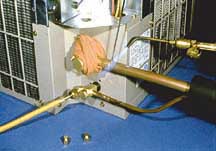
Sidebar: Brazing Connections
“The refrigerant connections are easy to make in the field,” states technical information from York UPG. “The connections are parallel to the front and penetrate the cabinet in the lower left corner of the front. The base pan has been cut away to provide as much clearance as possible to avoid paint damage during a brazing operation.”It’s important to note that “The factory charge supplied in the unit contains enough refrigerant charge for the condenser, evaporator, and 15 feet of matched size tubing. Refrigerant line tubing must be field supplied. Always use refrigeration-grade copper tubing that is internally clean and dry and is the size specified in the installation instructions.”
The valves, the company explained, are belled to receive the correct size tubing. The suction line must be insulated with Armaflex or an equivalent insulation. Check with the company for minimum thickness requirements.
“After the refrigerant lines are routed between the condensing unit and evaporator coil,” the company continues, “we next remove the Schrader cores from each of the service valves. Again, these service valves are not backseating valves; that is, the service access ports cannot be closed off with the service valve.
“This will allow the installing technician to connect a hose to supply a flow of nitrogen prior to brazing any connections. The nitrogen should be introduced into the liquid valve through the evaporator coil and out the suction valve at the condensing section. Always use a pressure regulator and safety valve to ensure that only low-pressure dry nitrogen is introduced into the tubing.
“Dry nitrogen must always be supplied through a connection while it is being brazed,” the company explains, “because the temperature is high enough to cause oxidation (carbon deposits) inside the copper tubing unless an inert atmosphere is provided. It is important that the flow of nitrogen continue until the joint has cooled.”
Line Brazing Procedure
Start at the liquid line of the condensing unit, the company advises. “This is the reason we have applied nitrogen at this point,” the company states. “All tubing connections are copper-to-copper joints and should be brazed with a phosphorous copper alloy material such as Silfos-5 or equivalent. Do not use soft solder.”
To prevent heat damage to the valve body, wrap it with a wet rag.
After the liquid line has been brazed at the condensing unit, “we move on to the suction line.”
(Note: The refrigerant lines must be connected to the evaporator coil in order for nitrogen to flow throughout the system during the brazing procedure, the company points out.)
“With the nitrogen still flowing, we make our braze joint on the suction line at the condensing unit,” the company explains. “Note that we took the precaution of wrapping the suction valve with a wet rag. However, we left the suction Schrader out so the nitrogen flow can still enter at the liquid valve and flow through the evaporator and out of the suction Schrader port.
“Now that we have brazed the liquid and suction lines at the condensing unit, we move on to the evaporator.”
With nitrogen still flowing, the next joint be brazed is the liquid connection at the evaporator cabinet. Wrap a wet rag around the tubing to act as a heat sink while brazing. “Use locking pliers or some other means to hold back the compressed pipe insulation,” the company advises.
Finally, braze the suction line.
System Evacuation
“After brazing is completed, the lines must be evacuated,” the company says. “Evacuate the system down to 500 microns and triple blot.
“When servicing an air conditioning system, don’t be fooled by a reading of 500 microns at the gauge,” the company says, “especially in a split system where the indoor coil might be as far as 50 feet or more away from the pump. Because of pressure drops and the last traces of any moisture that’s boiling off, we may have a pressure of more than 500 microns in the system.
“To evaluate if the system has any leaks, simply close the valve to the vacuum pump suction to isolate the pump and hold the system under vacuum. Watch the micron gauge for a few minutes. If the micron gauge indicates a steady and continuous rise, it’s an indication of a leak. If the gauge shows a rise, then levels off after a few minutes and remains fairly constant, it’s an indication the system is leak free, but still contains moisture and may require further evacuation if the reading is above 500 microns.”
To triple blot the system, the company says, “first pull a vacuum to 500 microns and evaluate as stated earlier. If the system holds at 500 microns, break the vacuum with dry nitrogen. Evacuate again to 500 microns, evaluate reading and break again with dry nitrogen. Do this once more and then break the vacuum with refrigerant.”
Leak Checking
If the system has a leak, the technician needs to check the connections. “Add a few ounces of R-22 to the system,” the company says, “then connect a supply of dry nitrogen to the system by attaching the end of the hose with the Schrader core depressor to the liquid line service port. Be sure that the nitrogen cylinder has a working pressure regulator to prevent rupturing of the refrigerant system due to high nitrogen pressure.
“Open the dry nitrogen source supply valve to pressurize the liquid line, suction line, and evaporator. Close the supply valve and leak test the brazed tubing joints. There are various techniques and devices to use in finding a leak.”
Once the system is leak free, “evacuate to 500 microns and triple blot as previously stated. Once that is completed, you are ready to open both the liquid and suction valves, thereby releasing refrigerant charge into the system. Open both the liquid and suction fittings.”
Publication date: 05/19/2003
Looking for a reprint of this article?
From high-res PDFs to custom plaques, order your copy today!