ACHR News
search
Ask ACHR NEWS AI
cart
facebook twitter instagram linkedin youtube
  • Sign In
  • Subscribe
  • Sign Out
  • My Account
ACHR News
  • NEWS
    • Breaking News
    • New HVAC Products
    • Featured Products
    • Manufacturer Reports
    • HVAC Data
    • Legislation
    • ACHR NEWS Centennial
  • RESIDENTIAL
    • Air Conditioners
    • Furnaces
    • Residential Heat Pumps
    • Ductless
    • Residential IAQ
    • Testing, Monitoring, Tools
    • Components & Accessories
  • COMMERCIAL
    • Air Handlers
    • Rooftop Units
    • Chillers and Cooling Towers
    • Commercial Heat Pumps
    • Boilers and Hydronics
    • VRF/Ductless
    • Commercial IAQ
  • REFRIGERATION
    • Refrigerants
    • Refrigerant Regulations
    • Leak Management
  • CONTRACTOR PRO
    • Geothermal
    • Homeowner Study
    • VRF and VRV Ductless
    • Unitary Trends
  • EDUCATION
    • Training and Education
    • Business Management
    • Service and Maintenance
    • Continuing Education
    • Market Research >
      • HVAC Brand Awareness Report
      • VRV, VRF, VRVZ Report
      • Unitary Trends Report
      • Water Heat Professionals Report
    • Webinars
    • Sponsor Insights
    • eProducts Info
    • White Papers
  • EVENTS
    • HVAC Contractor Forum
    • Industry Events and Webinars
  • MEDIA
    • Videos
    • AHR Expo 2025 Videos
    • Podcasts >
      • ACHR News Podcast
      • HARDI Podcasts
      • AHR Expo Podcasts
      • ACCA Podcasts
    • Interactive Spotlights
    • Quizzes
    • eBooks
    • HVAC Talkback
  • HVAC GROUP
    • ACHR NEWS >
      • Current Issue
      • Digital Edition
      • Subscribe
    • Distribution Trends
    • SNIPS NEWS >
      • Join SNIPS NEWS
    • Engineered Systems News >
      • Join ES News
    • HVACR Directory
    • Contests
    • Newsletters
    • Contact
    • Advertise
    • My Account

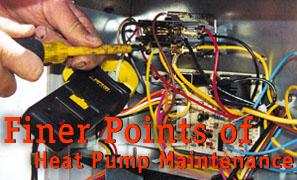
Finer Points of Heat Pump Maintenance
By Barbara A. Checket-Hanks
May 18, 2001


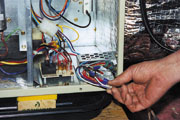
"While working on the indoor or outdoor equipment, we simply work through the wiring compartment to make sure all connections are sound," says Dean Martin of Tanner Home and Energy.
Regular service and maintenance is necessary for optimum operation of any hvacr system, but from their very design, some systems require more maintenance than others. Just what constitutes acceptable heat pump maintenance? What do contractors and service technicians tend to miss? And just what should “maintenance” include?

Scott Meenen, owner of G&S Mechanical Services in Laurel, MD, contends that “changing the filter is important, but it’s not maintenance.” In his opinion, changing the filter is an absolute minimum of activity that keeps the unit alive.

Still, not enough homeowners seem to realize the importance of this bare necessity. Even worse, Meenen says, too many new systems are installed with cheap filters; “They need a new filter box” to accommodate better-quality filters. “I’ve seen really good systems ruined” due to lack of proper filtration, he says.
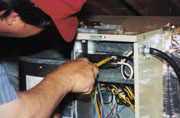


Tanner technician Brian Dougherty checks the tightness of the main connections.

Accessibility

But in order to be able to maintain a system at all, you need to be able to get to it. “Stuff that drives us nuts is when the unit is installed too close to the house, in the mud, or it’s too tight in tubing,” he says. “The easier it is to maintain, the fewer problems you have.”

Meenen frequently sees indoor cooling coils installed backwards, in a closet or against a wall. “Then it ices up all summer,” he says.

Heat pump icing in summer tends to confound system owners who don’t understand the unit’s operation. The icing phenomenon, says Meenen, is caused by a low refrigerant charge, a dirty filter, “or the

Heat pump icing in summer tends to confound system owners who don’t understand the unit’s operation. The icing phenomenon, says Meenen, is caused by a low refrigerant charge, a dirty filter, “or the owner tries to run the unit when it’s too cold outside. Head pressure drops, and refrigerant isn’t fed properly to the indoor coil.” As a result, ice forms.

Outside icing is usually a problem with the defrost circuit, Meenen adds. “It’s a control problem, but the compressor is still pumping.” Nonetheless, many servicers replace the compressor. “Too many techs just replace parts,” Meenen says. “They don’t think the problems through.”

In regular maintenance, this contractor pays particular attention to fan motors, inside and out (“some need oiling regularly”). He checks belts for wear and play, and checks the condition of the bearings. “If the oil dries out, bearing damage can occur,” he says.

Looking for quick answers on air conditioning, heating and refrigeration topics? Try Ask ACHR NEWS, our new smart AI search tool. Ask ACHR NEWS →

And this leads us to refrigerant floodback and the role of the crankcase heater, which Meenen describes as an electric heater or circuit that provides heat during the off cycle, keeping the refrigerant and oil from mixing. “Liquid refrigerant will find the coldest place in the system,” explains Meenen.
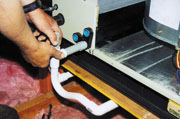


Cleaning and flushing the drain lines is an important part of heat pump maintenance.

The Oft-Forgotten Crankcase Heater

Jeff Smith, CMS, president, and ceo of J.A. Smith Heating and Air Conditioning, Inc., Warminster, PA, says that checking the operation of the crankcase heater is “a critical but often overlooked part of normal maintenance.”

Crankcase heater devices are located at the bottom of the compressor. They are installed so that oil pooling there during nonoperational times stays warm and thus will not attract liquid refrigerant, Smith says.

When a compressor is not running (such as during mild weather), it’s possible for refrigerant to migrate to the bottom of the compressor, he explains. On start-up there is a reduction of pressure; the refrigerant comes out of solution very rapidly and foams up to the top, carrying oil out of the unit with it. These are sometimes referred to as flooded starts.

According to the Air Cold Supply website (http://www.air cold.com/trouble/compfail.htm), flooded starts are indicated by:

  • Worn or scored rods or bearings;
  • Rods broken from seizure; and
  • An erratic wear pattern of the crankshaft.
  • “This is the result of refrigerant vapor migrating to the crankcase oil during the off cycle,” according to a website bulletin. “When the compressor starts, the diluted oil cannot properly lubricate the crankshaft load bearing surface causing an erratic wear or seizure pattern.”

    Corrections include locating the compressor in a warm ambient area or installing continuous pumpdown; and checking crank-case heater operation.

    The compressor motor may only run for a few minutes without oil, Smith says, but over time this damages the bearings and the compressor dies an early death.

    A heat pump or air conditioner will keep working even though the crankcase heater is not. The bearings eventually go bad, “but it wouldn’t be noticed until they are rattling and it’s too late,” explains Smith.
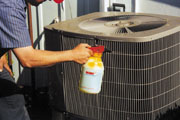


    Technician Brian Dougherty sprays coil cleaner onto the heat pump outdoor unit.

    Crankcase Heater Inspection Methods

    Older units had continuously operating crankcase heaters, whose operation could be checked by simply touching the metallic band around the bottom of the compressor, Smith says; if it was hot, the heater was working. (Techs got a lot of burned fingers using that method.)

    Newer units are wired in a relay that shuts them when the compressor operating temperature reaches a certain point. These PTC (positive temperature coefficient) semi-conductor-type crankcase heaters turn themselves off and are therefore more efficient.

    However, because they are out of sight and out of mind, buried in the compressor well, they tend to be overlooked during routine maintenance, Smith points out. Air conditioners have them as well as heat pumps. However, they are more critical in heat pumps because these units start up and shut down more frequently throughout the year, whereas a/c unit operation is seasonal.

    Smith advises checking the crankcase heater’s operation twice yearly, with normal spring and fall maintenance.

    “Inspecting PTC heaters is more complicated because of its location in the little well built into the bottom of the compressor,” says Smith. However, it’s no less necessary to do.

  • If the weather is mild and the heat pump has not been operating, touch the crankcase directly above the heater, Smith says; it should be warm to the touch (not as hot as the older models that ran continuously). If it’s cold, the heater needs to be replaced.
  • If the unit has been running:
  • 1. Shut the power to the outdoor unit.

    2. Tug out the crankcase heater; if it comes out in one piece, let it sit out and cool down. (If it comes apart, it was time to replace it anyway, Smith comments.)

    3. Put power to the heater; it should warm up. If it doesn’t, replace it. Or, unwire the circuit that the heater is on and check it out with an ohmmeter. Make sure the wire does not get brittle, Smith advises.
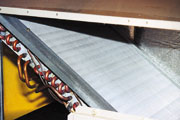


    Check the filter to make sure it isn't loaded.

    Other Maintenance Tips

    Like many service contractors, Tanner Home and Energy, Chambersburg, PA, offers a multipoint service and maintenance package that covers most key aspects of heat pump service.

    Dean Martin, the company’s service manager, described the company’s 15-point heat pump inspection. “These are not listed in the order that we do them and several are done at the same time,” he explains. “An organized service tech can do this in about an hour.”

    1. Check the fan switch to see if the auto and on positions both work properly.

  • Mechanical thermostats have steel balls to make contact; if they become corroded, this can cause an open circuit.
  • While the cover is off, blow out the dust to keep the heat anticipator from overheating.
  • “Cleanings are typically done in the spring and fall of the year, when we can test both the heating and cooling cycles without causing undue discomfort for the homeowner,” says Martin. “If we are well into the heating or cooling season, we only test that particular operation.”
  • 2. Check for visual signs of refrigerant leaks.

    “While doing the cleaning, we are constantly looking for anything out of the ordinary, one thing being the presence of oil around any fittings or refrigerant lines that would indicate the presence of a refrigerant leak.”

    3. Check voltage and amp draw.

    “We use an amprobe to check the voltage and amperage of the outdoor unit during start-up and after several minutes of operation. This gives us an indication of compressor health or system charge.”

    4. Check blower operation.

    “This is just a simple test while cleaning the indoor unit,” Martin explains. “We will typically jumper the fan control circuit to pull in the fan relay and listen to the fan starting. Slow startup or low airflow draw can indicate a weak capacitor, dirty centrifugal blades, or the beginning of a fan motor winding problem. An imbalanced fan cage is easily detected at this time also.”

    5. Check and tighten all electrical connections.

  • “While working on the indoor or outdoor equipment, we simply work through the wiring compartment to make sure all connections are sound. Any connections that are visually overheated or pull off easily need further attention or replacement.
  • “A quick turn of the screwdriver on all line voltage main feeds at the outdoor contactor and indoor heat package connection ensure that a high-amp-draw condition will be averted.”
  • This is also when the company’s techs check the operation of the crankcase heater if the unit has one. “Not too many new models have been coming out with them,” says Martin.
  • 6. Check heat transfer.

  • “We do not hook up the refrigerant gauges unless we are sure the system is low,” Martin says. “To ensure that the refrigerant system is working correctly, we calculate the temperature difference between the supply and return airstream in either the heating or cooling cycle (whichever is most appropriate). We look for 15° to 18°F at a supply register. This is a test of both the system charge and duct system losses.
  • “When checking delta T in the heating cycle, be careful to not have any supplemental heat operating as this will surely skew the test.”

    7. Check lockout circuits.

  • “We test the 5-minute time delay by breaking the control circuit to the outdoor unit for a short time and making sure it stays locked out for the proper time period.”
  • 8. Check temperature difference across the indoor coil.

    “We look for a 18° to 20° difference at the indoor unit. This is a continuation of the refrigerant system check. Again, it is important to make sure that no supplemental heat is being used.”

    9. Check the starting contactor.

    “This is simply a visual check of the contactor points and coil,” says Martin. “Slight pitting is noted on the workorder.” If the tech finds severely pitted contacts or an overheated coil, s/he recommends that the homeowner replace them.

    10. Check the outside disconnect.

    “This another visual inspection along with a quick turn of the screwdriver to test for loose connections.”

    11. Replace or wash filters.

    “If the system has washable filters, we wash them while cleaning the outdoor coil,” says Martin. “If they’re throwaway filters, we replace them for the homeowner.”

    12. Check and adjust all safety controls.

    “While cleaning the indoor unit, we jumper a test lead to the supplemental heat circuit while pulling a fan lead to test the overheat klixons,” says Martin. “We also check the safety circuits in the outdoor compressor section.”

    13. Check and flush the condensate drains.

  • “While cleaning the indoor unit we inspect the drain pan for standing water, which indicates a clogged drain or moisture in the base of the unit, which indicates pan leakage.
  • “All the systems we install have a cleanout drain installed to make it easy to flush any dirt out of the trap,” Martin adds. “Any systems we service that we did not install, we recommend installing a cleanout trap for the same purpose.”
  • 14. Test the compressor windings.

    “We have a megohmeter to test compressor leads to ground. This gives another picture of compressor health or high moisture level in the refrigerant.”

    15. Clean the indoor and outdoor coils.

    “We use coil cleaner on every job, inside and out, whether it looks like the coil is dirty or not,” says Martin. “We have found coils that look fairly clean on both surfaces but upon application of the cleaner, we find dirt foaming up deep within the coil.

    “That’s about it,” Martin sums up. “We also used to list oiling fan motors, but manufacturers recommend oiling only every three to five years, and lately motors have sealed bearings.”

    Did we miss anything?
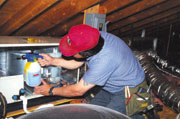
    Don't forget to clean the indoor coil.
    Some points of maintenance are obvious, while others seem to be a matter of preference or cost. For example, some contractors regularly include inspection of the crankcase heater, while others use it to differentiate their “premium” service.


    What is agreed upon, however, is that consumers need to be aware of their systems’ requirement for regular care by a trained professional.

    Send your recommended service and maintenance procedures to Barb Checket-Hanks at checket-hanksb@bnp.com (e-mail).

    Share This Story

    Looking for a reprint of this article?
    From high-res PDFs to custom plaques, order your copy today!


    Barbara Checket-Hanks is Service & Maintenance Editor. E-mail her at barbarachecket-hanks@achrnews.com.

    Recommended Content

    JOIN TODAY
    To unlock your recommendations.

    Already have an account? Sign In

    • HVAC-enrollment

      The Trades Are Back: HVACR Programs See Nearly 30% Enrollment Spike

      A new wave of future technicians is entering the pipeline.  
      Training and Education
      By: Matt Jachman
    • 2025 Top 40 Under 40

      2025 Top 40 Under 40 HVACR Professionals List

      The 11th annual Top 40 Under 40 list highlights those...
      HVAC Residential Market
      By: Hannah Belloli-Oster
    • LG Ductless Mini-Split Systems

      The 9 Types of Heat Pumps

      As the U.S. moves toward electrification, heat pumps are...
      Air Source Heat Pumps
      By: Joanna R. Turpin
    Subscription Center
    • Create an Account
    • Start a Subscription
    • Manage My Account
    • Sign Up for Newsletters
    • Visit Customer Service
    • Update Preferences

    More Videos

    Sponsored Content

    Sponsored Content is a special paid section where industry companies provide high quality, objective, non-commercial content around topics of interest to The News audience. All Sponsored Content is supplied by the advertising company and any opinions expressed in this article are those of the author and not necessarily reflect the views of The News or its parent company, BNP Media. Interested in participating in our Sponsored Content section? Contact your local rep!

    close
    • Piggy Bank
      Sponsored byWatercress Financial

      Energy Prices, Inflation, and HVAC: What Today’s Homeowners Care About

    • Refrigerated Food
      Sponsored bySolstice Advanced Materials

      R-455A Refrigeration: A Cold Storage Solution for the Future

    • Airex Rooftop Units
      Sponsored byAirex Manufacturing Inc

      Consolidating Roof Penetrations: A Growing Trend in Multifamily HVAC Design

    Popular Stories

    Outdoor-condensing-units.jpg

    EPA Removes R-410A Installation Deadline

    Trump-Section-232.jpg

    Trump Reduces Section 232 Tariffs on HVAC Equipment to 15%

    HVAC-Price-Increase-graphic

    HVAC Price Increase List: June 2026

    cooling-habits.jpg

    50 Percent of Americans Have Skipped HVAC Maintenance

    ACHR NEWS Editor Chris Gray Presenting HVAC Minute 5-18-2026

    HVAC Manufacturers Fight Pricing Lawsuits

    View The ACHR NEWS
    Centennial Anniversary Timeline

    The ACHR News Timeline Chart
    Submit a Letter
    Submit a letter to our editors.

    Events

    November 6, 2025

    Next-Gen Data Center Cooling: HVAC Innovation and Real-World Solutions

    On Demand As AI workloads and high-density computing push traditional cooling methods to their limits, the data center industry is accelerating the adoption of next-generation HVAC technologies.

    June 9, 2026

    Before You Go All In on AI: Set Up Your Business to Actually Win

    In this webinar, we'll walk you through exactly what to get in place before you add AI to your business. You'll leave with a clear picture of where you stand today and a practical action plan to set yourself up for real results.

    View All Submit An Event

    Poll

    EPA Decision

    Are you happy the EPA decided contractors can continue to install R-410A equipment?
    View Results Poll Archive

    Products

    BNI Mechanical/Electrical Square Foot Costbook, 2026 Edition

    BNI Mechanical/Electrical Square Foot Costbook, 2026 Edition

    See More Products
    A2L Refrigerants - Free Webinar - May 21, 2026

    Related Articles

    • Basics and finer points of troubleshooting gas furnaces

      See More
    • the technician uses a digital camera- ashburn hvac.jpg

      The Importance of Regular Heat Pump Maintenance

      See More
    • A/C and Heat Pump Preventive Maintenance

      See More

    Related Products

    See More Products
    • HPOIS.png

      Heat Pump Operation, Installation, Service

    • A-Heat-Pump-Thats-Not-Delivering-Any-Air-DVD-Cover-218x300.jpg

      A Heat Pump That’s Not Delivering Any Air

    • A-Heat-Pump-That-Won__t-Cool-DVD-Cover-214x300.jpg

      A Heat Pump That Won't Cool

    See More Products

    Related Directories

    • BP Porter Inc. (Heat Pump Controls/Thermostats)

      BP Porter Inc., the products of this company BPC-1 Bill Porter Control (a fossil fuel control) and BPC-ODS micro'stat was developed (invented) by Bill Porter, an HVAC technician in early 1994.
    • IGSHPA-International Ground Source Heat Pump Assn.

      IGSHPA is an association of companies, professionals and users dedicated to promoting the science, utility and use of geothermal (ground source) heating and cooling technology.
    • Cold Point Corp.

      Replacement water source heat pumps and PTAC units, vertical PTAC's and packaged heat pumps.
    ×

    Sign Up. Stay Informed.

    The #1 trusted source for the HVACR industry since 1926

    SUBSCRIBE
    • RESOURCES
      • Advertise
      • Contact Us
      • Advisory Board
      • Classifieds
      • Submit a Letter
      • Directories
      • Store
    • ACCOUNT CENTER
      • Create an Account
      • Start a Subscription
      • Manage My Account
      • Sign Up for Newsletters
      • Visit Customer Service
      • Update Preferences
    • SERVICES
      • Marketing Services
      • Reprints
      • Market Research
      • List Rental
      • Survey/Respondent Access
    • STAY CONNECTED
      • LinkedIn
      • Facebook
      • Instagram
      • YouTube
      • X (Twitter)
    • PRIVACY
      • PRIVACY POLICY
      • TERMS & CONDITIONS
      • DO NOT SELL MY PERSONAL INFORMATION
      • PRIVACY REQUEST
      • ACCESSIBILITY

    Copyright ©2026. All Rights Reserved BNP Media, Inc. and BNP Media II, LLC.

    Design, CMS, Hosting & Web Development :: ePublishing