Improving heat pump installations

Air-to-air heat pumps have something of a bad reputation in the critical areas of comfort, efficiency, longevity, and serviceability, according to the respondents in our recent online poll.
This residential and light commercial product, which initially seemed to create expections of high consumer satisfaction, is still selling well; year-to-date shipments through June are reported to be up 10% over last year (see chart below). However, the product apparently still needs improvements in airflow design and installation to fulfill its earlier promise.
According to our respondents, some of these improvements need to come from manufacturers. Over the past few years, certain protective features, such as high- and low-pressure switches and airflow sensors, have been designed out, possibly to lower unit cost.
However, a good chunk of the improvements (better ventilation and refrigerant charging practices, correct load calculations, and customer education) needs to come from contractors, installers, and servicers — and they’re the first ones to admit it.
Most common problems
According to The News online heat pump survey, the most common customer complaint was, “Air comes out of the vent too cold.”Of course, this is mainly a winter operational complaint. However, it indicates that problems are occurring in the system that can affect operation and efficiency year round.
According to a contractor who responded to the survey, the main causes of air that comes out too cold are poorly designed and/or installed ventilation, incorrect airflow, and mechanical problems caused by poorly calculated refrigerant charges.
Mike Easley, vice president, GT Performance HVAC&R Inc., Yacolt, WA, points out that cold air could be attributed to many factors. “Usually the heat pump is installed with no outdoor thermostat, so the owner sees that the pump is working, but they’re not getting its performance because the heat strips come on.” This, in turn, leads to whopping electricity bills.
However, when troubleshooting a heat pump system, Easley says that “the first place I go to is the air.”
Ventilation's role
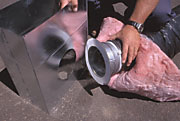
“Most installers don’t pay attention to airflow,” he points out. The resulting heat pump problems have nothing to do with unit design.“Heat pumps don’t survive without proper airflow,” Easley states. When the systems fail early, this leads to bad word of mouth for the product, regardless of the brand.
Looking for quick answers on air conditioning, heating and refrigeration topics? Try Ask ACHR NEWS, our new smart AI search tool. Ask ACHR NEWS
“It would seem to me, manufacturers should start paying attention to the installation of ductwork,” says Easley. “Static pressure in flex duct is incredibly high.” In order to get the proper operation from the heat pump, “The customer has to redo the system, including ductwork.” So more money goes into the system, either up front to address ductwork problems, or afterwards in service and repair costs.
“Someone has got to take a look at the ductwork going in.” Easley explains that heat pump installations are not easy from design or installation considerations. “You have to be a trained tech or trained engineer to do this.”
He recounted the story of a new construction contractor that installed scores of ducts that were so bad, the company had callback rates of 35% to 40%. Crews would run in the ductwork quickly, stick the unit in, and run out. The contractor had to deal with all those callbacks and consequential bad word of mouth for the company and the product.
Having an airflow sensor at the blower motor would have nipped it in the bud, says Easley.
He adds that heat pumps used to have them as standard options, but “Competition got stiff, most manufacturers took [these types of options] off their units to bring down the price.”
With an airflow sensor, Easley says, whenever total static pressure goes outside set limits, the sensor shuts off the blower, and the customer has to call for service. If this happens too many times, the customer will realize that they need to have the ventilation system redone in order to correct the problem.
Moreover, when heat pumps are installed with an airflow sensor at the blower, the installing techs will have to meet the demand of the blower in order for the unit to run.
“If you start [fixing the problem] electronically, the larger problems will show up and have to be fixed. If it doesn’t meet the sensor’s operating parameters, it won’t operate.”
Incorrect ventilation is a common problem in applications when a heat pump is going into a home designed for an older furnace. “Furnaces could get away with smaller duct runs,” says Easley. If you have an older vent system with a heat pump blower, it won’t support the cfm. The ductwork has to be redesigned.
Ductwork redesigns are no small feat; “I did a house last week, took out all the ductwork, and put in new; the whole thing took four days.” Contractors in some areas of the country may want to consider whether a customer’s existing air-handling system is suitable for a heat pump.
“I won’t put it in if the airflow is incorrect,” says Easley. “That’s the secret to our trade.”
Maintenance issues
A big part of the ventilation equation comes from simple maintenance that homeowners are supposed to perform, like changing air filters. However, it seems that many (if not most) homeowners don’t even understand how their units are supposed to operate, much less what is required to keep them operating optimally.Audwin B. (Auddy) Faulk, ceo of FJA Construction, Inc., Smyrna, GA, says that air conditioning itself is complex enough, it’s tough to explain the principles of system operation. Heat pumps are tougher for most homeowners to understand.
“There’s a lot of misinformation out there,” says Faulk. “We need a better explanation of proper and improper system operation.
“The unit itself works pretty good for this area and climate,” he continues. The problem is usually with inexperienced and/or unlicensed installers. Not only do they do a poor job with the installation, they don’t explain how a heat pump operates, “and the homeowner doesn’t understand what it’s supposed to do.” They’ll call and complain that the unit froze up outside; well, it’s supposed to do that, it has to go through a complete cycle for heating. And they often complain that the unit doesn’t cycle on or off when it’s supposed to.
There’s also a problem with homeowners’ care of their units; filter changing is typically not explained by installing or servicing technicians. Homeowners need to understand that they should change their heat pump system air filters more often than on direct-expansion systems, Faulk says.
Nor do many technicians explain the importance of keeping the outdoor unit clean and clear of debris. “Then the reversing valve gets dirty, which causes flutter” and resulting operational problems.
And what of the “too cold” complaints? Faulk attributes many of them to an insufficient refrigerant charge. “A 5-ton unit requires a certain amount of heat,” he explains. If the line set is installed with a longer run than the manufacturer has charged the unit with refrigerant for, not enough heat will be supplied.
The refrigerant charge
Faulk is by no means alone in pointing to the refrigerant charge as a source of customer comfort complaints and operational efficiency. Charles Salsman, owner, Connestee Heating & Cooling, Brevard, NC, agrees that these type of complaints most often stem from a mechanical problem caused by poor refrigerant practices.“Ninety-nine percent of the time, heat pump manufacturers charge the unit for 25 feet of line set,” Salsman says. “Sometimes installers run line sets up to 50 feet, but don’t charge enough refrigerant into the system.” Or, if the line set runs less than 25 ft installed, they may need to take some refrigerant out, but don’t.
“Higher-efficiency equipment is intolerant of poor charging practices, within a couple of ounces,” says Salsman. Home-owners will not get the comfort or efficiency, in heating or cooling mode, that they expect.
Too often, when inexperienced and/or untrained techs undertake an installation, “They don’t pull a good vacuum on the system; in fact, since they’re not servicers, they don’t even keep charging scales on the truck.”
In addition, North Carolina winters have freezing rain and sleet, adds Salsman. “They’re cold but humid, so ice can accumulate on top of the unit. If you don’t explain to homeowners that they need to keep the top clear of ice, there can be problems.” This leads us back again to airflow.
Airflow revisited
Salsman’s company sells a lot of dual-fuel systems (electric heat pump and gas furnace). Ductwork is a consideration that many contractors don’t seem to take into account when they’re installing heat pumps.“If I’m doing a retrofit, I will include any changes that need to be made to the ductwork.” Other contractors may not do this, because they don’t want to be priced out of the job.
Also, “I estimate for round sheet metal, externally insulated. Many contractors size for square ductboard, internally insulated, and don’t take into account the extra friction created.” This leads to high head pressure in winter, flooding of the indoor coil in summer, poor comfort, and higher utility bills.
Salsman says he tries to educate customers on the importance of changing air filters regularly; in new home construction or extensive retrofits, he advises filtering air at the return air filter grille, which is easily accessible and, more importantly, visible to the homeowner. “They tend to get changed more often.”
For more traditional air filters, Salsman tells his customers to try to remember to change their filters monthly, when they receive their electric bills. That way, they can make a mental link to the effect filtration can have on system operation and energy costs.
So there you have it: It’s a good product, but with more care in installation, more homeowner education, and a few more options from the manufacturers, that bad reputation could start to clear up.
Sidebar: The contractors' heat pump wish list
This is what contractors would like to see manufacturers offer on heat pump units, to help make sure they are serviced properly and operate optimally.Charles Salsman, owner, Connestee Heating & Cooling, Brevard, NC, says he would like to see high- and low-pressure switches added to heat pumps, but especially low-pressure controls for units with scroll compressors. “You can’t run a scroll into a vacuum condition, it’ll kill the compressor.” Burning oil from arcing makes the oil turn into something Salsman calls “green slime,” which contaminates the system.
Audwin B. (Auddy) Faulk, FJA Construction, Inc., Smyrna, GA, would like to see a reversing valve mechanism that has the fan relay and reversing valve in a one-piece, unibody design. It would be easier to remove and replace.
Mike Easley, vice president, GT Performance HVAC&R Inc., Yacolt, WA, would like to see an airflow detector/sensor that flags or shuts down the system. “Airflow is the key to long life.”
Dan Duddy, AHR Department head, Coastal Carolina Community College, Jacksonville, NC, and an independent contractor, says that “In this part of the country, many, many oversized heat pump systems are installed, leading to poor humidity control during the cooling season. Dirty filters and coils result in freezing evaporator in summer and high head pressure (and lock-outs) in winter. Manufacturers should provide better long-term protection for attached wiring schematics and charging tables.”
Mike Houdak, owner, Houdak Refrigeration, Walla Walla, WA, says manufacturers should make “easy-serviceability optional items as standard; more permanent system checks, and PC diagnostics for optimum operational performance.”
Scott A. Shelly, owner, All Season Climate Control (ASCC), says manufacturers should “improve controls to optimize operation (i.e., defrost control improvement, discharge air control for back-up electric heat staging, and a good digital/programmable heat pump stat).”
William Williams, manager, Urgent Air Inc., Aiken, SC, thinks that “By law, all heat pumps should have both high- and low-pressure switches.” Also, “test procedures for the control should be clear and readily accessible. Test procedures for the defrost sensor(s) need to be established and, once again, readily accessible.”
Bill Brelig, president, Brelig Refrigeration Inc., Ocracoke, NC, says, “The hell with competitive prices; put a brass accumulator on! How much can that cost. It’s the most common replacement part.”
Dick Decker, technical support coordinator, KCPL, Kansas City, MO, says manufacturers should offer a “built-in fossil fuel kit for use with gas furnace backup heat.”
James Moore, Master Plumber/Mechanical/Cross-Connection, Artisian Plumbing/Mechanical, Alexandria, VA, says manufacturers should offer “Pressure-temperature defrost for better efficiency, an alarm for emergency heat notification, and reversing valve or union connections.”
Marshall Denninger, service technician, Southland Industries, Newbury Park, CA, says manufacturers should offer “easy access to the reversing valve if it ever needs changing out.”
Looking for a reprint of this article?
From high-res PDFs to custom plaques, order your copy today!