ACHR News
search
Ask ACHR NEWS AI
cart
facebook twitter instagram linkedin youtube
  • Sign In
  • Subscribe
  • Sign Out
  • My Account
ACHR News
  • NEWS
    • Breaking News
    • New HVAC Products
    • Featured Products
    • Manufacturer Reports
    • HVAC Data
    • Legislation
    • ACHR NEWS Centennial
  • RESIDENTIAL
    • Air Conditioners
    • Furnaces
    • Residential Heat Pumps
    • Ductless
    • Residential IAQ
    • Testing, Monitoring, Tools
    • Components & Accessories
  • COMMERCIAL
    • Air Handlers
    • Rooftop Units
    • Chillers and Cooling Towers
    • Commercial Heat Pumps
    • Boilers and Hydronics
    • VRF/Ductless
    • Commercial IAQ
  • REFRIGERATION
    • Refrigerants
    • Refrigerant Regulations
    • Leak Management
  • CONTRACTOR PRO
    • Geothermal
    • Homeowner Study
    • VRF and VRV Ductless
    • Unitary Trends
  • EDUCATION
    • Training and Education
    • Business Management
    • Service and Maintenance
    • Continuing Education
    • Market Research >
      • HVAC Brand Awareness Report
      • VRV, VRF, VRVZ Report
      • Unitary Trends Report
      • Water Heat Professionals Report
    • Webinars
    • Sponsor Insights
    • eProducts Info
    • White Papers
  • EVENTS
    • HVAC Contractor Forum
    • Industry Events and Webinars
  • MEDIA
    • Videos
    • AHR Expo 2025 Videos
    • Podcasts >
      • ACHR News Podcast
      • HARDI Podcasts
      • AHR Expo Podcasts
      • ACCA Podcasts
    • Interactive Spotlights
    • Quizzes
    • eBooks
    • HVAC Talkback
  • HVAC GROUP
    • ACHR NEWS >
      • Current Issue
      • Digital Edition
      • Subscribe
    • Distribution Trends
    • SNIPS NEWS >
      • Join SNIPS NEWS
    • Engineered Systems News >
      • Join ES News
    • HVACR Directory
    • Contests
    • Newsletters
    • Contact
    • Advertise
    • My Account
HVAC ContractingTechnicalHeat Pumps

Checking the Charge on a Heat Pump in the Winter
By Bryan Orr
EE_Technical Bryan Orr_1
EE_Technical Bryan Orr_2
EE_Technical Bryan Orr_3
EE_Technical Bryan Orr_1
EE_Technical Bryan Orr_2
EE_Technical Bryan Orr_3
January 7, 2019

Nowadays, when you ask people how to check the charge on a heat pump during low outdoor temps, they will say that you need to “weigh in and weigh out” the charge. While this may be an effective method, it isn’t always practical.

Now… If you are making a refrigerant circuit repair, weighing out and weighing in makes perfect sense, especially since microchannel condensers and scroll compressors make pumping down less viable anyway. But there are many cases where you just need to check the charge to make sure the system is working properly, and in these cases, weighing in and out is just plain silly.

I originally wrote this guideline back in 2003, and truthfully, not much has changed since then in regards to checking a heat mode charge on a heat pump.

Step No. 1: If there is any frost on the outside unit, get it completely defrosted first.

Step No. 2: Check all the obvious things first — filter, coils, blower wheel, etc. If the unit isn’t clean, it will be really hard to check.

When charging in heat mode, read manufacturer specifications first. Lennox gives specific instructions for charging its units in below 65˚ outdoor ambient conditions. It involves blocking off the condenser coil with cardboard — or even better, using a charging jacket — while continuing to run the system in cool mode. Lennox gives specific instructions for how high to raise the head pressure, and what level of subcooling you should expect.

Remember that in heat mode on a heat pump, the evaporator is outside and the condenser is inside. This is important because in cool mode, a dirty air filter caused low airflow on the evaporator. This would typically cause a low suction pressure and a low superheat. In heat mode, a dirty air filter causes low airflow across the condenser. This can cause extremely high head pressure. In heat mode, a dirty outdoor coil can cause a low suction pressure.

Looking for quick answers on air conditioning, heating and refrigeration topics? Try Ask ACHR NEWS, our new smart AI search tool. Ask ACHR NEWS →

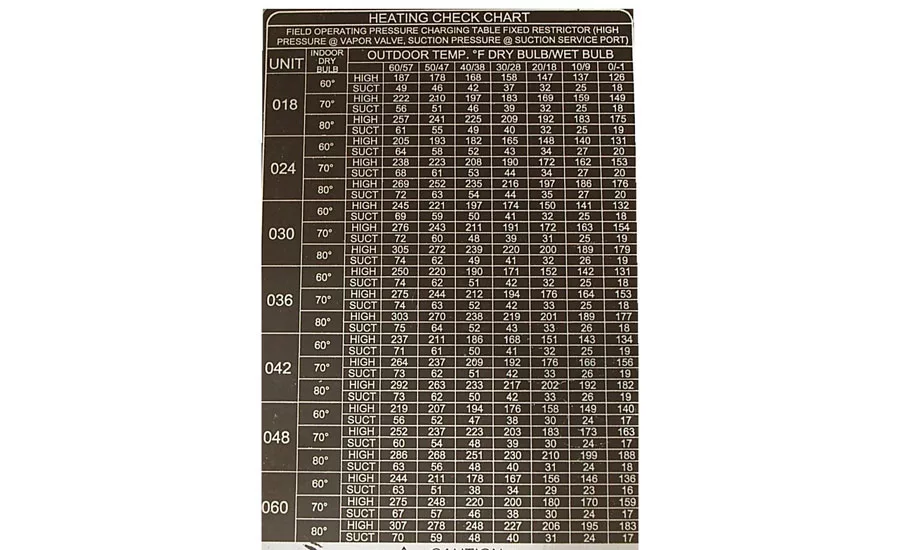
As an example, Trane includes a pressure curve chart with many heat pump condensing units. Be sure to use the scale all the way to the right that says heat mode. Indoor and outdoor dry bulb temperatures are necessary to use the Trane pressure curve. Carrier supplies many heat pump condensing units with a pressure guideline chart. Carrier only wants the heat mode pressure chart used as a guideline, not as a charging tool. Always reference manufacturer guidelines before setting any charge.

100˚ OVER AMBIENT RULE OF THUMB

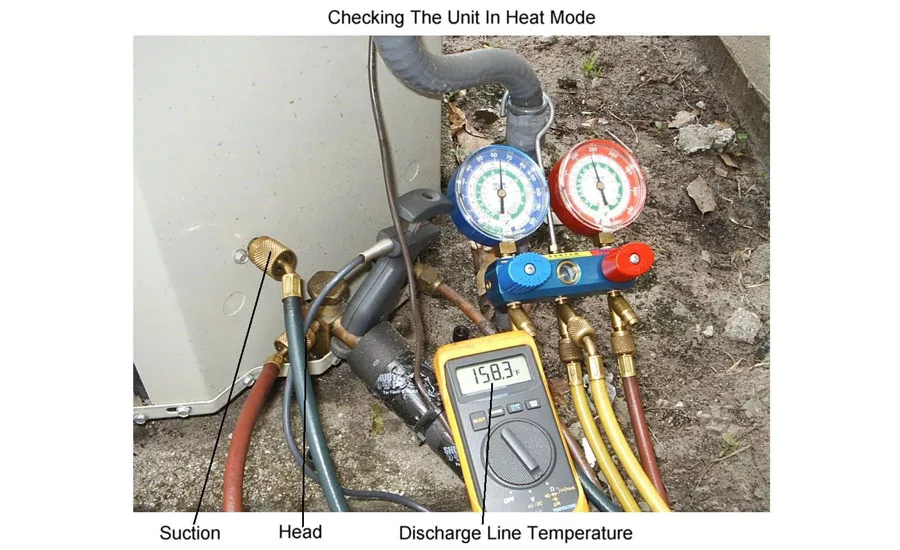
Even though manufacturer specifications should be followed, there are some basic guidelines that will aid in charging and diagnosis in a pinch. The most widely quoted rule of thumb is the 100˚ – 110˚ over ambient discharge rule. This guideline states that a properly charged unit will have a discharge line temperature of 100˚ – 110˚ above the outdoor temperature. If the discharge line is too hot add refrigerant (If the charge is the issue and not another problem). If the discharge line is too cool remove refrigerant (again only if the charge is diagnosed as the issue).

First off, the photo above was taken in 2003 so give me some slack on my gauges. Nowadays, I would be using my Testo 550.

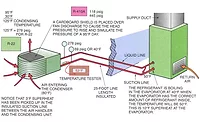
Here's a simple example using the 100˚ – 110˚ over ambient rule. If it were 60˚ outside, you could say by the 100˚ – 110˚over ambient rule, the charge is about correct. If it were 30˚ outside, the 100˚ – 110˚ over ambient rule would show undercharge. If, for example, the discharge temperature were 210˚ with a 150 psi head pressure, a 10 psi suction, and a 50˚ outdoor temperature, this would show an extreme undercharge. Subcool and superheat can still be checked in heat mode, the problem is since there are rarely any set guidelines, it is difficult to tell when the charge is set correctly by simply checking subcool or superheat alone. Generally, you will see normal superheat (8-14) on a system with heat mode TXV. The subcooling will generally be a bit higher than usual, especially when measured outside.

SUCTION PRESSURE / EVAP DTD RULE OF THUMB  

Another common old school rule of thumb is suction pressure should be close to the outdoor temperature in a R-22 system. However, this rule of thumb (obviously) does not work on an R-410A system. A more applicable guideline is 20˚-25˚ suction saturation below outdoor ambient. This means if it is 50˚ outside, the suction saturation temperature should be between 25˚and 30˚ (on most systems).

HEAD PRESSURE / CTOA RULE OF THUMB 

Because the evaporator coil is substantially smaller than the condenser, you will usually see higher head pressure (condensing temperature) in relationship to the condensing air, or in this case, the indoor air. This can vary a lot depending on the age / SEER of the unit, the size of the coil and how the indoor airflow is setup but generally will be 30˚ – 40˚ condensing temperature over the indoor dry bulb.

CHECKING WITHOUT GAUGES 

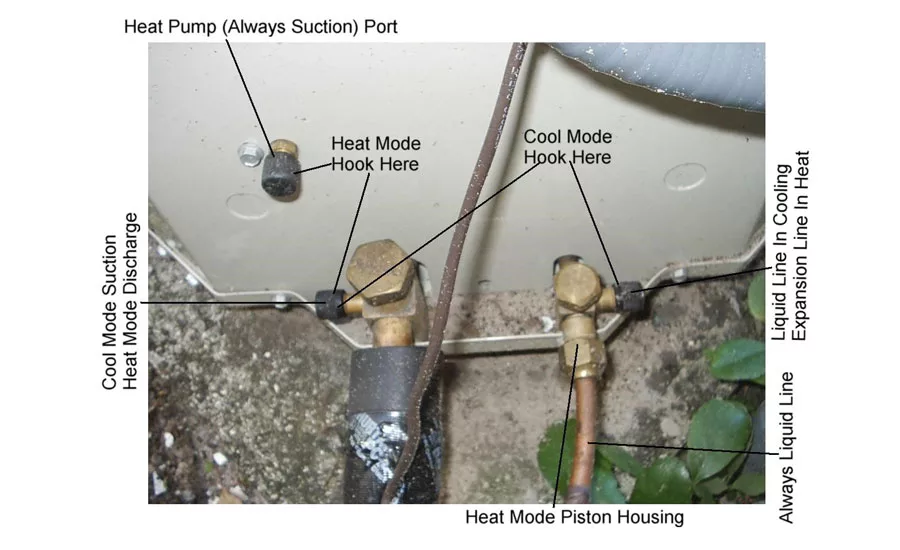
Here are some quick tests you can do on a heat pump to confirm it is operating close to specs without using gauges when the coil is frost free and the outdoor temps are between 15˚ – 65˚:

  • Check the discharge (vapor) line, it should be 100˚ – 110˚ over outdoor ambient temperature;
  • Suction line temp should be 5˚ – 15˚ cooler than the outdoor temperature;
  • Liquid Line should be 3˚ – 15˚ warmer than the indoor temperature; and
  • Delta T indoors will vary greatly depending on outdoor temperature.

If anything looks off, go ahead and connect gauges to verify further…. and like I said several times already, follow manufacturers guidelines.

Publication date: 1/07/2019

Want more HVAC industry news and information? Join The NEWS on Facebook, Twitter, and LinkedIn today!

KEYWORDS: troubleshooting and HVACR

Share This Story

Looking for a reprint of this article?
From high-res PDFs to custom plaques, order your copy today!


Podcast studio

Bryan Orr is the vice president at Kalos Services Inc. and founder of the HVAC School. 

Recommended Content

JOIN TODAY
To unlock your recommendations.

Already have an account? Sign In

  • HVAC-enrollment

    The Trades Are Back: HVACR Programs See Nearly 30% Enrollment Spike

    A new wave of future technicians is entering the pipeline.  
    News
    By: Matt Jachman
  • 2025 Top 40 Under 40

    2025 Top 40 Under 40 HVACR Professionals List

    The 11th annual Top 40 Under 40 list highlights those...
    HVAC Contracting
    By: Hannah Belloli-Oster
  • LG Ductless Mini-Split Systems

    The 9 Types of Heat Pumps

    As the U.S. moves toward electrification, heat pumps are...
    Ground Source Heat Pumps
    By: Joanna R. Turpin
Subscription Center
  • Create an Account
  • Start a Subscription
  • Manage My Account
  • Sign Up for Newsletters
  • Visit Customer Service
  • Update Preferences

More Videos

Sponsored Content

Sponsored Content is a special paid section where industry companies provide high quality, objective, non-commercial content around topics of interest to The News audience. All Sponsored Content is supplied by the advertising company and any opinions expressed in this article are those of the author and not necessarily reflect the views of The News or its parent company, BNP Media. Interested in participating in our Sponsored Content section? Contact your local rep!

close
  • An illustration shows a house with a geothermal heating system. Pipes are depicted running underground.
    Sponsored byClimateMaster

    Residential Tax Credits Are Ending, But Demand Continues

  • Piggy Bank
    Sponsored byWatercress Financial

    Energy Prices, Inflation, and HVAC: What Today’s Homeowners Care About

  • Refrigerated Food
    Sponsored bySolstice Advanced Materials

    R-455A Refrigeration: A Cold Storage Solution for the Future

Popular Stories

price-raising-practices.jpg

Rising Costs Force Contractors to Take a Harder Look at Pricing

DOE-sign.jpg

HVAC Groups Support DOE’s Rulemaking to Cut Energy Efficiency Mandates

New-HVAC-Equipment.jpg

Amended Complaint Filed in HVAC Price-Fixing Lawsuit

HARDI lolgo navy

HARDI Distributors' Sales Down Nearly 5% in May

Data-Center-Inspection.jpg

Can HVAC Train Enough Technicians for the Data Center Boom?

View The ACHR NEWS
Centennial Anniversary Timeline

The ACHR News Timeline Chart
Submit a Letter
Submit a letter to our editors.

Events

November 6, 2025

Next-Gen Data Center Cooling: HVAC Innovation and Real-World Solutions

On Demand As AI workloads and high-density computing push traditional cooling methods to their limits, the data center industry is accelerating the adoption of next-generation HVAC technologies.

July 22, 2026

Designing VRF Systems Using A2L Refrigerant

In this session, we will cover how to design VRF systems for the U.S. market using new A2L refrigerants. These systems provide an advanced zoning solution by using inverter technology to deliver precise heating and cooling control across multiple zones and spaces.

View All Submit An Event

Poll

Summer Staff

Are you fully staffed for the summer season?
View Results Poll Archive

Products

BNI Mechanical/Electrical Square Foot Costbook, 2026 Edition

BNI Mechanical/Electrical Square Foot Costbook, 2026 Edition

See More Products
Designing Systems Using A2L Refrigerant - Free Webinar - 7/22/2026

Related Articles

  • HVAC system with a 25 foot lineset

    Btu Buddy 158: Checking the Charge in Mild Weather

    See More
  • Checking The Charge Without Gauges

    See More
  • Btu Buddy 23: Handling A Frozen Outdoor Coil On A Heat Pump

    See More

Related Products

See More Products
  • A-Heat-Pump-That-Won__t-Cool-DVD-Cover-214x300.jpg

    A Heat Pump That Won't Cool

  • A-Heat-Pump-Thats-Not-Delivering-Any-Air-DVD-Cover-218x300.jpg

    A Heat Pump That’s Not Delivering Any Air

  • Uncomplicating The Heat Pump: Refrigeration & Air Flow Systems DVD

See More Products

Related Directories

  • BP Porter Inc. (Heat Pump Controls/Thermostats)

    BP Porter Inc., the products of this company BPC-1 Bill Porter Control (a fossil fuel control) and BPC-ODS micro'stat was developed (invented) by Bill Porter, an HVAC technician in early 1994.
  • IGSHPA-International Ground Source Heat Pump Assn.

    IGSHPA is an association of companies, professionals and users dedicated to promoting the science, utility and use of geothermal (ground source) heating and cooling technology.
  • The Whalen Co.

    The Whalen Company is the pioneering manufacturer of HVAC vertical stack riser heat-exchanger fan coil units and water-source heat pumps for hotels, apartments and other multi-story buildings.
×

Sign Up. Stay Informed.

The #1 trusted source for the HVACR industry since 1926

SUBSCRIBE
  • RESOURCES
    • Advertise
    • Contact Us
    • Advisory Board
    • Classifieds
    • Submit a Letter
    • Directories
    • Store
  • ACCOUNT CENTER
    • Create an Account
    • Start a Subscription
    • Manage My Account
    • Sign Up for Newsletters
    • Visit Customer Service
    • Update Preferences
  • SERVICES
    • Marketing Services
    • Reprints
    • Market Research
    • List Rental
    • Survey/Respondent Access
  • STAY CONNECTED
    • LinkedIn
    • Facebook
    • Instagram
    • YouTube
    • X (Twitter)
  • PRIVACY
    • PRIVACY POLICY
    • TERMS & CONDITIONS
    • DO NOT SELL MY PERSONAL INFORMATION
    • PRIVACY REQUEST
    • ACCESSIBILITY

Copyright ©2026. All Rights Reserved BNP Media, Inc. and BNP Media II, LLC.

Design, CMS, Hosting & Web Development :: ePublishing