Cannabis Farms Require Proper Ventilation
Constant air movement is crucial for healthy crops
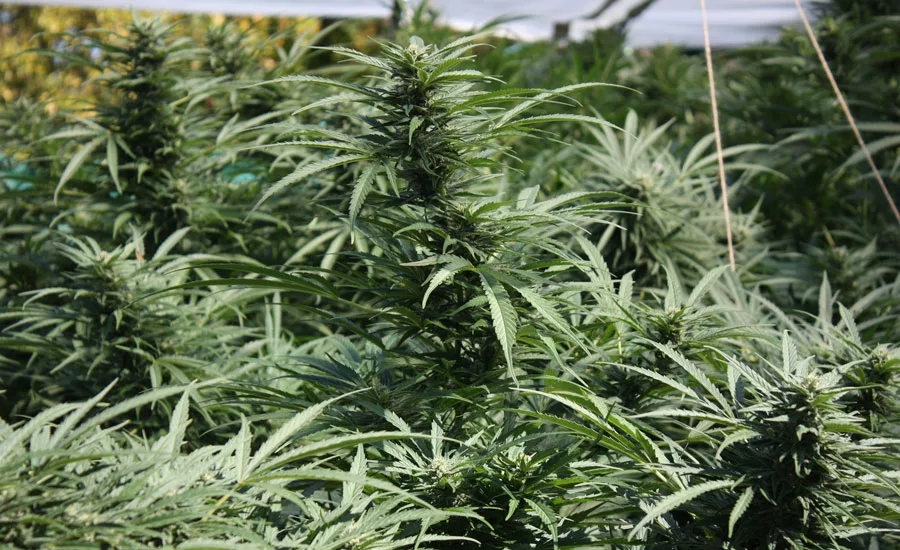
With almost 30 states now allowing some sort of legal use of marijuana, it is not surprising that the number of cannabis growing facilities in the U.S. is exploding. These growing facilities range from small farms that supply medical marijuana to local patients to large, multimillion-dollar facilities that produce enough to supply entire states with both recreational and medical marijuana.
State and local ordinances concerning cannabis growing facilities can differ from one location to the next, but the actual cultivation of cannabis does not vary too much. Like most plants, cannabis needs just the right amount of light, humidity, heating/cooling, nutrients, and ventilation in order to grow and thrive. Ventilation is probably the least understood part of this equation, but if the system is not designed properly, then the plants — and the workers — can suffer.
UNIQUE SYSTEMS
Ventilation is an important part of cannabis growth because proper air movement over the plants helps keep them healthy by reducing the chance of mold growth, distributing heat and humidity, and preventing pest and fungus infestations. For those working in cannabis facilities, ventilation is important as well, because fumes from sulfur burners and pesticides can be dangerous to breathe. In addition, dangerous levels of CO2 can occur if growers are enriching the air with compressed CO2 as a way to improve crop yields. Many growers provide a range of approximately 1,000 to 1,500 ppm of CO2 to assist in the flowering stage of growth, and when CO2 injectors are used, it’s prudent to design a purge system with multiple alarms, said Jay Takacs, CEO, 15000 Inc., Santa Rosa, California.
“The first alarm is to alert the owner that the CO2 range is within the elevated range desired and a secondary alarm energizes the purge system if the CO2 concentration is excessive and a danger to occupants," he said.
Takacs and his colleagues Matt Torre and Gary Welch have been designing indoor grow facilities, distribution centers, and extraction facilities in the San Francisco area since 2010. Last year, they were the engineer of record for 12 separate cannabis grow facilities, and they anticipate similar numbers this year.
Takacs noted that, for the most part, cannabis growing facilities are very similar to typical agricultural buildings in which air movement and humidity control are paramount.
“In a completely sealed indoor system, we have the added challenge of maintaining pressure relationships within the building to ensure positive pressurized grow rooms while scrubbing the discharge air," he said. "Relief and intake air is typically treated with activated carbon filtration, but recently we’ve been utilizing UV filtration as well."
Looking for quick answers on air conditioning, heating and refrigeration topics? Try Ask ACHR NEWS, our new smart AI search tool. Ask ACHR NEWS
The types of ventilation systems used in growing facilities are as unique as the growers themselves, noted Takacs, with systems varying from 100 percent outdoor air to minimum ventilation requirements.
“Typically, we provide minimum code required outdoor air ventilation and scrubbing of the exhaust air with UV and activated carbon filtration as it exits the building," said Takacs. "In between the beginning and end, we lean toward split system fan coils and air-cooled heat pumps in addition to dehumidification, as the ideal conditions vary between 65° and 75°F and 40 to 50 percent relative humidity.”
KEEP IT MOVING
Ventilation is the key factor in creating Mother Nature in a building, according to Shelby Chase, a cannabis cultivator since 1999; owner of Garden Rebels Wholesale Inc. in Willits, California; and an independent manufacturer’s representative for Fantech. Stagnant air will create prime real estate for pathogens, such as powdery mildew and spider mites, she said.
To ensure she designs the correct ventilation system for a grow facility, Chase first asks a series of questions (see sidebar on page 7), which helps her decide on the correct solution.
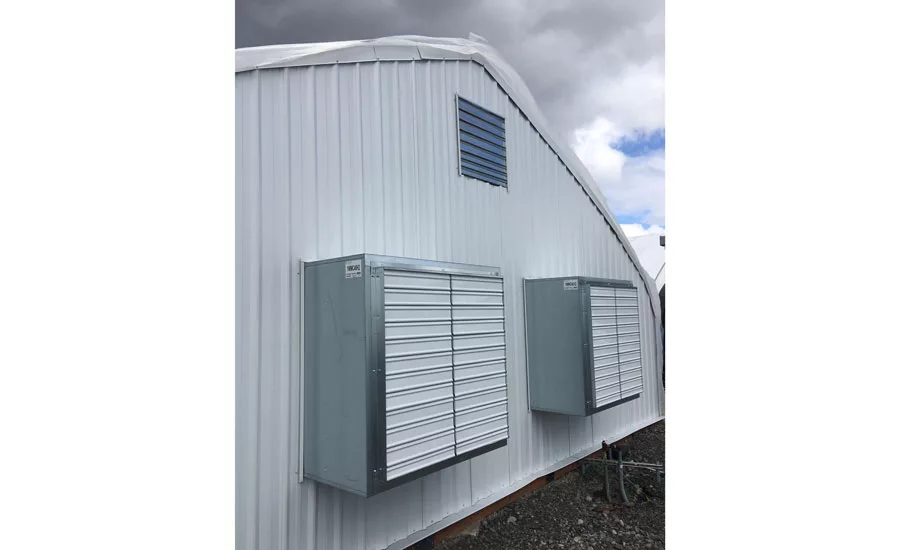
The one constant in every facility is that air must always be in motion, so she recommends installing oscillating wall-mounted fans about every 10 feet along the walls all the way around a facility, paired with HVAC equipment that matches the calculated cfm of the room. If using carbon filters for odor control on the exhaust, it will be necessary to size the fans to accommodate the static pressure added by the filter.
For indoor facilities not utilizing the sealed room method and CO2 injectors, air intakes should be installed near the ground at the opposite end of the exhaust, said Chase.
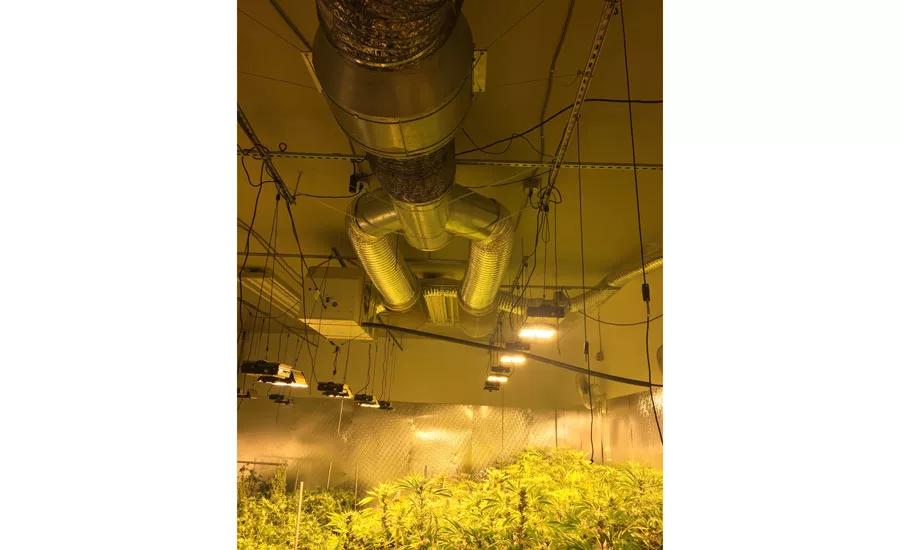
“On a large facility, the intake must be ducted and powered with an inline fan that has an antimicrobial filter to keep out pathogens," she said. "I recommend having intake and exhaust manifolds custom made to equally distribute air throughout the area.”
To keep the fresh air moving, the air in the facility should be exchanged every minute to minute-and-a-half, and the exhaust needs to match the cfm of the room.
“The exhaust should be placed high up and on the opposite end of the intake," said Chase. "Generally there is a carbon filter attached to the fan to assist in odor control. Too often, the intake and exhaust are not properly sized and/or not placed in the right locations. In addition, be aware that although flex duct is the standard for most HVAC professionals, it is not the best choice for moving air, as the static pressure can negatively affect fan performance.”
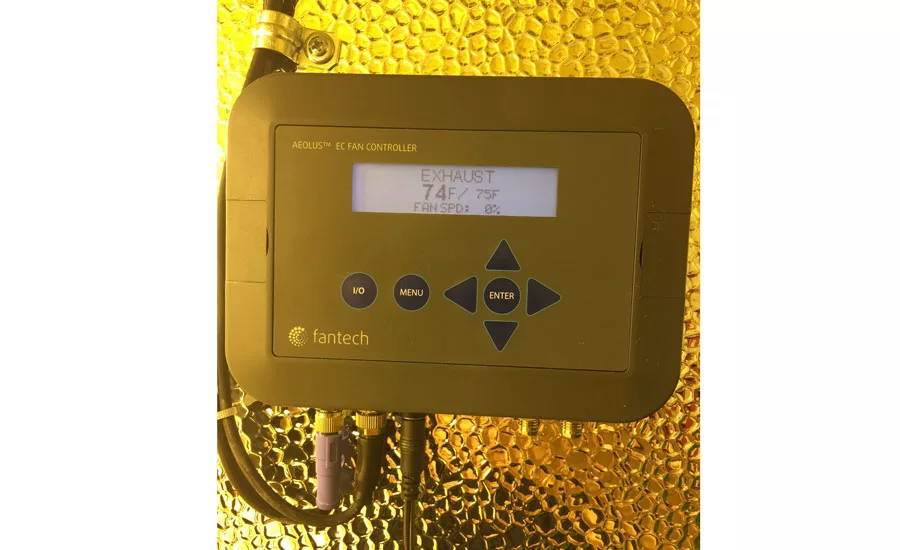
There are many ways to monitor and control the environmental conditions in a grow facility, and those can range from simple thermostats to controllers that measure humidity, CO2, and temperature. All controllers have a probe to read the room temperature; this probe should be centrally located and hang at the plant canopy level, said Chase.
“If the controller has a photocell, keep that photocell out of direct light,” she said.
Chase likes Fantech’s EC controller, as it gently ramps up or down the rpm on the fan, maintaining the set temperature and eliminating power spikes. In facilities that use CO2 injectors but not air conditioning, Chase recommends a total environmental controller, which will turn off the fans while CO2 is being injected.
“If the facility is using air conditioning, then the exhaust will be a backup plan for when the a/c goes out (and it will)," she said. "In this case, you can use a simple analog temperature controller that will be set to a high temperature (around 85°), so the exhaust can kick on and save the crop.”
ODOR CONTROL
Bruce A. Straughan, a building systems expert in Arvada, Colorado, did a technical presentation on cannabis grow facilities for ASHRAE’s Rocky Mountain Chapter conference, and he believes one of the biggest challenges is odor control.
“Flowering marijuana plants produce a very strong scent that must be contained to comply with local codes," he said. "Odor control is a big issue in Denver, and some neighborhoods that are close to grow facilities have made formal complaints to the city about the smell. The most common method used for odor control is to filter the exhaust with an activated charcoal filter.”
Filtering intake air is also important, as mold spores can spoil the entire crop. Some facilities eliminate the risk completely by not bringing in any outside air, according to Staughan.
"Instead, they use carbon filters to scrub the air and recirculate it around the room," he said. "Most facilities use CO2 injectors, and because that costs money, growers like to avoid exhausting the CO2-enriched air out of the room.”
As for ventilation, all facilities need wall-mounted or oscillating fans to prevent stratification and to keep the air moving, said Straughan.
“Some facilities ventilate the grow lights with a dedicated system that’s sealed and separate from the rest of the room," he added. "In that type of system, the ventilation is only for cooling, and there would be no need to filter the air.”
Since ASHRAE does not address cannabis grow facilities in its standards, engineers and contractors must do their due diligence when it comes to designing systems.
“System designers must know how to estimate the huge latent cooling load due to the transpiring plants," said Straughan. "They must also understand the critical factors that affect crop yield and the importance of maintaining an environment free of contaminants.”
Ventilation is one of those critical factors, and the need for constant air movement in a grow facility cannot be emphasized enough, said Chase. “Many people undersize their ventilation or purchase cheap equipment in an attempt to cut cost on the build out. That never ends well!”
SIDEBAR: Asking the Right Questions
There simply isn't a standard design for ventilation systems in grow facilities. That’s why Shelby Chase, owner, Garden Rebels Wholesale Inc., asks the following questions in order to find the correct solution for each application:
• What is the outside climate of the facility? Location?
• Is the building out in the open? What is the tree coverage? Is it facing south?
• What kind of building is it — Warehouse? Barn? Greenhouse?
• Is the building insulated? Metal roof? Shingles?
• What is the size of the space? The length times width times height will provide the true cfm needed for the space. Greenhouses require different math due to gothic or dome styles.
• Where are the windows and doors?
• How many lights? Open or air-cooled?
• Will CO2 be used?
• Is it a sealed room with an air conditioner?
• What kind of floor? Concrete? Crawl space?
• Is there attic space? Will exhausting be achieved to common space or through the roof?
• How many plants? What grow system — Hydro? Soil? How much evaporation will there be from the grow medium?
Publication date: 4/23/2018
Want more HVAC industry news and information? Join The NEWS on Facebook, Twitter, and LinkedIn today!
Looking for a reprint of this article?
From high-res PDFs to custom plaques, order your copy today!