Btu Buddy 177: Leaking Commercial AC System
Bob and Tim are on air-conditioning system service call, and the system has a persistent leak. It seems to leak down about once a month and has to be recharged. Several technicians have tried working on the system and cannot seem to find and stop the persistent leaking. Their service order says to says to repair the leak using whatever methods needed to be used. This persistent leak must be stopped.
They arrive at the job and look the system over and discover that it is truly low on refrigerant again.
Bob said, “This system has caused so many people so many problems that I think drastic measures are in order. I believe we should recover the refrigerant and divide the system up into sections (different components or vessels) and see if we can discover which portion is leaking”.
They recovered the refrigerant and used dry nitrogen to bring the system back up to about 2 psi above atmospheric pressure.
Tim then asked“Where will we divide the system and how will we do it”?
Bob said, “There are different methods that we could use to divide the system up depending on what type of system that we might be working with. With this system and the valves that we have to work with we will first attempt to divide the system up into two vessels isolating the suction and liquid line piping and the evaporator as one vessel and the condensing unit as another vessel. Then we will pressurize both vessels and see which one leaks down overnight. We can do that by front seating the suction service valve on the compressor and front seating the liquid line service valve at the condensing unit. We can then pressurize the condensing unit through the suction service on the compressor.
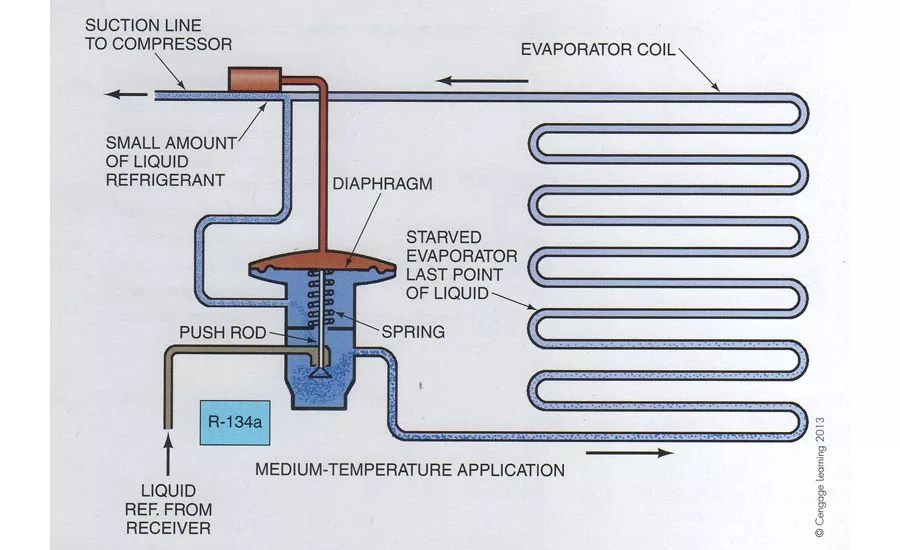
"Pressurizing the evaporator and field piping will be a little different. We can remove the external equalizer line from the expansion valve connection on the suction line and plug port going to the expansion valve and add refrigerant into the evaporator and field piping through the connection that is left on the suction line. That way we will be able to put vapor in the suction line external equalizer connection and pressurize the evaporator the liquid line through the suction line.
Looking for quick answers on air conditioning, heating and refrigeration topics? Try Ask ACHR NEWS, our new smart AI search tool. Ask ACHR NEWS
"We will now have two vessels, the condensing unit being one vessel and the evaporator and field piping being the other vessel. We can add nitrogen and push the pressure up to 150 psi in both vessels and let them stand overnight and see which vessel leaks."
They front seated the suction line service valve and then front seated the liquid service valve. Then went to the evaporator section and disconnected the flare nut on the side of the thermostatic expansion valve. They put a cap on the quarter-inch connection on the expansion valve and connected a union in the external equalizer line that fastened to the suction line. They pressurized both sections of the equipment. They now had two different vessels pressurized to 150 psi. This was accomplished without cutting any piping and only loosening only one flare nut.
Bob then said, “It is now going to be a waiting game. We will come back in the morning and see if either vessel has leaked down. Let’s go on to another service call for today and come back here in the morning.
They returned the next morning and Tim looked at both of the pressure gauges and said, “the condensing unit pressure is still on 150 psi. The evaporator and piping section pressure is down to 120 psi. We now know that the leak is somewhere in that vessel, how are we going to find it”?
Bob said, “Let’s look at the piping arrangement on the system. The evaporator is quite a ways from the condensing unit. The condensing unit is sitting out back on a slab, the piping goes through the wall into the basement of the building. Then it turns up the wall in the basement and crosses over the basement in the floor joists and then down into the connections on the evaporator section on the floor of the basement. There seems to be a lot of possibilities. We can disconnect the piping on the evaporator end and cap the piping with a pressure port in the suction line and the liquid line piping. The other end of the suction line and liquid line will be sealed by the service valves in the condensing unit. Then we will need to cap the piping connections on the evaporator and use the external equalizer connection for the pressure port. That’s a good bit of work, but we can find that leak this way”.
Tim said, “That will be one way to narrow it down. We will have three vessels, the evaporator, the liquid line and the suction line”.
They let the pressure out of the low side of the system and cut the suction line loose at the evaporator. Then they cut the liquid line loose at the evaporator. Then they capped the suction line connection on the piping with a pressure port, and then the liquid line piping connection at the evaporator and capped it with a pressure port. They now had three vessels. One, the evaporator section with a pressure port at the external equalizer line, one in the liquid one and one in the suction line. They pressurized all three vessels up to 150 psi.
When they got all of this accomplished they were standing around just watching and Tim noticed that the pressure in the liquid line was going down. The liquid line and suction line were still connected to the condensing unit, but the condensing unit still had 150 psi of pressure on it.
Tim said, “I believe our problem is in this liquid line I think we should examine it closely”.
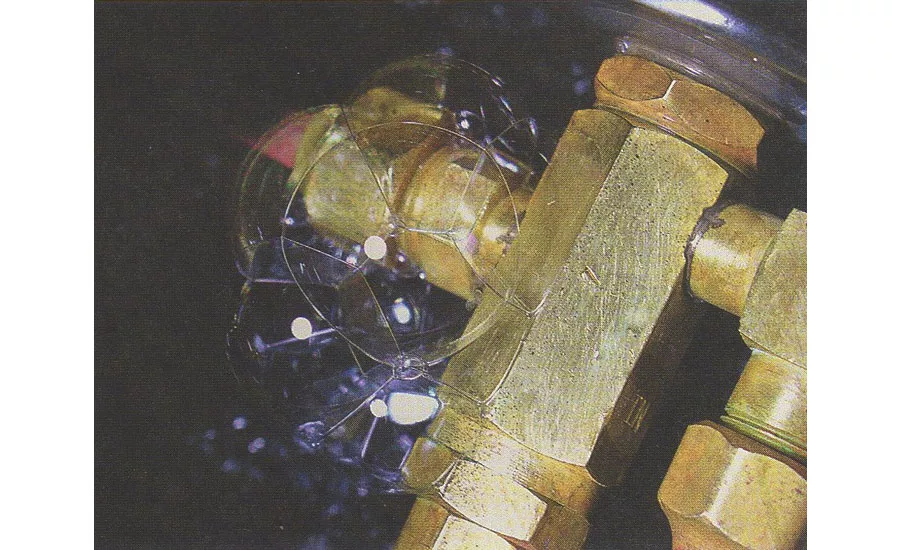
They took their flashlights and started following the liquid line and examining it closely. When they were looking up in the floor joist where the liquid line was routed along close to the flooring they noticed a long deck screw protruding through the floor from above touching the liquid line. Tim got the soap bubbles and soaped around the touch point, which they could not see exactly, and soap bubbles immediately started forming (Figure 2).
Tim said, “I believe we have found the problem that has plagued the system for a long time”.
Bob said, “get the small torch and let’s repair this leak and pressurize the system again”.
They let the pressure out of the liquid line and repaired the leak and pressurized it again.
Bob said, “We have found a leak. Let’s stick with our plan and leave 150 psi on this system overnight and come back again in the morning and see what we have. Let’s go to the next service call”.
They returned the next morning to find all vessels pressures at 150 psi.
Tim was elated and said, "That was a simple find and a simple fix. We found the leak without resorting to an electronic leak detector. We only used common sense mostly. It is too bad somebody didn’t find this long ago. If somebody had walked the piping examining the system they probably would have discovered this in the past. We probably would have discovered it and not had to pressurize the system if we had examined the system more carefully before we pressurized”.
Bob said, “This is very true. We now know that this system is leak free today. This system is now in 100% ready to run condition. Let’s put the entire system back together and leak check each connection very carefully”.
When they had the entire system back together with a new liquid line filter dryer, they evacuated the system and charged the system through the liquid line using liquid. Then they started the system and topped off the charge using vapor and the subcooling method for charging the system.
They were through with the job and Tim said, “that seemed like it took a long time, but the system is now in 100 percent good shape. It is ready to run for a long time without problems. Somewhere down the line and someone put a screw through the floor from above without looking below to see what they might be driving the screw into. I’m sure that is quite common, but not very common to get a refrigerant line”.
Bob said, “I agree this was an unusual situation that occurred along the way sometime in the past and we don’t know when. I have to say, my BTU Buddy told me many years ago that I should always make a good close examination of the entire system before I did anything. I often forget that good advice and blunder ever onward and it often cost me another bad experience like this one. You are right we should have walked the piping and looked before we started pressurizing or working on the system. It seems like old methods that are not followed come back to bite you in the backside when you don’t follow them. We are all still learning”.
Publication date: 12/18/2017
Want more HVAC industry news and information? Join The NEWS on Facebook, Twitter, and LinkedIn today!
Looking for a reprint of this article?
From high-res PDFs to custom plaques, order your copy today!