Protecting Boilers Against Flue Gas Condensation
Follow the laws of thermodynamics
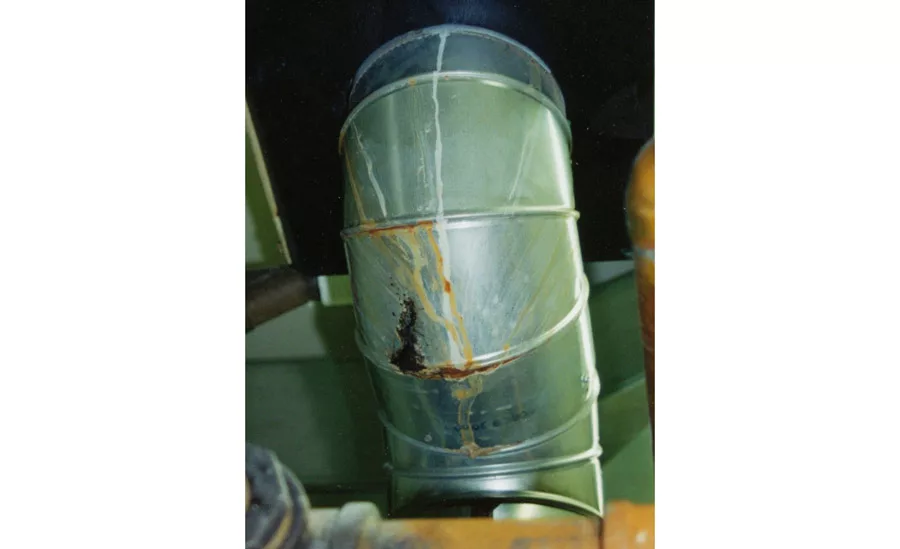
FIGURE 1: A boiler vent that has corroded from condensate.
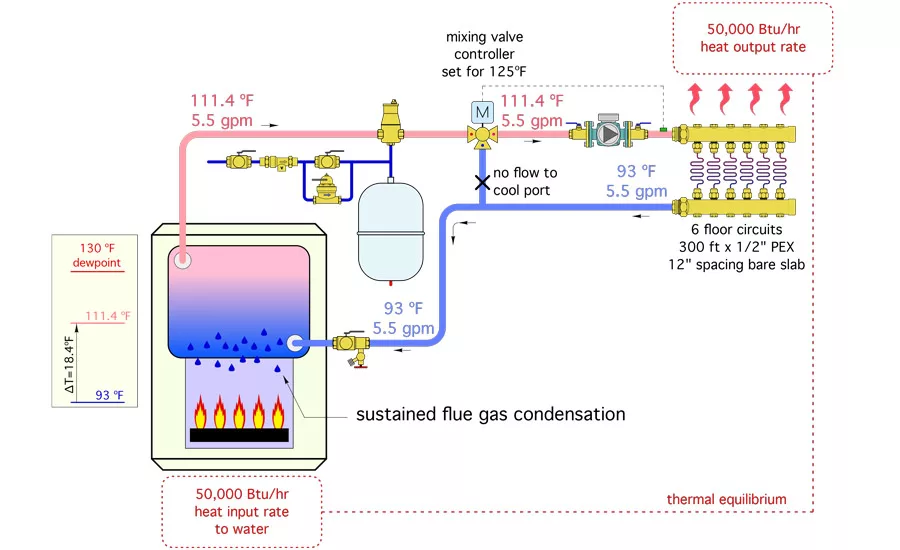
FIGURE 2
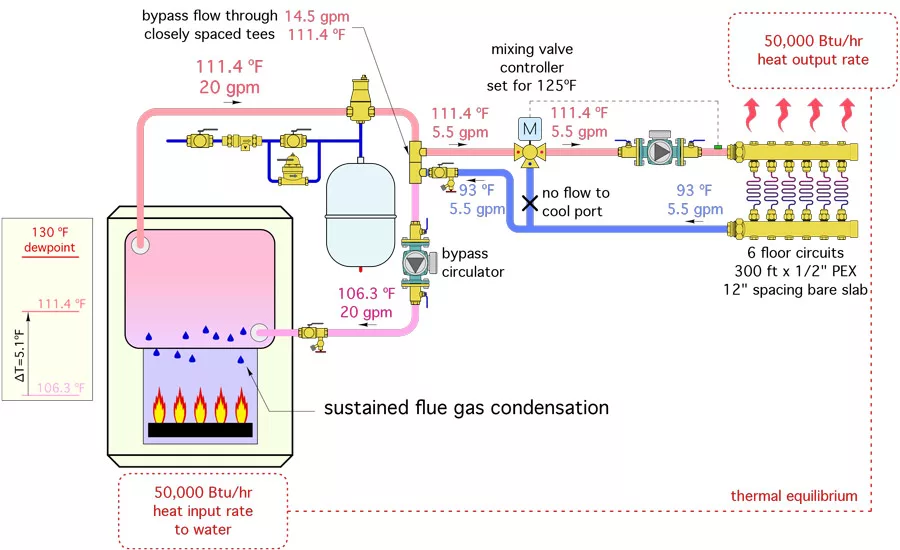
FIGURE 3
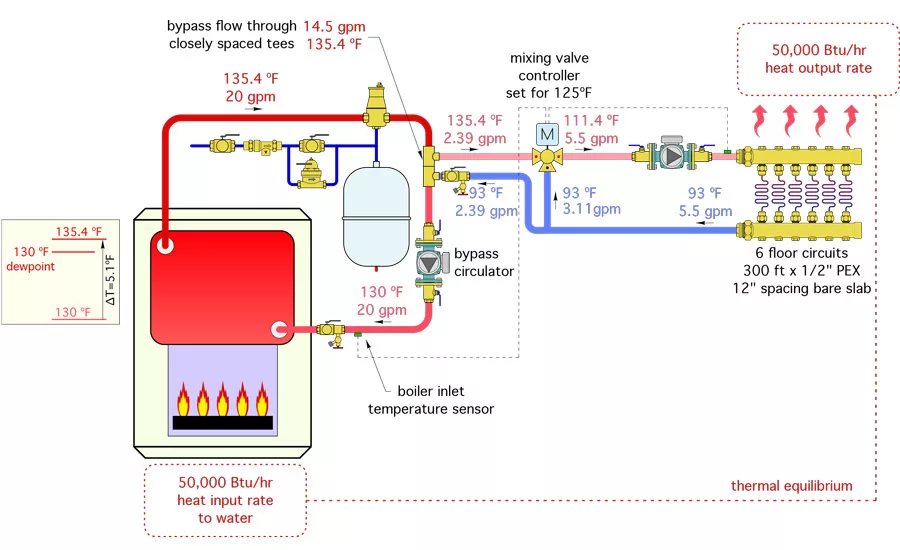
Figure 4
Many years ago, someone — I honestly have forgotten who — told me: “Thermodynamics isn’t just a good idea, it’s the law.”
Anytime you conjure up a new idea about how a heating or cooling system might work, test it against the laws of thermodynamics. In the case of hydronic systems, this law can be stated as follows: All systems inherently seek a balanced condition where the rate of energy input equals the rate of energy dissipation.
Left to their own control, all systems will automatically adjust their operating conditions so that this balance is achieved.
NONCONDENSING BOILERS
One great example of this is what happens to a so-called noncondensing boiler under certain conditions. If the load connected to the boiler can dissipate the full heat output from the boiler when supplied with only warm water, say 110°F, that’s as hot as the water temperature leaving the boiler will get. It doesn’t need to climb any higher, and won’t, even if the boiler’s high limit controller was set to 140°, 180°, or 220°. The conditions for thermal equilibrium are achieved at a supply water temperature of 110°, thus the first law of thermodynamics is satisfied. End of story.
The unfortunate consequence of this example is that the water temperature entering the noncondensing boiler is well below the dewpoint of the exhaust gases. The noncondensing boiler has just been forced to operate as a condensing boiler. In boilers operating on natural gas or propane, the condensate is primarily water. However, several other chemical compounds come along for the ride, making every drip of condensate a nasty hot acid with a pH in the range of 4.0.
This condensate has a healthy appetite for ferrous metals as well as copper. It will chemically eat away at the boiler’s heat exchanger as well as the inside of the vent connector. Figure 1 shows the results after only one year of operation.
The presence or absence of sustained flue gas condensation is determined by the temperature of the water entering the boiler and the air/fuel ratio at which combustion occurs. Of these, only the boiler inlet water temperature is easily controllable by how the boiler is applied.
Looking for quick answers on air conditioning, heating and refrigeration topics? Try Ask ACHR NEWS, our new smart AI search tool. Ask ACHR NEWS
OLD DAYS
Several decades ago, sustained flue gas condensation was seldom a problem in hydronic systems. They were designed around heat emitters that forced the system to operate at relatively high water temperatures, typically in the range of 180°-200°.
During a cold-start condition, a small amount of intermittent flue gas condensation would form within the boiler. However, the operating conditions quickly increased the water temperature entering the boiler above the dewpoint and any initial condensate quickly evaporated. This situation occurs in every boiler during a cold start and is generally not a problem.
What has changed over the last three decades is the water temperature at which an increasing percentage of modern hydronic systems operate. When radiant panel heating made its comeback in North America beginning in the 1980s, conventional boilers began to be paired with low-temperature distribution systems. This is where the ugly issue of sustained flue gas condensation began appearing.
The North American hydronics industry struggled with this issue for several years. Various arrangements of circulators, valves, and pipes were connected to boilers to try to prevent this condensation. Some worked and some did not. Hindsight shows that only the methods respecting the first law of thermodynamics were successful. Try as you might, you will never get around this law.
Fortunately, there are legitimate ways to avoid sustained flue gas condensation when a conventional boiler is paired up with a low-temperature distribution system.
Here is the bottom line: The only way to avoid sustained flue gas condensation is to monitor the boiler’s inlet water temperature and react to that temperature by limiting the rate at which heat moves from the boiler to the distribution system.
This requires the use of a mixing assembly between the boiler and distribution system.
The mixing assembly must determine if the distribution system is extracting heat faster than the heat source is generating heat. If heat dissipation exceeds heat production, thermodynamics demands the fluid temperature in the system to drop until the rate of heat dissipation by the distribution system equals the rate of heat production by the boiler. If this requires the boiler to operate well below the dewpoint of its flue gases — so be it. Thermodynamics doesn’t care if the boiler is condensing; it only cares about balancing heat dissipation with heat production.
A properly installed and controlled mixing assembly protects the boiler by reducing the rate of heat flow from the boiler into the distribution system whenever the boiler temperature approaches or falls below a specified minimum operating temperature. This partially unloads the boiler from the distribution system, allowing its temperature to quickly rise above condensing conditions. This action lifts the combustion side of the boiler’s heat exchanger above the dewpoint of the exhaust gases.
ARE YOU PROTECTED?
Figures 2, 3, and 4 illustrate situations in which a conventional boiler is, and is not, protected from flue gas condensation. These systems all use a three-way mixing valve to control the temperature of the water going to the distribution system. The manifold station in each system serves six floor-heating circuits, each being 300 feet of ½-inch PEX tubing embedded at 12-inch spacing in a 4-inch-thick bare concrete slab.
All these systems have a conventional boiler with a rated output of 50,000 Btuh and a boiler high-limit setting of 180°. In each case, the controller operating the mixing valve is set with the intention of maintaining a supply temperature of 125° to the manifold station.
The system in Figure 2 does not measure boiler inlet temperature. The water temperatures shown are those required based on a thermodynamic heat balance (e.g., where the rate of heat dissipation of the distribution system matches the rate of heat generation by the boiler with the boiler in continuous operation). In this case, the distribution system requires water at 111.4° to dissipate 50,000 Btuh
Because the mixing valve controller is trying to achieve a supply water temperature of 125° and only has water at 111.4° available from the boiler, the hot port of the mixing valve is fully open and the cool port completely shut. Hence, the mixing valve is simply passing through the entering water stream directly to the manifold station. No mixing occurs.
All water exiting the return manifold flows directly back to the boiler at 93°. This temperature is low enough to cause sustained flue gas condensation within the boiler. A mixing system that does not monitor and react to boiler inlet temperature cannot protect the boiler.
The system in Figure 3 adds a bypass circulator between the boiler and mixing valve. The three-way mixing valve is correctly coupled to the boiler bypass piping using a pair of closely spaced tees. These tees provide hydraulic separation between the bypass circulator and the distribution circulator. The intent of the bypass circulator is to mix higher temperature water leaving the boiler into the cooler water flow returning from the distribution system, thus boosting boiler inlet temperature.
The temperatures shown are again those mandated by a thermodynamic balance between heat dissipation by the distribution system and heat production by the boiler. Although the bypass circulator increases the flow rate through the boiler, it cannot adjust the rate of heat transfer to the distribution system relative to the rate of heat production in the boiler.
To dissipate the 50,000 Btuh added to the water by the boiler, the manifold station still requires 111.4° water at a 5.5 gallons per minute (gpm) flow rate and returns the same flow at 93°. The hot port of the mixing valve is again fully open and passing all entering hot water directly to the manifold station. No mixing occurs in the mixing valve.
The bypass circulator and boiler loop create a second mixing point within the lower of the two closely spaced tees. The mixing that occurs at this location slightly boosts boiler inlet temperature, but not high enough to prevent flue gas condensation within the boiler. Installing a larger bypass circulator would increase the flow rate through the boiler and slightly boost the boiler inlet temperature. The temperature rise across the boiler would decrease in response to the higher flow rate. However, no matter how high the flow rate, the boiler’s inlet temperature could never reach its outlet temperature. Sustained flue gas condensation will, again, occur within the boiler.
This demonstrates the myth that a boiler bypass circulator, by itself, is insufficient to protect the boiler.
The missing element is a mixing system that senses and reacts to the boiler inlet temperature.
The system in Figure 4 uses a mixing valve controller that measures boiler inlet temperature. The operating logic within this controller gives priority to maintaining the boiler inlet temperature above a user-selected minimum value, which, in this example, will be 130°.
Notice the water temperature entering the boiler is now 130°. Given the same 20-gpm flow rate through the boiler, the temperature rise across the boiler will only be 5.1°, and its outlet temperature will be 135.4°. This higher water temperature now enters the hot port of the mixing valve.
DON’T ASSUME
Because hot water is now available to the mixing valve at 135.4°, one might assume the mixing valve controller would adjust the valve for a mixed supply temperature of 125° (e.g., the setting of the mixing valve’s controller). However, if the water temperature supplied to the floor circuits were to increase, so would heat output from the floor.
Under such conditions, the floor circuits would release heat faster than the boiler can add heat to the water. The resulting thermodynamic imbalance would force the water temperature entering the boiler to drop. The boiler inlet temperature sensor would immediately detect this, and the mixing controller would reduce the rate at which hot water enters the hot port of the mixing valve until the boiler inlet temperature increased back to 130°.
Thus, the system in Figure 4 stabilizes at the conditions shown where the floor circuits continue to be supplied with water at 111.4° and release heat at 50,000 Btuh, and the boiler inlet temperature remains at the mixing valve controller’s set minimum value of 130°. A thermodynamic balance between the boiler and distribution system is achieved, and the boiler inlet temperature is high enough to avoid flue gas condensation.
The key to the successful strategy shown in Figure 4 is a mixing assembly that senses and reacts to boiler inlet temperature. This detail was lacking in the systems shown in Figures 2 and 3.
The systems shown here use a motorized three-way valve as the main component of the mixing assembly. Alternatives to this mixing method include motorized four-way mixing valves and injection mixing using a variable-speed pump or a motorized two-way injection valve.
When properly applied, these mixing assemblies also can protect a conventional boiler against flue gas condensation. Just stick with the same principle of measuring boiler inlet temperature and reacting to it by not allowing the distribution system to extract heat from the water flowing through it faster than the rate at which the boiler produces heat.
There are still many situations where conventional boilers (e.g, those not intended to operate with sustained flue gas condensation) are used to supply low-temperature distribution systems. In addition to boilers fueled by gas, propane, and fuel oil are boilers burning cordwood, wood chips, and wood pellets. These solid-fuel boilers also require protection against sustained flue gas condensation and can be equipped with the same type of hardware to provide that protection.
Publication date: 8/14/2017
Want more HVAC industry news and information? Join The NEWS on Facebook, Twitter, and LinkedIn today!
Looking for a reprint of this article?
From high-res PDFs to custom plaques, order your copy today!