HVACR Contractors Must Prioritize Chiller Maintenance
Proper chiller maintenance can be the difference between a happy customer and a former customer

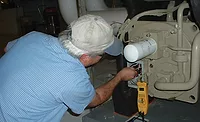
EDDY CURRENT TEST: A technician from Minneapolis-based Owens Cos. performs eddy current testing on an older-model water-cooled centrifugal chiller. PHOTO COURTESY OF OWENS COS. INC.

LANDS AND GROOVES: A look inside an internally advanced “rifled” chiller tube.
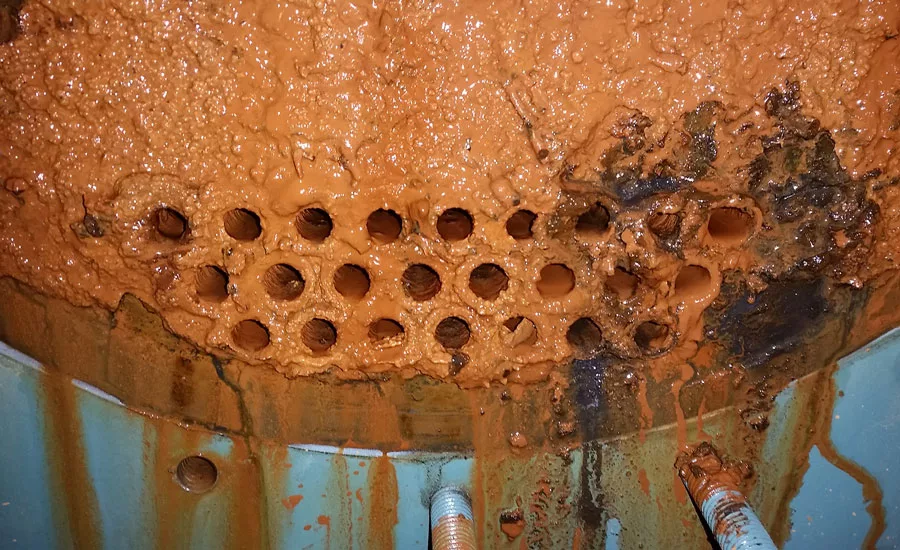
CLEANING NEEDED: A condenser fouled with mud and sludge and likely scaling in the tubes. Despite how bad it may look, this condenser is cleanable. PHOTOS COURTESY OF CONDENSER AND CHILLER SERVICES
Commercial building owners and managers count on HVAC contractors to take care of their buildings in many ways. They’re expected to keep their facilities cool and comfortable, ensure their processes and procedures continue to hum along, provide quality IAQ, and, of course, maintain their equipment. On this last point, the proper maintenance of chillers takes top billing.
These large and expensive pieces of equipment can run well for decades if properly maintained. On the other hand, a lack of good maintenance sets the stage for problems, breakdowns, and dissatisfied (ex-) customers.
John Owens, president and CEO of Owens Cos. Inc. in Minneapolis, said Owens Cos. helped pioneer what today are the standards in the industry for preventive and predictive maintenance of central chiller systems. Owens was a founding member of the Chiller Systems Group (CSG) in 1994. CSG is comprised of some 45 independent central chiller contractors committed to sharing information and helping members solve complex and difficult chiller problems. Its members perform service annually on more than 10,000 chillers.
Some of the modern tools and techniques for chiller system maintenance include:
- Oil Analysis: According to Owens, this is one of the best tools to understand what is happening inside a chiller. An oil analysis will indicate if there is moisture, acid, corrosion, bearing wear, impeller rubbing, or other problems.
“Oil analysis was actually my father’s idea back in the 1960s,” Owens told The NEWS. “It was the advent of public air travel, and the aviation industry was trying to show the public that air travel was safe with these new-fangled jet engines. They were doing oil analyses on the engines and my father, Bob, said, ‘If they can do it on jet engines, why can’t we do it on a centrifugal compressor?’”
- Eddy Current Testing: This reduces the risk of chiller failure caused by condenser and evaporator tube leaks or failures.
- Vibration Analysis: Owens called this a “must” for true predictive maintenance. This test will tell if there are problems with chiller bearings, impeller imbalance, or open rotor bars in the motor.
- Die-penetrant Testing: Designed to test the impellers for cracks, Owens said this non-destructive test will find the smallest imperfections.
Owens offered a word of caution when it comes to chiller maintenance: Hiring someone who works on chillers does not make you a central chiller company.
“Many companies are trying to do that, but there’s a lot more to it,” he said. “It’s easy when everything goes right, but you’re dealing with expensive equipment, and if there’s a problem or an issue, the liability is a lot greater than just working on a rooftop unit. If you make a mistake on a centrifugal chiller, you could end up with a five- or six-figure warranty claim.”
One of the challenges for service contractors is that chillers come in several shapes and styles. Owens said every machine is different and, over the years, CSG has facilitated ongoing training for its members on the dismantling and repair of all the different types of chillers.
Looking for quick answers on air conditioning, heating and refrigeration topics? Try Ask ACHR NEWS, our new smart AI search tool. Ask ACHR NEWS
In addition, Owens said most chillers are equipped with proprietary control panels. This serves to “lock building owners in and independent service contractors out, limiting the options for building owners.”
“Contractors who are servicing central chillers know they should be using an open-protocol control panel,” Owens said. “Many older machines are being retrofitted right now with control panels, and that’s the time when contractors can give building owners that open-protocol option.”
Although remote monitoring of chillers will assist contractors in their maintenance and service efforts, the most important element going forward is training, Owens said.
“Where are you going to get your next generation of chiller technicians?” he asked. “We are training our sixth generation of central chiller technicians. And it’s even more crucial with chillers because, to be a chiller technician, you have to know much more than just the mechanical side of the equipment. You must have the right personality and a good head on your shoulders. Not every technician is cut out to work on chillers.”
REGIONAL DYNAMICS
Chiller maintenance is a dynamic subject that can vary based on region, said R. Scott Tracy, president, Chiller Systems Service Inc., Lakewood, Colorado. He is also one of the cofounders of the Independent Contractors Exchange (ICE) Group, which consists of more than 50 contracting firms across the country that specialize in the installation, operation, repair, and maintenance of large commercial and industrial cooling systems and building and process control systems.
According to Tracy, maintenance has evolved differently across the country based on the regional location of chillers and the maintenance criteria set forth by the building management companies that oversee the chillers.
“In our climate here in Colorado, we have 3,800-4,500 hours per year of chiller run time,” Tracy noted. “In certain other areas of the country, they have easily double that. And, in some areas, operating hours dictate a proper service schedule.”
Tracy said one major change he has identified over the years is a decrease in complete chiller annual shutdown inspections. The culprit for this, he said, is changes in the commercial real estate market.
“Over the years, commercial real estate companies have minimized our ability to perform that kind of service,” he said. “So, by necessity, companies that perform chiller maintenance have tried to redirect their attention to ensuring that there are not any glaring issues and that the chillers start and run when requested. That diminishes the energy-efficiency piece. How do you know if the machine is performing at its best if you’re not afforded the opportunity to perform the services you recommend?”
This is one of the symptoms of a larger issue: Some of the larger property management groups are controlling more of the real estate now, and they’re driving what is done to the machines, which, in some cases, is not in concert with what contractors may recommend.
For example, most management companies, Tracy noted, are not interested in paying for any performance testing of the machines.
“We have a program called Reliability Focused Service, and we try to convince customers to let us spend some time with the equipment when it’s operating at load. But, most customers prefer to focus on the maintenance work that can be done in the winter and just let it run in the summer. That basically leaves us with focusing on the electrical integrity, refrigerant leak-tightness, and making sure the condensers are serviced and cleaned. In many cases that’s really what the market dictates in terms of what’s going to be done.”
In fact, some of the large national property management firms now provide worklists to their contractors that detail the maintenance services they want performed. This is quite a change from the days when building owners viewed the contractors as the experts and took contractors’ advice on what needed to be done to their machines. It also creates a dilemma for contractors.
“Even though the customer is providing the worklist/scope, if there’s something not on that list that you would recommend, there’s an expectation and an implied agreement that you would tell them,” Tracy said. “I think we need to resist the temptation to say, ‘Well, the customer supplied what they wanted done, and we’re just going to do that and nothing more.’ We need to look at it as an opportunity rather than a barrier. We have the opportunity to be with the machine, and we need to share with the customer any maintenance services we’d recommend. If they don’t take our recommendations, that’s their choice, but at least we’ve fulfilled our obligation as professionals and industry experts to help provide the advice to make their machines operate better and more reliably — whether they asked for it or not.”
THE PREDICTIVE MAINTENANCE MODEL
Mark Mikes, service group leader, Kahn Mechanical in Dallas, said HVAC equipment maintenance is evolving, and chillers can benefit from a maintenance model known as predictive maintenance.
Mikes explained that reactive maintenance was the predominant HVAC system service model for many years. The “fix on fail” reactive approach relies on the use of in-house facilities personnel or service contractors to repair equipment after it breaks down. The obvious flaws in this approach led to the birth of the preventive maintenance model. In preventive maintenance, which is still widely used, building operators and service contractors closely follow industry and manufacturers’ service recommendations. They schedule routine maintenance and equipment inspections at recommended industry standards and perform a brief check of system performance.
“Although far better than reactive maintenance, preventive maintenance doesn’t always validate system performance, because the servicing technician doesn’t always have the unit design conditions documentation to verify actual performance,” Mikes said.
This brings us to predictive maintenance. In a predictive maintenance strategy, building operators and their service contractors collect, analyze, and act on information to anticipate system problems and determine when equipment actually needs to be serviced.
As an example, eddy current testing will identify tube conditions within the heat exchangers. Identifying a defective tube before a rupture occurs could save downtime and expensive costs related to refrigerant loss or dehydration of the chiller.
“Today’s energy-efficient equipment, in most cases, requires greater attention to maintenance tasking to maintain equipment design operation,” Mikes said. “Brand X’s chiller may require different task-based maintenance than Brand Y’s.”
In addition, the chillers being built today have built-in electronic controls to control and monitor equipment operation. This adds to their complexity but also presents a great opportunity for contractors.
“One way to take advantage of the electronic control systems built in to the equipment is to remotely monitor equipment running conditions and generate alarms when conditions approach out-of-range design run conditions,” Mikes said. “Maintenance programs can be based on monitoring run conditions and recommended run time intervals that also can be monitored.”
So, keep the maintenance rolling and keep those chillers humming. There are challenges, but your customers are entrusting the performance of their buildings to you.
Enhanced Tubes Present Cleaning Challenges
The most effective way to ensure chiller tubes achieve their full lives and heat transfer efficiencies is to keep them clean.
That’s the word from Michael Golondzinier, service manager, Condenser and Chiller Services, Chino, California.
“Ideally, each time tube deposits, sedimentation, biofouling, and obstructions are effectively removed, the tube surfaces are returned to bare metal,” Golondzinier said. “In addition to providing the most effective heat transfer, the cleaned tube also is given a new life as a result of the rebuilding of its protective oxide coating.”
The most common way of cleaning tubes is with a tube cleaner consisting of a flexible shaft and brush. It’s very important to size the brush to the inner diameter of the tubes being cleaned. It is equally important to measure the length of the tube, so the brush doesn’t come out on the back side of the tube and get stuck.
According to Golondzinier, internally enhanced chiller tubes, a relatively new feature in the evolution of chillers, provide performance benefits but also present cleaning challenges. These chiller tubes are manufactured with a “rifling” or spiral groove inside the tubes. The idea behind the internally enhanced tube is to provide more surface area for heat transfer. The internal enhancement also creates more turbulence in the water passing through the chiller tube, which allows it to absorb more heat. Using internally enhanced tubes, chiller manufacturers are able to get more cooling out of smaller chillers, thereby reducing costs and enhancing efficiency.
This is all great until internally enhanced chiller tubes become fouled, Golondzinier noted. The high points inside the rifling are called the lands, and the low points are the grooves. When using the rod-and-brush method, the brush can simply ride over the lands and leave the grooves filled with deposits, he said.
According to Golondzinier, acid cleaning will work, but must be done by a skilled professional as acid cleaning introduces a corrosive chemical into the system that can attack not only the condenser tubes but the condenser piping and cooling tower, as well.
“Unless this is professionally done, the acid does not know when to stop,” he said.
Golondzinier added that other tube-cleaning methods also face challenges with internally enhanced tubes.
“Projectiles from tube cleaning guns move through the chiller tubes too quickly to effectively remove deposits from these tubes, and online systems have not proven to be very effective at keeping the grooves clean,” he said. “Rotary tube cleaners have proven to be best suited for cleaning internally enhanced tubes, and they have undergone several modifications over time to make them the best choice for this application. We recommend internally enhanced tubes be cleaned every six months.”
Ultimately, chiller tube maintenance is important for optimizing efficiency and extending equipment life, Golondzinier concluded, and it takes training and knowledge to perform this essential maintenance procedure properly.
Publication date: 5/22/2017
Want more HVAC industry news and information? Join The NEWS on Facebook, Twitter, and LinkedIn today!
Looking for a reprint of this article?
From high-res PDFs to custom plaques, order your copy today!