ACHR News
search
Ask ACHR NEWS AI
cart
facebook twitter instagram linkedin youtube
  • Sign In
  • Subscribe
  • Sign Out
  • My Account
ACHR News
  • NEWS
    • Breaking News
    • New HVAC Products
    • Featured Products
    • Manufacturer Reports
    • HVAC Data
    • Legislation
    • ACHR NEWS Centennial
  • RESIDENTIAL
    • Air Conditioners
    • Furnaces
    • Residential Heat Pumps
    • Ductless
    • Residential IAQ
    • Testing, Monitoring, Tools
    • Components & Accessories
  • COMMERCIAL
    • Air Handlers
    • Rooftop Units
    • Chillers and Cooling Towers
    • Commercial Heat Pumps
    • Boilers and Hydronics
    • VRF/Ductless
    • Commercial IAQ
  • REFRIGERATION
    • Refrigerants
    • Refrigerant Regulations
    • Leak Management
  • CONTRACTOR PRO
    • Geothermal
    • Homeowner Study
    • VRF and VRV Ductless
    • Unitary Trends
  • EDUCATION
    • Training and Education
    • Business Management
    • Service and Maintenance
    • Continuing Education
    • Market Research >
      • HVAC Brand Awareness Report
      • VRV, VRF, VRVZ Report
      • Unitary Trends Report
      • Water Heat Professionals Report
    • Webinars
    • Sponsor Insights
    • eProducts Info
    • White Papers
  • EVENTS
    • HVAC Contractor Forum
    • Industry Events and Webinars
  • MEDIA
    • Videos
    • AHR Expo 2025 Videos
    • Podcasts >
      • ACHR News Podcast
      • HARDI Podcasts
      • AHR Expo Podcasts
      • ACCA Podcasts
    • Interactive Spotlights
    • Quizzes
    • eBooks
    • HVAC Talkback
  • HVAC GROUP
    • ACHR NEWS >
      • Current Issue
      • Digital Edition
      • Subscribe
    • Distribution Trends
    • SNIPS NEWS >
      • Join SNIPS NEWS
    • Engineered Systems News >
      • Join ES News
    • HVACR Directory
    • Contests
    • Newsletters
    • Contact
    • Advertise
    • My Account
HVAC ContractingService and MaintenanceRefrigerationAir Conditioners

Btu Buddy 165: What is a Ton of Refrigeration?
By Bill Johnson
BTU Figure 1

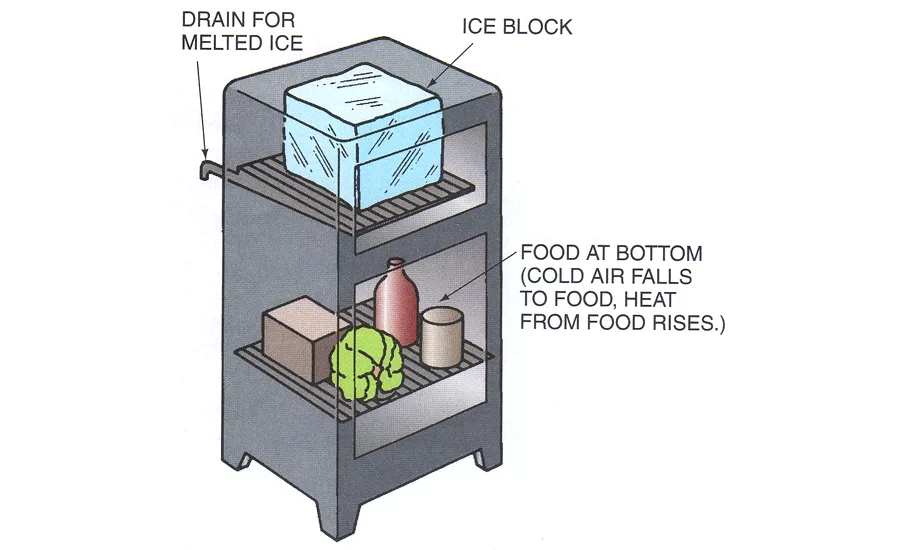
FIGURE 1: This is the way an ice box was constructed in the early days. The ice was located in the top of the box because cold air falls naturally to the bottom of the box and refrigerates the entire box. A pan under the ice collected the water from the melted ice. This pan drained into another pan below the ice box, and someone had to empty it periodically. (Figures are from Refrigeration & Air Conditioning Technology, 7th Edition, by William Whitman, William Johnson, John Tomczyk and Eugene Silberstein published by Delmar Cengage Learning.) (©Delmar Cengage Learning.)
 

BTU Figure 2

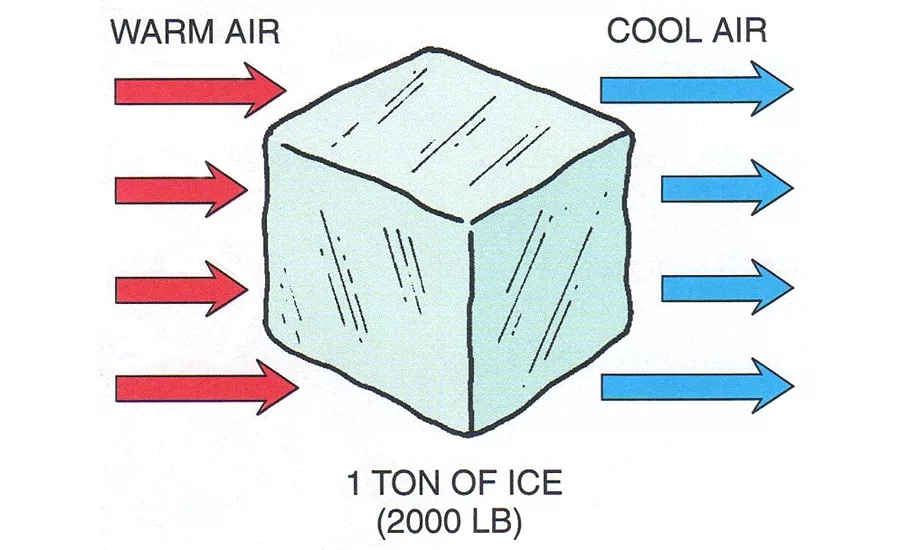
FIGURE 2: This illustrates a block of ice that weighs a ton, 2,000 pounds. When one ton of ice is melted in a 24-hour period, it has absorbed 288,000 Btus, or 12,000 Btus per hour. This is called one ton of air conditioning or refrigeration. (©Delmar Cengage Learning.)

BTU Figure 1
BTU Figure 2
December 19, 2016

Bob and Tim have had a big day at work — it’s 3:30 in the afternoon, and they are done for the day. They’re having coffee at a local restaurant, talking about their careers when Tim asked a question, “What is a ton of refrigeration, and why is it called a ton?”

Bob explained, “The earliest known cooling medium was ice. It goes way back and was used to preserve food over long periods of time. People then started using ice for cooling structures. Refrigeration for homes became popular in the late 1800s, and ice was used in insulated boxes for preserving food. There needed to be some way to establish a method of determining the capacity of these various refrigeration boxes. The first ice that was used was cut from lakes in the wintertime and stored in houses or buildings that were insulated with sawdust. The ice was covered with sawdust and would last all summer long if properly insulated and enough ice was available.”

Tim then asked, “How did they use ice to cool a building? Was this the first air conditioning”?

Bob said, “The term, ‘air conditioning,’ applies to the conditioning of air to cool, clean, humidify, or dehumidify. The southern part of the United States is hot and humid in the summer time. The first air conditioning systems actually stacked up blocks of ice, and fans forced air over the ice for the cooling and dehumidifying process. In order to know how many blocks of ice to order, or how many pounds of ice, some sort of measuring system had to be established. You learned in school that it takes 144 Btus to melt one pound of ice, at 32°F. The reason that you use ice in your beverage cooler instead of cold water is the cooling capacity of melting ice. If you put your beverages down in 32° water, it only takes one-half of a Btu to raise the temperature to 33°. With ice it takes 144 Btus to melt one pound of ice at 32°.”

Tim asked again, “How did we arrive at the system of using a ton?”

Bob said, “A ton of ice is 2,000 pounds. It takes 288,000 Btus to melt one ton of ice (144 Btus per pound x 2000 pounds = 288,000 Btus). If this is accomplished in a 24-hour period, that is a rate of one ton of ice per 24 hours, or a rate of 12,000 Btus per hour (288,000 Btus/24 hours per day = 12,000 Btus per hour). We call this one ton of refrigeration or air conditioning. In the old days, if they wanted to put enough ice in an airstream, they had to place a ton of ice in the airstream and melt it for every 12,000 Btus per hour that they wanted to remove from the air. When you pass air over 32° ice, it will remove moisture from the air because the ice is well below the dew point temperature of the air.”

Tim then asked, “When did they stop getting ice out of frozen lakes? How did they get the ice in the south?”

Looking for quick answers on air conditioning, heating and refrigeration topics? Try Ask ACHR NEWS, our new smart AI search tool. Ask ACHR NEWS →

Bob said, “They used to cut the ice out of the northern lakes and ship it south by wagon or train. Warmer than normal winters and shipping costs, along with having to build insulated buildings in the south to store large amounts of ice, caused engineers to start thinking about ways to make ice closer to the place where it would be consumed. Thus, mechanical refrigeration was explored in detail in the late 1800s. An ice plant that could make a ton of ice in 24 hours was called a one-ton ice plant. Of course, much larger ice plants had to be developed in order to have enough ice. You used to go to the ice plant for your ice and get a block in 25-pound increments. They made the ice in cube shaped tubs, brought it out front, and chipped it to size or used cutters to make chipped ice in bags. Icemen used to deliver ice to homes for ice boxes before mechanical refrigeration. In apartment buildings, the iceman had to carry the ice to the upper floors. It was quite physical”

Tim said, “So, the term, ‘a ton of air conditioning or refrigeration,’ goes way back to the beginning. They established a way of rating the products way back then, and it still holds good today. When the products are rated like this, you can compare one product to another.”

Bob said, “Yes those early terms still work today — all rating systems are expressed in Btus per hour or tons of air conditioning or refrigeration. These terms were well thought out when they were developed, and no one has tried to change them through the years. It is also nice to know that it takes approximately a 1 horsepower (hp) compressor to generate a ton of air conditioning. This rule of thumb does not hold up in the refrigeration part of the business because it takes more than one horsepower for a ton of refrigeration at the lower temperatures. As you know, the design operating temperature for an air conditioning system is 40°. That is the temperature of the operating evaporator. When it comes to lower temperature refrigeration, the evaporator may operate down to -60°. It simply takes more horsepower per ton at these lower temperatures.”

Tim said, “When we talk to other technicians and engineers, we should thoroughly understand all of these terms. When we go to a store to look at an air conditioner generation device, we should understand these terms in order to compare one company’s equipment to another company’s.”

Bob said, “That is correct, particularly when we talk to engineers we need to know the technology. Engineers and technical people are sensitive to the way you say things and judge you on how you express yourself and what kinds of terms you use. They know that you know what you’re talking about when you express yourself in the correct terms.”

Publication date: 12/19/2016

Want more HVAC industry news and information? Join The NEWS on Facebook, Twitter, and LinkedIn today!

KEYWORDS: air conditioning troubleshooting troubleshooting and HVACR

Share This Story

Looking for a reprint of this article?
From high-res PDFs to custom plaques, order your copy today!


Active in the HVACR industry since the 1950s, Bill Johnson graduated in gas fuel technology and refrigeration from the Southern Technical Institute, a branch of Georgia Tech (now known as Southern Polytechnic Institute). He taught HVAC classes at Coosa Valley Vocational & Technical Institute for four years. He moved on to become service manager for Layne Trane, Charlotte, N.C. He taught for 15 years at Central Piedmont Community College, part of this time as program director. He had his own business for five years doing installation and service work. Now retired, he is the author of Practical Heating Technology and Practical Cooling Technology, and continues as a co-author of Refrigeration & Air Conditioning Technology, seventh edition, all published by Delmar Cengage Learning. For more information, he can be reached at 704-968-0000 or thebillj1@gmail.com.

Btu Buddy Notebook is a collection of more than 50 service call scenarios in book form covering both cooling season and heating season troubleshooting. For more information and to purchase the book, visit the HVACR Industry Store.

Recommended Content

JOIN TODAY
To unlock your recommendations.

Already have an account? Sign In

  • HVAC-enrollment

    The Trades Are Back: HVACR Programs See Nearly 30% Enrollment Spike

    A new wave of future technicians is entering the pipeline.  
    Training and Education
    By: Matt Jachman
  • 2025 Top 40 Under 40

    2025 Top 40 Under 40 HVACR Professionals List

    The 11th annual Top 40 Under 40 list highlights those...
    News
    By: Hannah Belloli-Oster
  • LG Ductless Mini-Split Systems

    The 9 Types of Heat Pumps

    As the U.S. moves toward electrification, heat pumps are...
    Heat Pumps
    By: Joanna R. Turpin
Subscription Center
  • Create an Account
  • Start a Subscription
  • Manage My Account
  • Sign Up for Newsletters
  • Visit Customer Service
  • Update Preferences

More Videos

Sponsored Content

Sponsored Content is a special paid section where industry companies provide high quality, objective, non-commercial content around topics of interest to The News audience. All Sponsored Content is supplied by the advertising company and any opinions expressed in this article are those of the author and not necessarily reflect the views of The News or its parent company, BNP Media. Interested in participating in our Sponsored Content section? Contact your local rep!

close
  • Piggy Bank
    Sponsored byWatercress Financial

    Energy Prices, Inflation, and HVAC: What Today’s Homeowners Care About

  • Refrigerated Food
    Sponsored bySolstice Advanced Materials

    R-455A Refrigeration: A Cold Storage Solution for the Future

  • Airex Rooftop Units
    Sponsored byAirex Manufacturing Inc

    Consolidating Roof Penetrations: A Growing Trend in Multifamily HVAC Design

Popular Stories

Outdoor-condensing-units.jpg

EPA Removes R-410A Installation Deadline

HVAC-Price-Increase-graphic

HVAC Price Increase List: June 2026

Trump-Section-232.jpg

Trump Reduces Section 232 Tariffs on HVAC Equipment to 15%

ACHR NEWS Editor Chris Gray Presenting HVAC Minute 5-18-2026

HVAC Manufacturers Fight Pricing Lawsuits

R410A-Refrigerant-Cylinder.jpg

Refrigerant Recovery is a Revenue Opportunity

View The ACHR NEWS
Centennial Anniversary Timeline

The ACHR News Timeline Chart
Submit a Letter
Submit a letter to our editors.

Events

November 6, 2025

Next-Gen Data Center Cooling: HVAC Innovation and Real-World Solutions

On Demand As AI workloads and high-density computing push traditional cooling methods to their limits, the data center industry is accelerating the adoption of next-generation HVAC technologies.

June 9, 2026

Before You Go All In on AI: Set Up Your Business to Actually Win

In this webinar, we'll walk you through exactly what to get in place before you add AI to your business. You'll leave with a clear picture of where you stand today and a practical action plan to set yourself up for real results.

View All Submit An Event

Poll

Summer Staff

Are you fully staffed for the summer season?
View Results Poll Archive

Products

BNI Mechanical/Electrical Square Foot Costbook, 2026 Edition

BNI Mechanical/Electrical Square Foot Costbook, 2026 Edition

See More Products
A2L Refrigerants - Free Webinar - May 21, 2026

Related Articles

  • Ice Breaker: What Is a Ton of Refrigeration?

    See More
  • Btu Buddy 149: Bob’s Home A/C Unit Is Not Working

    See More
  • Btu Buddy 123: Devastated 20-Ton Condensing Unit - Part 2

    See More

Related Products

See More Products
  • Tech_CommRef_Guide_Small.jpg

    Technician’s Guide & Workbook for Quality Maintenance on Commercial Refrigeration Equipment

  • comfortcoolingdvd.jpg

    COMFORT COOLING REFRIGERATION SYSTEM TROUBLESHOOTING

  • Refrigeration Fundamentals for HVAC/R Technicians DVD

See More Products
×

Sign Up. Stay Informed.

The #1 trusted source for the HVACR industry since 1926

SUBSCRIBE
  • RESOURCES
    • Advertise
    • Contact Us
    • Advisory Board
    • Classifieds
    • Submit a Letter
    • Directories
    • Store
  • ACCOUNT CENTER
    • Create an Account
    • Start a Subscription
    • Manage My Account
    • Sign Up for Newsletters
    • Visit Customer Service
    • Update Preferences
  • SERVICES
    • Marketing Services
    • Reprints
    • Market Research
    • List Rental
    • Survey/Respondent Access
  • STAY CONNECTED
    • LinkedIn
    • Facebook
    • Instagram
    • YouTube
    • X (Twitter)
  • PRIVACY
    • PRIVACY POLICY
    • TERMS & CONDITIONS
    • DO NOT SELL MY PERSONAL INFORMATION
    • PRIVACY REQUEST
    • ACCESSIBILITY

Copyright ©2026. All Rights Reserved BNP Media, Inc. and BNP Media II, LLC.

Design, CMS, Hosting & Web Development :: ePublishing