ACHR News
search
Ask ACHR NEWS AI
cart
facebook twitter instagram linkedin youtube
  • Sign In
  • Subscribe
  • Sign Out
  • My Account
ACHR News
  • NEWS
    • Breaking News
    • New HVAC Products
    • Featured Products
    • Manufacturer Reports
    • HVAC Data
    • Legislation
    • ACHR NEWS Centennial
  • RESIDENTIAL
    • Air Conditioners
    • Furnaces
    • Residential Heat Pumps
    • Ductless
    • Residential IAQ
    • Testing, Monitoring, Tools
    • Components & Accessories
  • COMMERCIAL
    • Air Handlers
    • Rooftop Units
    • Chillers and Cooling Towers
    • Commercial Heat Pumps
    • Boilers and Hydronics
    • VRF/Ductless
    • Commercial IAQ
  • REFRIGERATION
    • Refrigerants
    • Refrigerant Regulations
    • Leak Management
  • CONTRACTOR PRO
    • Geothermal
    • Homeowner Study
    • VRF and VRV Ductless
    • Unitary Trends
  • EDUCATION
    • Training and Education
    • Business Management
    • Service and Maintenance
    • Continuing Education
    • Market Research >
      • HVAC Brand Awareness Report
      • VRV, VRF, VRVZ Report
      • Unitary Trends Report
      • Water Heat Professionals Report
    • Webinars
    • Sponsor Insights
    • eProducts Info
    • White Papers
  • EVENTS
    • HVAC Contractor Forum
    • Industry Events and Webinars
  • MEDIA
    • Videos
    • AHR Expo 2025 Videos
    • Podcasts >
      • ACHR News Podcast
      • HARDI Podcasts
      • AHR Expo Podcasts
      • ACCA Podcasts
    • Interactive Spotlights
    • Quizzes
    • eBooks
    • HVAC Talkback
  • HVAC GROUP
    • ACHR NEWS >
      • Current Issue
      • Digital Edition
      • Subscribe
    • Distribution Trends
    • SNIPS NEWS >
      • Join SNIPS NEWS
    • Engineered Systems News >
      • Join ES News
    • HVACR Directory
    • Contests
    • Newsletters
    • Contact
    • Advertise
    • My Account
RefrigerationRefrigerants

The Professor: Global Warming Scares Costing Us Some Popular Refrigerants

Many refrigerants have been delisted in certain applications
By John Tomczyk
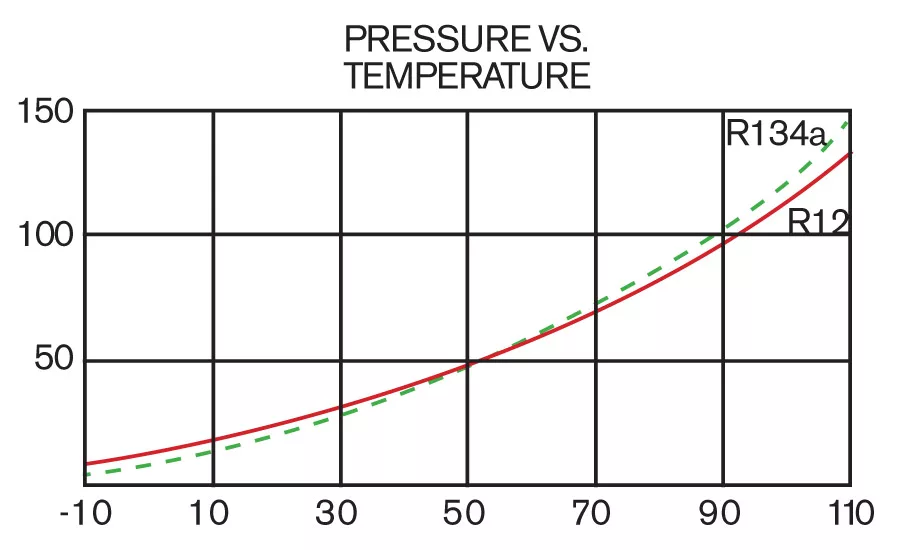
A comparison of the pressure/temperature relationships of HFC-134a and CFC-12

FIGURE 1: A comparison of the pressure/temperature relationships of HFC-134a and CFC-12. Information courtesy of Tecumseh Products Co.
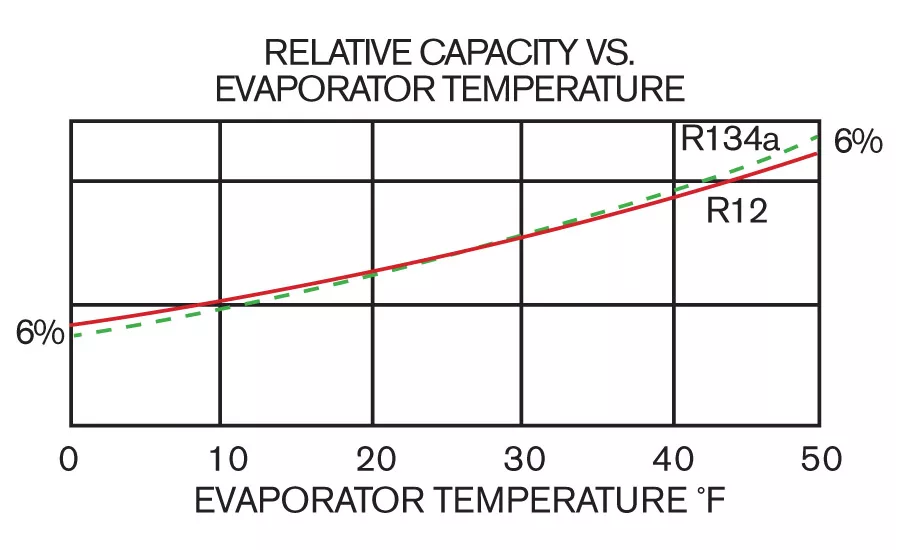
A comparison of the capacities of HFC-134a and CFC-12

FIGURE 2: A comparison of the capacities of HFC-134a and CFC-12 at lower and higher evaporating temperatures. Information courtesy of Tecumseh Products Co.
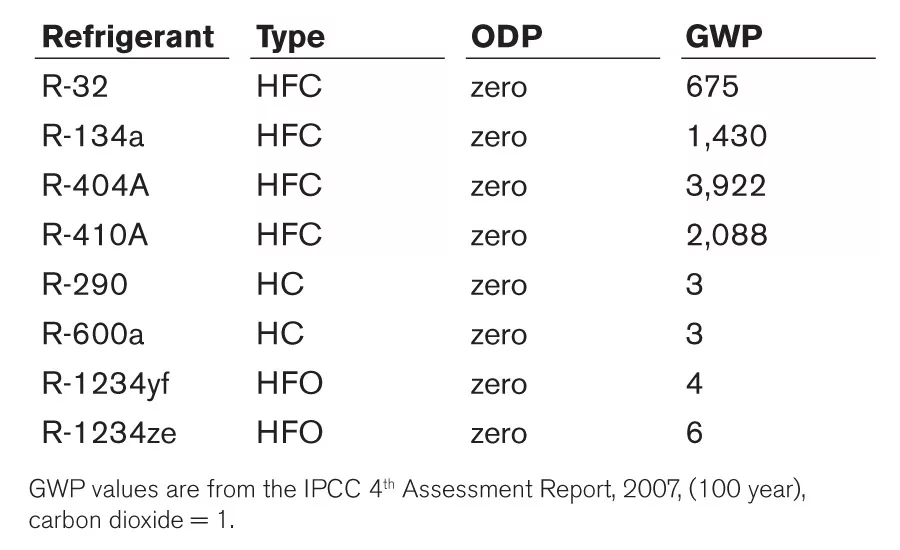
A comparison of the global-warming potentials of some refrigerants

TABLE 1: A comparison of the global-warming potentials of some hydrofluorocarbon (HFC), hydrocarbon (HC), and hydrofluoroolefin (HFO) refrigerants.
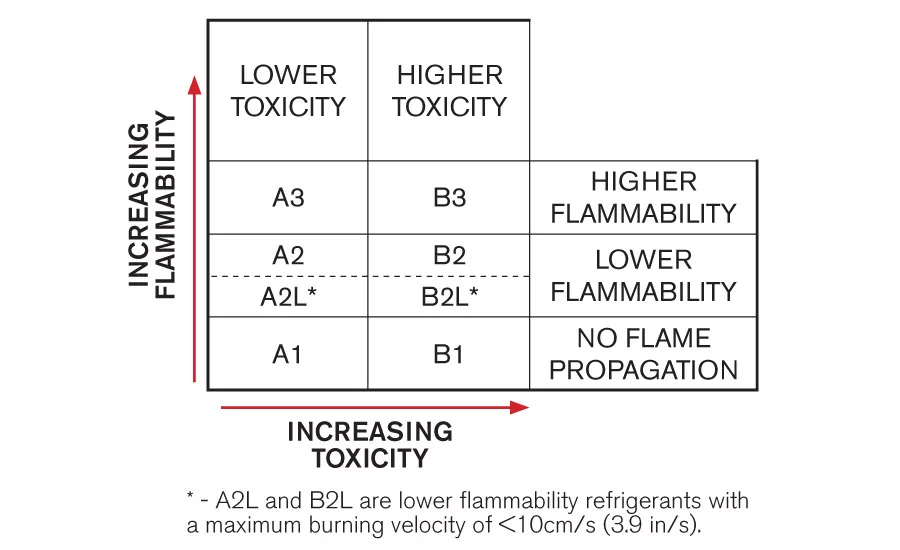
ASHRAE safety classifications for refrigerants

TABLE 2: ASHRAE safety classifications for refrigerants. A classification of A1 is the safest and a classification of B3 is the most toxic and flammable.

A comparison of the pressure/temperature relationships of HFC-134a and CFC-12
A comparison of the capacities of HFC-134a and CFC-12
A comparison of the global-warming potentials of some refrigerants
ASHRAE safety classifications for refrigerants
July 4, 2016

Hydrofluorocarbon (HFC)-134a replaced chlorofluorocarbon (CFC)-12. Now, 134a is on its way out, too.

The July 2, 2015, ruling from the U.S. Environmental Protection Agency (EPA) set forth the time frames for the phasedown of certain HFC refrigerants in specific applications. Since then, there has been no if, ands, or buts about it: The HVACR industry will be fading away from heavy use of HFC refrigerants that have unacceptable global-warming potential (GWP) values. Table 1 lists some refrigerants and their GWP values for comparison purposes.

Many refrigerants have been delisted in certain applications under the EPA’s recent rule, “Protection of Stratospheric Ozone: Change of Listing Status for Certain Substitutes” under the Significant New Alternatives Policy (SNAP) Program. For example, for new and retrofit retail food refrigeration, including stand-alone equipment, condensing units, direct and indirect supermarket systems, and new and retrofit vending machines, the popular refrigerant blends HFC-507A and HFC-404A are listed as unacceptable. R-134a has been determined as unacceptable for new stand-alone retail food refrigeration and new vending machines. The rules will be phased in over various time frames for the various equipment, but all by Jan. 1, 2020. R-134a also is considered unacceptable in motor vehicle air conditioning in newly manufactured light-duty vehicles starting with model year 2021.

This means the industry will transition to low-GWP refrigerants, whether they be HFCs, hydrofluoroolefins (HFOs), hydrocarbons (HCs), or some other natural refrigerant. At the same time, this industry will strive to develop other alternative refrigerants that are efficient, affordable, and environmentally safe. There also are code and standard task forces within the industry that have been addressing barriers to adaption of mildly flammable, low-GWP refrigerants, such as accelerating the implementation of fire and building codes for such refrigerants.

COMPARING HFC-134A AND CFC-12

Many of us remember working comfortably with R-12, R-22, and R-502, and then transitioning over to and becoming comfortable with R-134a, R-410A, and R-404A. We must now change again and get used to handling lower-GWP alternate refrigerants. As the applications become limited for R-134a, let’s take a closer look at this refrigerant.

In years gone by, HFC-134a used to be the alternative refrigerant of choice to replace R-12 (CFC-12) in many medium- and high-temperature stationary refrigeration and air conditioning applications. It also replaced CFC-12 in automotive air conditioning applications. However, HFC-134a is not and was never a direct drop-in replacement for CFC-12. Retrofit guidelines always had to be followed carefully when converting a system to HFC-134a.

HFC-134a is a very safe refrigerant and has a safety classification of A1. This means it is not flammable and is very low in toxicity. Table 2 addresses toxicity and flammability of refrigerants. Notice that a classification of A1 is the safest, whereas a classification of B3 would be the most toxic and flammable.

Looking for quick answers on air conditioning, heating and refrigeration topics? Try Ask ACHR NEWS, our new smart AI search tool. Ask ACHR NEWS →

HFC-134a is not a refrigerant blend. It is considered a pure compound and has only one molecule present, consisting of carbon (C), fluorine (F), and hydrogen (H). This molecule is small and will leak more rapidly than other refrigerants. Because HFC-134a has no chlorine in its molecule, it has a zero ozone-depletion potential (ODP). Its GWP is at a relatively medium level of 1,430. However, because of this GWP value, other refrigerants with lower GWP values, such as HFOs, may soon be replacing R-134a.

In medium- and high-temperature stationary refrigeration and air conditioning applications, HFC-134a has a very similar pressure/temperature relationship when compared to the refrigerant it was initially designed to replace (CFC-12). Although the pressure/temperature relationships of the two refrigerants closely compare, at lower temperatures, HFC-134a has lower pressures than CFC-12, and, at higher temperatures, HFC-134a has higher pressures.

Both HFC-134a and CFC-12 have comparable capacity relationships. When comparing capacities of HFC-134a to CFC-12, HFC-134a suffers some capacity loss when used as a low-temperature refrigerant. As shown in Figure 2, HFC-134a shows a 6 percent capacity loss when compared to CFC-12 in lower-temperature applications. However, in higher-temperature applications, there is a 6 percent increase in capacity when compared to CFC-12. Again, because of this phenomenon, HFC-134a is a good medium- and high-temperature a/c refrigerant. In many centrifugal chiller applications, efficiencies have improved, but not without some reductions in capacity.

As a medium- and high-temperature refrigerant for stationary refrigeration and air conditioning, HFC-134a is not usually used in low-temperature applications, because it loses some capacity when compared to CFC-12. HFC-134a often operates with a very low pressure, if not a slight vacuum, at these lower temperatures. At about a minus 15°F evaporating temperature, HFC-134a starts to fall into a vacuum. These lower pressures at lower-temperature applications cause higher compression ratios and low efficiencies, not to mention added stress on the system’s compressor.

READY FOR ANOTHER MASSIVE TRANSITION?

Just as service technicians started feeling comfortable using R-134a and R-404A, regulations started phasing out their use because of global warming concerns. The HVACR industry went through massive refrigerant and oil transitions with the ozone depletion scares and now is doing the same because of global warming concerns. I certainly hope this industry is ready for another massive transition.

Publication date: 7/4/2016
 

KEYWORDS: GWP (Global Warming Potential) refrigerants HFC refrigerants Refrigerant Phasedown

Share This Story

Looking for a reprint of this article?
From high-res PDFs to custom plaques, order your copy today!


John Tomczyk is HVACR professor emeritus, Ferris State University, Big Rapids, Michigan, and coauthor of Refrigeration & Air Conditioning Technology, published by Cengage Learning. Contact him at tomczykjohn@gmail.com.

Recommended Content

JOIN TODAY
To unlock your recommendations.

Already have an account? Sign In

  • HVAC-enrollment

    The Trades Are Back: HVACR Programs See Nearly 30% Enrollment Spike

    A new wave of future technicians is entering the pipeline.  
    News
    By: Matt Jachman
  • 2025 Top 40 Under 40

    2025 Top 40 Under 40 HVACR Professionals List

    The 11th annual Top 40 Under 40 list highlights those...
    HVAC Residential Market
    By: Hannah Belloli-Oster
  • LG Ductless Mini-Split Systems

    The 9 Types of Heat Pumps

    As the U.S. moves toward electrification, heat pumps are...
    Heat Pumps
    By: Joanna R. Turpin
Subscription Center
  • Create an Account
  • Start a Subscription
  • Manage My Account
  • Sign Up for Newsletters
  • Visit Customer Service
  • Update Preferences

More Videos

Sponsored Content

Sponsored Content is a special paid section where industry companies provide high quality, objective, non-commercial content around topics of interest to The News audience. All Sponsored Content is supplied by the advertising company and any opinions expressed in this article are those of the author and not necessarily reflect the views of The News or its parent company, BNP Media. Interested in participating in our Sponsored Content section? Contact your local rep!

close
  • Piggy Bank
    Sponsored byWatercress Financial

    Energy Prices, Inflation, and HVAC: What Today’s Homeowners Care About

  • Refrigerated Food
    Sponsored bySolstice Advanced Materials

    R-455A Refrigeration: A Cold Storage Solution for the Future

  • Airex Rooftop Units
    Sponsored byAirex Manufacturing Inc

    Consolidating Roof Penetrations: A Growing Trend in Multifamily HVAC Design

Popular Stories

Lennox equipment

Platinum Equity to Sell Heat Controller to Lennox

Trade groups challenge EPA refrigerant rule

HVACR Trade Groups Challenge EPA Refrigerant Rule in Federal Court

heat-pump-tech-customer.jpg

DOE Updates $8.8B Home Energy Rebate Program Guidance

Lovato-refrigerant-rooftop_AC_Units_.jpg

When Refrigerants Change, So Do the Contactors

HVAC-Price-Increase-graphic

HVAC Price Increase List: July 2026

View The ACHR NEWS
Centennial Anniversary Timeline

The ACHR News Timeline Chart
Submit a Letter
Submit a letter to our editors.

Events

November 6, 2025

Next-Gen Data Center Cooling: HVAC Innovation and Real-World Solutions

On Demand As AI workloads and high-density computing push traditional cooling methods to their limits, the data center industry is accelerating the adoption of next-generation HVAC technologies.

July 28, 2026

How Top Home Services Companies Turn Every Conversation Into Predictable Revenue

In this webinar, we'll outline how top contractors are turning every conversation into predictable revenue by coaching every comfort advisor visit, not just the ones a manager rides along on.

View All Submit An Event

Poll

Summer Staff

Are you fully staffed for the summer season?
View Results Poll Archive

Products

BNI Mechanical/Electrical Square Foot Costbook, 2026 Edition

BNI Mechanical/Electrical Square Foot Costbook, 2026 Edition

See More Products
Designing Systems Using A2L Refrigerant - Free Webinar - 7/22/2026

Related Articles

  • Lower GWP Refrigertants - The ACHR News

    Transitioning to Alternative, Lower Global Warming Potential Refrigerants

    See More
  • The Professor: Basic Leak Detection Methods

    See More
  • The Professor’s Lesson on HFO, HC Refrigerants

    See More

Related Products

See More Products
  • quick guide.png

    Quick Guide to Refrig Cycle, Refrigerants, Components

  • low grade.png

    Low GWP Refrigerant Safety: Flammable & Mildly Flammable Refrigerants Manual

  • The ACHR News - June 02, 2025

    ACHR NEWS June 2, 2025, Issue

See More Products
×

Sign Up. Stay Informed.

The #1 trusted source for the HVACR industry since 1926

SUBSCRIBE
  • RESOURCES
    • Advertise
    • Contact Us
    • Advisory Board
    • Classifieds
    • Submit a Letter
    • Directories
    • Store
  • ACCOUNT CENTER
    • Create an Account
    • Start a Subscription
    • Manage My Account
    • Sign Up for Newsletters
    • Visit Customer Service
    • Update Preferences
  • SERVICES
    • Marketing Services
    • Reprints
    • Market Research
    • List Rental
    • Survey/Respondent Access
  • STAY CONNECTED
    • LinkedIn
    • Facebook
    • Instagram
    • YouTube
    • X (Twitter)
  • PRIVACY
    • PRIVACY POLICY
    • TERMS & CONDITIONS
    • DO NOT SELL MY PERSONAL INFORMATION
    • PRIVACY REQUEST
    • ACCESSIBILITY

Copyright ©2026. All Rights Reserved BNP Media, Inc. and BNP Media II, LLC.

Design, CMS, Hosting & Web Development :: ePublishing