HCs: Revisions, Efficiencies, Warnings
Examining, Tweaking, and Considering the Legality of Hydrocarbon Refrigerants
|
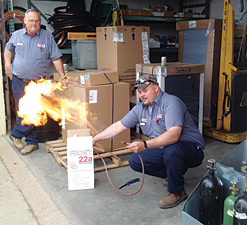
| This photo was supplied to The NEWS by contractors from the Lafayette, Ind., area, who were concerned over the sale of a 95 percent propane/butane product promoted for retrofitting into R-22 systems, the demonstrators show the flammability potential. (The NEWS recommends the use of safety goggles when handling refrigerants.) |
The road to wider use of HC refrigerants remains a rocky one — although it is still being navigated. The latest developments involve more revisions to the regulatory landscape, the tweaking of a refrigerant mix to make it more energy efficient in certain applications, and, as always, warnings about flammability.
Revisions in Canada
Environment Canada, a government agency set up for coordinating environmental policies and programs, accepted comments through the first quarter of 2013 regarding proposals to revise federal halocarbon regulations first established in 2003. The focus is on recovery; requirements regarding the keeping of service logs; issues related to the release of HCs; and the installation, servicing, leak-testing, and charging of systems using the refrigerant.
Some of the specifics include allowing a system to be out of commission for just up to 12 months before the HC has to be recovered, required service logs for everything except small refrigeration and air conditioning systems, a requirement that a release of more than 220 pounds of an HC be reported to Environment Canada within three days, and a prohibition on using HCs for leak detection unless allowed in certain clearly defined instances.
Refrigerant Tweak
Israel-based Galkor Energy Systems is working on what it called “new refrigerants based on natural hydrocarbons.” The company said the products, which it is calling C3 and C4, have been developed using specific additives or oxygenated organic compounds.
The new refrigerants have the same environmental indicators like basic organic hydrocarbons (i.e., have zero ODP [ozone depletion potential] and minimal GWP [global warming potential]), but exceed them in energy (provide much more efficient thermodynamic cycle) and operational (e.g., lower flammability) performance.
The company claimed its preliminary tests “have shown a significant increase in the energy efficiency of operating an air conditioner with the new refrigerant based on C3 in comparison to operating the air conditioner on pure hydrocarbon.”
The company further noted it is in the process of developing a heat pump that will enable the use of the refrigerant in medium-to-large air conditioning and refrigeration systems as well as stand-alone heat pumps for space and water heating.
Looking for quick answers on air conditioning, heating and refrigeration topics? Try Ask ACHR NEWS, our new smart AI search tool. Ask ACHR NEWS
In an executive summary made available to The NEWS, the company described the familiar basics of the refrigeration cycle then pointed out how its new technology addresses oil-related issues in the cycle to provide the increased efficiency.
“In the vast majority of modern air conditioners and heat pumps, a reverse vapor compression thermodynamic cycle is performed, where circulating refrigerant undergoes a phase transition (gas-liquid-gas-liquid ...) while the heat transfer from cold to hot occurs.
“The main element of the device — the compressor — is the booster of the refrigerant in the cycle. Special oils are used for lubrication and sealing of the rubbing parts of the compressor. The oils are inevitably carried by the refrigerant into the tubes and interior of two heat exchangers: the condenser (‘hot’ heat exchanger) and the evaporator (‘cold’ heat exchanger).
“As a result, an oil film is deposited on the inner surface of the heat exchangers. The oil film is partially washed out by the refrigerant, while the refrigerant is in the liquid phase, but mostly stays on the surface, where the refrigerant is in a gaseous phase. The presence of oil film on the surface significantly reduces the heat transfer between the refrigerant and the cooled (heated) environment and, therefore, negatively affects the energy efficiency of the unit (air conditioner, heat pump).”
The new refrigerant dissolves the oil and promotes the removal of the insulating oil film from the inner surface of the heat exchangers where the refrigerant is mainly in the gaseous phase, thus ensures an improvement in the device’s efficiency.
Flammable Issues
While propane is a familiar product for backyard gas grills, its use as a refrigerant is still a work in progress. That’s why segments of the HVACR industry in the U.S. have been concerned over the introduction in supply stores of a product labeled as Frost22a, made by BlueSky Solutions Inc. of Champaign, Ill. Part of the marketing uses terms like “Why Switch from the Traditional R22 Refrigerants — Do it Yourself! — No license Required.”
The product is about 95 percent butane and propane — both HC refrigerants. There are websites that contain statements from users that it can be successfully retrofitted into air conditioning units. But in general the HVACR industry is opposed to the products in R-22 retrofit applications because of safety concerns over the flammability of the HC-based product and its proposed use in a system designed for HCFCs or HFCs, for that matter.
For example, an industry flier sent to wholesalers and contractors stated, “HVAC recovery equipment is not designed to safely recover flammable gases. Homeowners may be topping off their own equipment with this flammable mixture. Any gas that has been recovered with 22a will probably incur fine (if sent to) reclaimers.” The flier urges contractors before servicing to ask customers if they have used Frost22a, to check the area with a combustible gas detector, and purge the system with nitrogen before using a torch.
Now the industry concern has been joined by fire department officials. For example, the Lafayette, Ind., fire department issued a statement encouraging people not to use the product in refrigeration or air conditioning applications.
One official said, “Propane makes a very good refrigerant, but in the U.S. our (HVACR) equipment isn’t built to use it.” The official noted that propane is heavier than air, so it can sink to the lowest point and collect there. That means that if it is retrofitted into an R-22 residential air conditioner, the refrigerant could settle into a coil that sits near the furnace in the basement. If there was a leak at that point, the propane could drop into the furnace near the unit’s ignition source.
That development appeared to have results in that part of the country. According to information supplied to The NEWS, the local fire marshal told store owners carrying the product that the product was to be stored outside the business and must be stored like propane tanks in a cage or in an explosion proof building. It was reported that the local stores have sent all the product back to the distribution center.
Publication date: 7/1/2013
Want more HVAC industry news and information? Join The NEWS on Facebook, Twitter, and LinkedIn today!
Looking for a reprint of this article?
From high-res PDFs to custom plaques, order your copy today!