ACHR News
search
Ask ACHR NEWS AI
cart
facebook twitter instagram linkedin youtube
  • Sign In
  • Subscribe
  • Sign Out
  • My Account
ACHR News
  • NEWS
    • Breaking News
    • New HVAC Products
    • Featured Products
    • Manufacturer Reports
    • HVAC Data
    • Legislation
    • ACHR NEWS Centennial
  • RESIDENTIAL
    • Air Conditioners
    • Furnaces
    • Residential Heat Pumps
    • Ductless
    • Residential IAQ
    • Testing, Monitoring, Tools
    • Components & Accessories
  • COMMERCIAL
    • Air Handlers
    • Rooftop Units
    • Chillers and Cooling Towers
    • Commercial Heat Pumps
    • Boilers and Hydronics
    • VRF/Ductless
    • Commercial IAQ
  • REFRIGERATION
    • Refrigerants
    • Refrigerant Regulations
    • Leak Management
  • CONTRACTOR PRO
    • Geothermal
    • Homeowner Study
    • VRF and VRV Ductless
    • Unitary Trends
  • EDUCATION
    • Training and Education
    • Business Management
    • Service and Maintenance
    • Continuing Education
    • Market Research >
      • HVAC Brand Awareness Report
      • VRV, VRF, VRVZ Report
      • Unitary Trends Report
      • Water Heat Professionals Report
    • Webinars
    • Sponsor Insights
    • eProducts Info
    • White Papers
  • EVENTS
    • HVAC Contractor Forum
    • Industry Events and Webinars
  • MEDIA
    • Videos
    • AHR Expo 2025 Videos
    • Podcasts >
      • ACHR News Podcast
      • HARDI Podcasts
      • AHR Expo Podcasts
      • ACCA Podcasts
    • Interactive Spotlights
    • Quizzes
    • eBooks
    • HVAC Talkback
  • HVAC GROUP
    • ACHR NEWS >
      • Current Issue
      • Digital Edition
      • Subscribe
    • Distribution Trends
    • SNIPS NEWS >
      • Join SNIPS NEWS
    • Engineered Systems News >
      • Join ES News
    • HVACR Directory
    • Contests
    • Newsletters
    • Contact
    • Advertise
    • My Account
HVAC ContractingService and Maintenance

Btu Buddy 43: A Smoking Oil Furnace

By Bill Johnson
October 23, 2006
Bob is a service technician who is well trained and nationally certified. However, he sometimes suffers from the same confusion that all technicians occasionally do - the facts that he gathers may or may not point to the obvious cause of the problem or the best solution. But Bob has something that no one else has. He recalls his long-time HVACR mentor and imagines him accompanying him as "Btu Buddy," someone who reminds him to take time to stop and think before rushing to judgment, helping keep him on the right track, even with facts that are confusing.

The weather was getting to feel like fall and people were beginning to start their furnaces in the morning when Bob got a call from the dispatcher saying that a customer was smelling smoke and oil fumes from her oil furnace in the basement. Bob called the customer and told her to shut the furnace off until he could get there and check it out.

Bob arrived and talked to the customer who led him to the basement where the upflow oil furnace was located. He could still smell the oil fumes. He shut off the switch at the furnace and went to the room thermostat and set the thermostat to call for heat. Then he could operate the furnace from the basement switch when he wanted it to run.

Bob turned on the switch and the furnace started up normally. Within a few seconds, oil smoke began to seep from around the burner flange and the inspection door to the burner. He shut it off before it became too hot.

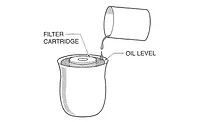
Bob thought to himself that this is a classic case of needing a burner tune-up. He went to his truck and brought in his oil burner tools. He removed the burner and set it on the floor so he could change the nozzle. It had a 0.75 nozzle in the burner. Just as a precaution he checked the nameplate and the nozzle was correct. The nozzle looked old and stained so Bob knew he was on the right track. After changing the nozzle, he changed the oil filter, careful to place it in a small pan that he carried just for containing oil spills. He then filled the filter cartridge housing with fresh oil from a gallon of oil that he carried for this purpose. He knew that filling the cartridge with fresh oil would keep air from entering the system.

This was a two-pipe system so Bob fastened a gauge on the inlet to the pump and the outlet to the pump to verify the correct oil pressure. He was now ready for start up.

Bob turned the furnace on while looking at the gauges. They read 100 psig on the outlet and 3 inches of vacuum on the inlet. He was thinking what a great job he had done when all of a sudden smoke began to form again in the same places. Now, his confidence went out the window. He knew that all oil furnaces need to have a routine nozzle and filter change. He had made sure the burner was tight against the flange, yet he still had smoke in the area. Btu Buddy appeared and asked, "What is the trouble, Bob?"

Bob went over all that he had done.

Looking for quick answers on air conditioning, heating and refrigeration topics? Try Ask ACHR NEWS, our new smart AI search tool. Ask ACHR NEWS →

Btu Buddy said, "You did the right thing in changing the nozzle and filter. That needed to be done. But you are not finished with this call. There are some other routine things that you owe the customer. Start with checking the draft over the fire. Then we will move on to a smoke test and a CO2 test for efficiency. I see that you have all of the instruments to do this."
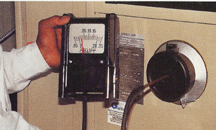
Figure 1. This figure shows a draft gauge that is being hand held. It actually should be placed on a level solid surface, not hand held. (Figures are from Refrigeration & Air Conditioning Technology, 5th Edition, by William Whitman, William Johnson, and John Tomczyk, published by Thomson Delmar Learning.)
Bob set his draft gauge on a level space and set it to 0 (Figure 1). Then he placed the probe in the furnace access door and started the furnace. In just a few seconds, the draft gauge showed a positive pressure. Bob said, "This system is showing a positive pressure. It is not drafting."

Btu Buddy asked, "What do you think the problem may be, and what are you going to do first?"

Bob said, "I am going to loosen the flue connector to the chimney and look in there and see what I can see."

Bob loosened the connector and saw that it was clean; this had not been going on for long. He then shined a light into the furnace and it was not very dirty - no soot accumulation - verifying that the problem was new. He then shined the light into the chimney and saw some straw at the bottom. He took a mirror and looked up the chimney. He could see light, but not much.

Bob put a ladder on the side of the house and went up on the roof. He shined his light down the chimney and saw the problem. There was a bird nest partway down that was partially blocking the chimney.
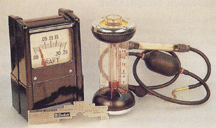
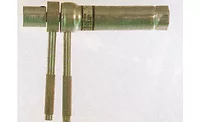
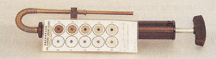
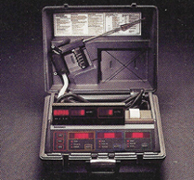
Figure 2. Here are some instruments that may be used to check CO2 and efficiencies for oil and gas furnaces. Some of these are purely mechanical devices, such as Figure 2-A (above) which shows a draft gauge, nozzle gauge, and CO2 tester, and Figure 2-B (below) which shows a smoke tester. Figure 2-C (bottom) is an electronic instrument that will serve the same purposes.
Bob went to his truck to figure out how to remove the bird nest. He didn't really want to push the nest to the bottom, so he took a piece of stiff wire and fastened it to his flue cleaning rod and bent it to look like a fish hook. He went back to the roof and hooked the nest and pulled it out. Now he also had something that he could show to the homeowner.

Bob then went to the furnace and started it up again. The furnace started and did not smoke. The draft gauge showed 0.02 inches of draft, which is a good draft for over the fire.

Btu Buddy then said, "It is time to perform the rest of the testing, a smoke test and a CO2 test."

Bob did a smoke test and it showed no smoke. The CO2 test showed 13 percent CO2 which is very good. The flue temperature was 510 degrees and the temperature of the basement was 65 degrees, a net flue temperature of 445 degrees, and the efficiency was over 75 percent. Figure 2 shows tools for taking these readings. All was well.
Bob then showed the nest to the homeowner and explained to her that he did a complete fall tune-up and on his report he showed the readings that he had taken. He advised her that she needed to have some sort of protection installed on top of the chimney to prevent more bird nests; they would likely return to the same place next year. She told Bob that she knew who to call to get that set up and would do it before spring.

While Bob was driving away, Btu Buddy said, "You tried to take a shortcut back there and proved to yourself that shortcuts don't pay."

Bob said, "You are right. I assumed that a tune-up would solve all of the problems."

Btu Buddy then said, "It is always best to run an efficiency test and smoke test. They take a little more time, but now you know the system is in good shape and you verified it in a written report to the customer. That builds customer confidence in you and your company."

Bob said, "Again, thanks for helping me become a professional."

Publication date: 10/23/2006

Share This Story

Looking for a reprint of this article?
From high-res PDFs to custom plaques, order your copy today!


Active in the HVACR industry since the 1950s, Bill Johnson graduated in gas fuel technology and refrigeration from the Southern Technical Institute, a branch of Georgia Tech (now known as Southern Polytechnic Institute). He taught HVAC classes at Coosa Valley Vocational & Technical Institute for four years. He moved on to become service manager for Layne Trane, Charlotte, N.C. He taught for 15 years at Central Piedmont Community College, part of this time as program director. He had his own business for five years doing installation and service work. Now retired, he is the author of Practical Heating Technology and Practical Cooling Technology, and continues as a co-author of Refrigeration & Air Conditioning Technology, seventh edition, all published by Delmar Cengage Learning. For more information, he can be reached at 704-968-0000 or thebillj1@gmail.com.

Btu Buddy Notebook is a collection of more than 50 service call scenarios in book form covering both cooling season and heating season troubleshooting. For more information and to purchase the book, visit the HVACR Industry Store.

Recommended Content

JOIN TODAY
To unlock your recommendations.

Already have an account? Sign In

  • HVAC-enrollment

    The Trades Are Back: HVACR Programs See Nearly 30% Enrollment Spike

    A new wave of future technicians is entering the pipeline.  
    News
    By: Matt Jachman
  • 2025 Top 40 Under 40

    2025 Top 40 Under 40 HVACR Professionals List

    The 11th annual Top 40 Under 40 list highlights those...
    HVAC Residential Market
    By: Hannah Belloli-Oster
  • LG Ductless Mini-Split Systems

    The 9 Types of Heat Pumps

    As the U.S. moves toward electrification, heat pumps are...
    HVAC Residential Market
    By: Joanna R. Turpin
Subscription Center
  • Create an Account
  • Start a Subscription
  • Manage My Account
  • Sign Up for Newsletters
  • Visit Customer Service
  • Update Preferences

More Videos

Sponsored Content

Sponsored Content is a special paid section where industry companies provide high quality, objective, non-commercial content around topics of interest to The News audience. All Sponsored Content is supplied by the advertising company and any opinions expressed in this article are those of the author and not necessarily reflect the views of The News or its parent company, BNP Media. Interested in participating in our Sponsored Content section? Contact your local rep!

close
  • Piggy Bank
    Sponsored byWatercress Financial

    Energy Prices, Inflation, and HVAC: What Today’s Homeowners Care About

  • Refrigerated Food
    Sponsored bySolstice Advanced Materials

    R-455A Refrigeration: A Cold Storage Solution for the Future

  • Airex Rooftop Units
    Sponsored byAirex Manufacturing Inc

    Consolidating Roof Penetrations: A Growing Trend in Multifamily HVAC Design

Popular Stories

HVAC-Price-Increase-graphic

HVAC Price Increase List: June 2026

Trump-Section-232.jpg

Trump Reduces Section 232 Tariffs on HVAC Equipment to 15%

R410A-Refrigerant-Cylinder.jpg

Refrigerant Recovery is a Revenue Opportunity

Heat-pump-cutaway.jpg

PFAS Rules and A2L Building Codes Continue to Evolve

Kroger.jpg

Kroger to Spend $100 Million to Reduce Refrigerant Leaks

View The ACHR NEWS
Centennial Anniversary Timeline

The ACHR News Timeline Chart
Submit a Letter
Submit a letter to our editors.

Events

November 6, 2025

Next-Gen Data Center Cooling: HVAC Innovation and Real-World Solutions

On Demand As AI workloads and high-density computing push traditional cooling methods to their limits, the data center industry is accelerating the adoption of next-generation HVAC technologies.

June 9, 2026

Before You Go All In on AI: Set Up Your Business to Actually Win

In this webinar, we'll walk you through exactly what to get in place before you add AI to your business. You'll leave with a clear picture of where you stand today and a practical action plan to set yourself up for real results.

View All Submit An Event

Poll

Summer Staff

Are you fully staffed for the summer season?
View Results Poll Archive

Products

BNI Mechanical/Electrical Square Foot Costbook, 2026 Edition

BNI Mechanical/Electrical Square Foot Costbook, 2026 Edition

See More Products
A2L Refrigerants - Free Webinar - May 21, 2026

Related Articles

  • This shows a technician filling the oil filter cavity after changing the filter cartridge.

    Btu Buddy 154: Frozen Oil Line on Oil Furnace

    See More
  • Btu Buddy 61: Servicing an Old Oil Furnace

    See More
  • Fig 1

    Btu Buddy 168: Oil Furnace Burner Malfunction — Part 1

    See More

Related Products

See More Products
  • A-Heat-Pump-Thats-Not-Delivering-Any-Air-DVD-Cover-218x300.jpg

    A Heat Pump That’s Not Delivering Any Air

  • A-Heat-Pump-That-Won__t-Cool-DVD-Cover-214x300.jpg

    A Heat Pump That Won't Cool

  • Lessons Learned in a Boiler Room: A common sense approach to servicing and installing commercial boilers

See More Products

Related Directories

  • Dornback Furnace Div.

    Residential and light commercial gas, and oil-fired warm air furnaces, barometric draft controls, electronic air cleaners, humidifiers, unit heaters, infrared heaters and gas and oil burners and waste oil heaters.
  • BVA Oils

    Our complete line of products is available for export. Most common is our refrigeration, A/C, and our ammonia line of lubricants. BVA also has a line of synthetic lubricants for green refrigerants.
×

Sign Up. Stay Informed.

The #1 trusted source for the HVACR industry since 1926

SUBSCRIBE
  • RESOURCES
    • Advertise
    • Contact Us
    • Advisory Board
    • Classifieds
    • Submit a Letter
    • Directories
    • Store
  • ACCOUNT CENTER
    • Create an Account
    • Start a Subscription
    • Manage My Account
    • Sign Up for Newsletters
    • Visit Customer Service
    • Update Preferences
  • SERVICES
    • Marketing Services
    • Reprints
    • Market Research
    • List Rental
    • Survey/Respondent Access
  • STAY CONNECTED
    • LinkedIn
    • Facebook
    • Instagram
    • YouTube
    • X (Twitter)
  • PRIVACY
    • PRIVACY POLICY
    • TERMS & CONDITIONS
    • DO NOT SELL MY PERSONAL INFORMATION
    • PRIVACY REQUEST
    • ACCESSIBILITY

Copyright ©2026. All Rights Reserved BNP Media, Inc. and BNP Media II, LLC.

Design, CMS, Hosting & Web Development :: ePublishing