Refrigeration
January 9, 2012
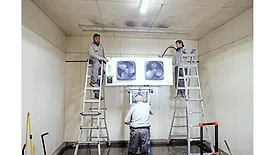
Longo’s Supermarkets needed an environmentally friendly, cost-effective warehouse refrigeration, Neelands Refrigeration Ltd. and Hill Phoenix® had an answer.
Read More
January 9, 2012
Ultra-low temperature systems are used to achieve low temperature baths or boxes for laboratory use, storage of pharmaceutical or biological samples, low temperature manufacturing of metals, or extreme temperature environmental testing.
Read More
January 9, 2012
Thermodynamics, as with most concepts in science and physics, is most accurately described using mathematical equations. This article is an attempt to simplify these concepts.
Read More
December 12, 2011
Efforts to make CO2 work in transcritical applications got a boost with the announcement the CSC, The Canadian manufacturer of refrigeration systems, will be making a major push in that regard.
Read More
December 5, 2011
“The sky isn’t falling. There are plenty of options.” Those words are from Rajan Rajendran, director of engineering services for Emerson Climate Technologies to an audience of supermarket engineers at the Food Marketing Institute Energy & Store Development Conference.
Read More
December 5, 2011
While there are no pending regulations that would curb production of HFCs, those specific refrigerants are a part of the equation when talk turns to the broad, emotionally laden topic of global warming.
Read More
December 5, 2011
In the category of “as California goes, so goes the rest of the nation,” the HVACR industry has been closely watching the impact of what is being called “the nation’s first comprehensive regulation to reduce potent greenhouse gases from commercial and industrial refrigeration.”
Read More
December 5, 2011
No technology has stirred up more attention in recent years than use of carbon dioxide (CO2) as a refrigerant in both stationary and mobile HVACR applications. And yet the technology has more people head scratching over it in terms of dealing with the pressures, efficiencies, installation costs, and servicing skills.
Read More
December 5, 2011
Whether or not HCs become major refrigerant players in the U.S. depends on who you talk to. Advocates point to extremely lower global warming potential, low cost, and a proven track record in Europe and Asia. Others see the flammability issue, A3 safety rating, and current building and fire codes limiting use to smaller applications.
Read More
December 5, 2011
While troubleshooting or installing refrigeration systems using a thermostatic expansion valve, it is a relatively common task to measure the superheat value of the refrigerant leaving the evaporator. However, there is a major consideration when using this measurement to analyze the operation of a system.
Read More