ACHR News
search
Ask ACHR NEWS AI
cart
facebook twitter instagram linkedin youtube
  • Sign In
  • Subscribe
  • Sign Out
  • My Account
ACHR News
  • NEWS
    • Breaking News
    • New HVAC Products
    • Featured Products
    • Manufacturer Reports
    • HVAC Data
    • Legislation
    • ACHR NEWS Centennial
  • RESIDENTIAL
    • Air Conditioners
    • Furnaces
    • Residential Heat Pumps
    • Ductless
    • Residential IAQ
    • Testing, Monitoring, Tools
    • Components & Accessories
  • COMMERCIAL
    • Air Handlers
    • Rooftop Units
    • Chillers and Cooling Towers
    • Commercial Heat Pumps
    • Boilers and Hydronics
    • VRF/Ductless
    • Commercial IAQ
  • REFRIGERATION
    • Refrigerants
    • Refrigerant Regulations
    • Leak Management
  • CONTRACTOR PRO
    • Geothermal
    • Homeowner Study
    • VRF and VRV Ductless
    • Unitary Trends
  • EDUCATION
    • Training and Education
    • Business Management
    • Service and Maintenance
    • Continuing Education
    • Market Research >
      • HVAC Brand Awareness Report
      • VRV, VRF, VRVZ Report
      • Unitary Trends Report
      • Water Heat Professionals Report
    • Webinars
    • Sponsor Insights
    • eProducts Info
    • White Papers
  • EVENTS
    • HVAC Contractor Forum
    • Industry Events and Webinars
  • MEDIA
    • Videos
    • AHR Expo 2025 Videos
    • Podcasts >
      • ACHR News Podcast
      • HARDI Podcasts
      • AHR Expo Podcasts
      • ACCA Podcasts
    • Interactive Spotlights
    • Quizzes
    • eBooks
    • HVAC Talkback
  • HVAC GROUP
    • ACHR NEWS >
      • Current Issue
      • Digital Edition
      • Subscribe
    • Distribution Trends
    • SNIPS NEWS >
      • Join SNIPS NEWS
    • Engineered Systems News >
      • Join ES News
    • HVACR Directory
    • Contests
    • Newsletters
    • Contact
    • Advertise
    • My Account

The Super Small Leak

By Peter Powell
October 2, 2006
The organosilanes approach to leak sealing can be used in conjunction with fluorescent dye.

Dealing with super-small refrigerant leaks is a challenge, especially when it comes to making repairs. But with the cost of refrigerants rising, such procedures become more and more important.

One approach introduced in recent years has been to inject a formulation of organosilanes directly into the system regardless of where the leak might be located. The solution flows throughout the system as a liquid with the refrigerant and oil. When it reaches a small leak it exits the system at that point. Atmospheric moisture then causes it to crystallize and form a bond.

It is a process that is gaining greater attention.

Here, for example, are three case histories showing how servicing is done with the product, how it can be incorporated into an overall company policy regarding its use, and how distributors can better inform their contractor customers about this option in leak repair.

THE METHOD

David Keivel, of Comfort Solutions Heating & Air-Conditioning in Dayton, Ohio, adapted this sealant approach as a way to offset the claim by some other contractors that the only way to deal with small leaks in residential units is with an annual "shot" of refrigerant rather than attempting to make a repair.

"I explain to the customers how the sealant (in this case made by Cliplight Mfg. of Toronto under the brand name SuperSeal HVACR) works, and they're quite appreciative of the procedure especially when they see the money they're saving over the long run," he said.

He said he was skeptical at first but noted that the first few systems he started up this spring "have been running flawlessly." To date, he has repaired more than 20 leaking air conditioners with the product.

"I make sure the customer realizes I've saved them money by repairing a slow leak because refrigerant prices will always go higher," he said. "They also appreciate the environmental aspect that their system is no longer releasing refrigerants into the atmosphere."

When a unit is a pound or more low on refrigerant over the course of a year, he uses an electronic leak detector. He noted leaks are usually in an inaccessible area such as interior portions of coils.

Looking for quick answers on air conditioning, heating and refrigeration topics? Try Ask ACHR NEWS, our new smart AI search tool. Ask ACHR NEWS →

After ensuring the system is free of moisture and contaminants, Keivel injects a 3-ounce can of the product, which he keeps in stock on his truck and is designed for systems from 1 ½ to 5-tons. (For larger systems, Cliplight has Seal 3-Phase, which Keivel also has for possible use with commercial customers having a leaking chiller, condenser or other large components).

Keivel hooks up the vacuum-packed can with the charging hoses that come with the product to the low-pressure side of the system. After purging the air out the hose, the can is pierced to allow refrigerant to enter the can and mix with the sealant. Turning on the unit draws the sealant into the system where it moves freely with refrigerant and without damage to components, according to Keivel.

On only one occasion so far has the hole been too large and therefore unable to be sealed with this method, he said. (Cliplight's specifications designate that only holes of 300 microns and smaller can be effectively sealed with the SuperSeal product 99 percent of the time. The company also recommends attempting to find the leak and fixing it conventionally before using the sealant as a last resort for inaccessible leaks or hard-to-find leaks.)

So far, Keivel has only used electronic sniffers to find leaks, but said he is planning to use the sealant in conjunction with fluorescent dye and UV leak detection systems, especially with today's newer systems using R-410A.

State Automatic Heating & Cooling in Batavia, Ill., is one of the companies involved in offering customers an injection process to seal small leaks.

THE MARKETING

Losing impatient customers was the concern of Jim Gates, president of State Automatic Heating & Cooling in Batavia, Ill. So he established a company-wide policy for central air conditioning leak detection and repair.

Typically, a leaking condenser or evaporator coil results in two or more trips to the site involving hours of leak detection, component repair or replacement, and refrigerant recharging. State still offers that service, but it also offers the option of sealing the system with SuperSeal, usually at about 50 percent of the cost of the other more conventional approach, said Gates.

"Sealing the system saves customers money, but more importantly the service crew is tied up only an hour or two instead of a day or more, which is critical during the start up season."

The new leak detection/repair policy requires all service techs to first search for field installation-related leaks with bubble soap and electronic leak detectors around brazes and joints at visible, accessible connections with hopes that a leak can be located and repaired quickly. If the leak isn't found, the service technician can then offer the homeowner two options:

  • A system pumpdown with a recovery unit, high-pressure nitrogen leak detection, and use of ultrasonic equipment followed by component repair or replacement.

  • Inject the sealant and recharge the system with R-410A.

    Gates said that in most cases the customers choose the sealant route, although he tells them there are no guarantees with that approach. He does maintain records showing that of the 34 applications of the sealant since 2004, all but one has remained sealed. (He said the unsuccessful one was because of holes too large for sealing caused by damage in an underground line-set put in by another contractor.)

    "The sealant option sells itself by product brochures (carried on all techs' trucks) combined with explanations of the great record we've had with 33 previous applications. Plus, if their systems develop another leak, the sealant will probably seal it as it occurs because it stays in the system and continues working."
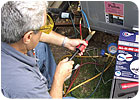
    Injecting a formulation of organosilanes into a system is a new technology to seal small leaks.

    DISTRIBUTOR PERSPECTIVE

    Like most distributors, cfm Distributors of Kansas City, Mo., find some contractors reluctant to try new things. So many new products are first tried and tested in one or more of the company's five buildings before they are promoted to the contractor customer.

    For example, at the Wichita, Kan., branch, a unit from a ductless mini-split air conditioning line the company carries operates for showroom cooling, service techs' malfunctioning electronics are tested at the counter with a multimeter the distributor sells, and rooftop air conditioners that were once leaking R-22 have been repaired using the SuperSeal product stocked by the supply house.

    Such an approach pays off, according to Rick Swenson, manager of the Wichita branch.

    For example, he said, "In the case of refrigerant sealants, many service techs are skeptical of putting in anything but oil and refrigerant. But when you show them solid evidence that a sealant stopped a refrigerant leak on your equipment without damaging components, they are more apt to try it."

    Publication date: 10/02/2006

  • Share This Story

    Looking for a reprint of this article?
    From high-res PDFs to custom plaques, order your copy today!


    Peter Powell is Refrigeration Editor. He can be contacted at 815-654-7270 or peterpowell@achrnews.com. Peter was formerly Editor/Publisher of Service & Contracting, where he gained his refrigeration experience. Among his duties, Powell is responsible for the monthly Refrigeration Zone sections in The NEWS

    Recommended Content

    JOIN TODAY
    To unlock your recommendations.

    Already have an account? Sign In

    • HVAC-enrollment

      The Trades Are Back: HVACR Programs See Nearly 30% Enrollment Spike

      A new wave of future technicians is entering the pipeline.  
      News
      By: Matt Jachman
    • 2025 Top 40 Under 40

      2025 Top 40 Under 40 HVACR Professionals List

      The 11th annual Top 40 Under 40 list highlights those...
      News
      By: Hannah Belloli-Oster
    • LG Ductless Mini-Split Systems

      The 9 Types of Heat Pumps

      As the U.S. moves toward electrification, heat pumps are...
      Heat Pumps
      By: Joanna R. Turpin
    Subscription Center
    • Create an Account
    • Start a Subscription
    • Manage My Account
    • Sign Up for Newsletters
    • Visit Customer Service
    • Update Preferences

    More Videos

    Sponsored Content

    Sponsored Content is a special paid section where industry companies provide high quality, objective, non-commercial content around topics of interest to The News audience. All Sponsored Content is supplied by the advertising company and any opinions expressed in this article are those of the author and not necessarily reflect the views of The News or its parent company, BNP Media. Interested in participating in our Sponsored Content section? Contact your local rep!

    close
    • Piggy Bank
      Sponsored byWatercress Financial

      Energy Prices, Inflation, and HVAC: What Today’s Homeowners Care About

    • Refrigerated Food
      Sponsored bySolstice Advanced Materials

      R-455A Refrigeration: A Cold Storage Solution for the Future

    • Airex Rooftop Units
      Sponsored byAirex Manufacturing Inc

      Consolidating Roof Penetrations: A Growing Trend in Multifamily HVAC Design

    Popular Stories

    Refrigerants-and-gauge.jpg

    HVAC Industry Warns of Counterfeit Refrigerants Entering U.S. Supply Chain

    U.S. Supreme Court building

    95% Furnace Efficiency Rule to Get New Hearing

    Midea-training.jpg

    HVAC Workforce Crisis Expands Beyond Technicians to Instructor Shortages

    Data_Center_facility.jpg

    HVAC Manufacturers Respond to Growing Data Center Backlash

    HVAC Minute retail refrigeration system

    EPA Final Rule’s Impact on R-410A Deadlines

    View The ACHR NEWS
    Centennial Anniversary Timeline

    The ACHR News Timeline Chart
    Submit a Letter
    Submit a letter to our editors.

    Events

    November 6, 2025

    Next-Gen Data Center Cooling: HVAC Innovation and Real-World Solutions

    On Demand As AI workloads and high-density computing push traditional cooling methods to their limits, the data center industry is accelerating the adoption of next-generation HVAC technologies.

    June 23, 2026

    HVAC Duct Sealing Mastics: Why Selection Matters

    In this webinar we will detail what HVAC material buyers and technicians need to know when selecting duct mastics, including matching mastic to substrate, alternatives to liquid mastic, and where UL 181 Listings fit into real world installations.

    View All Submit An Event

    Poll

    Summer Staff

    Are you fully staffed for the summer season?
    View Results Poll Archive

    Products

    BNI Mechanical/Electrical Square Foot Costbook, 2026 Edition

    BNI Mechanical/Electrical Square Foot Costbook, 2026 Edition

    See More Products
    HVAC Duct Sealing Mastics: Why Selection Matters - Free Webinar - 6/23/2026

    Related Articles

    • California state Sen. Ricardo Lara noted that one of the key barriers to the adoption of low-GWP equipment is its high first cost, which the incentive program is trying to mitigate. - The NEWS - ACHR

      The Case of Natural Refrigerants Versus the ‘Super Pollutants’

      See More
    • SUNDAY - January 28, 2001: Purafil, Inc. Share The Fun At The Super Bowl Sunday Celebration

      See More
    • Innovations Range Small to Super-Sized

      See More

    Related Products

    See More Products
    • air came to a stop.jpg

      The Air Came to a Stop

    • new cover.jpg

      Profit is An Attitude: The Strategies You Need to Optimize Profits

    See More Products

    Events

    View AllSubmit An Event
    • January 14, 2026

      Future-ready HVAC Systems: Transitioning to A2L with New Gas Leak Sensors

      On Demand This session will explore how emerging approaches to leak detection and system monitoring are meeting the demands of modern refrigeration and HVAC applications.
    View AllSubmit An Event

    Related Directories

    • Spectronics Corp./Spectroline Leak Detection

      Established in 1955, Spectronics Corporation is the inventor of UV fluorescent leak detection technology and manufacturer of leak detection tools for AC&R systems. Our fluorescent dyes and system additives are OEM-grade, universal (POE), co-solvent free, and NSF-certified.
    • Super Radiator Coils

      SRC engineers and manufactures custom condensers, evaporators, fluid coils, steam coils and steam distributing coils for dozens of HVAC applications.
    ×

    Sign Up. Stay Informed.

    The #1 trusted source for the HVACR industry since 1926

    SUBSCRIBE
    • RESOURCES
      • Advertise
      • Contact Us
      • Advisory Board
      • Classifieds
      • Submit a Letter
      • Directories
      • Store
    • ACCOUNT CENTER
      • Create an Account
      • Start a Subscription
      • Manage My Account
      • Sign Up for Newsletters
      • Visit Customer Service
      • Update Preferences
    • SERVICES
      • Marketing Services
      • Reprints
      • Market Research
      • List Rental
      • Survey/Respondent Access
    • STAY CONNECTED
      • LinkedIn
      • Facebook
      • Instagram
      • YouTube
      • X (Twitter)
    • PRIVACY
      • PRIVACY POLICY
      • TERMS & CONDITIONS
      • DO NOT SELL MY PERSONAL INFORMATION
      • PRIVACY REQUEST
      • ACCESSIBILITY

    Copyright ©2026. All Rights Reserved BNP Media, Inc. and BNP Media II, LLC.

    Design, CMS, Hosting & Web Development :: ePublishing