Tech Tips for Thermostatic Expansion Valves

In a nutshell, the role of the TEV is to control liquid injection into an evaporator as a function of the load. The controlling parameter is superheat at the evaporator. As the load on the evaporator increases, the valve responds to an increase in superheat and opens to allow more liquid refrigerant to flow into the evaporator.
In so doing, the TEV maximizes the usable evaporator heat transfer surface and protects the compressor by making sure that only vapor returns to it.

Parts Of a TEV
A TEV consists of three basic parts: The power head, the capillary tube and bulb, and the body. To understand how the TEV functions, a closer look at each of the parts is necessary:The movement of the pushpins depends on the pressure on the diaphragm, which is opposed by the force of a spring. Spring force, which determines static superheat, can be fixed or adjustable.

How TEVs Work
The function of a TEV depends on the relationship between three fundamental pressures.Bulb charge pressure acts on the upper surface of the diaphragm, moving it in the valve-opening direction.
Two pressures oppose bulb pressure. Evaporating pressure is introduced by either internal or external equalization. This equalization pressure acts on the underside of the diaphragm in the valve closing direction. Note: Evaporat-ing and equalization pressures should always be the same.
Spring pressure also acts on the underside of the diaphragm in the closing direction. In a valve with adjustable superheat, the spring pressure can be adjusted manually.
As the expansion valve regulates, there is balance between bulb pressure on one side of the diaphragm and equalization pressure plus spring pressure on the other side. This balance can be upset in either of two ways:
1. When spring force is adjusted manually, there is a proportional change in the TEV’s static superheat.
Looking for quick answers on air conditioning, heating and refrigeration topics? Try Ask ACHR NEWS, our new smart AI search tool. Ask ACHR NEWS
2. A change in the cooling load will change the evaporating pressure of the refrigerant and hence the equalization pressure under the diaphragm. This change occurs in proportion to the change in temperature at the evaporator outlet tube where the bulb is strapped. Any change in pressure is transmitted from the bulb through the capillary tube to the diaphragm.
The balance of forces is disturbed until a new equilibrium is reached as more refrigerant is injected into the evaporator and the cooling load demand is met.
What is Superheat?
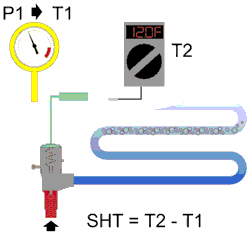
Physically, superheat is the temperature difference between the external pipe wall temperature and the evaporating pressure converted to temperature (saturation temperature) measured in °F. The level of superheat equals the temperature increase above the saturation temperature at the existing pressure.A vapor is superheated when its temperature is higher than the saturation temperature corresponding to its pressure. For example, R-22 at 70 psig has a saturation temperature of 41°, and if its temperature actually is 51°, it is said to be superheated by 10°.
With respect to valve operation, superheat has two distinct components:
1. Static superheat is the superheat at which spring force is met and the valve is ready to open.
2. Opening superheat is the amount of superheat above static superheat that opens the valve to allow refrigerant flow.
The superheat measured at the outlet of the evaporator is the sum of the two and is called operating superheat.
On valves with adjustable superheat, we are only changing spring force, and therefore only the static superheat. By adjusting the static superheat, however, we are effectively adjusting operating superheat. The opening superheat cannot be adjusted and is dependent on the system load or operating pressures as transmitted from the sensing bulb.

How to Measure Superheat
At the evaporator outlet, and adjacent to the bulb position, use accurate instruments to take measurements of the pressure and temperature of the refrigerant suction gas.1. Measure the suction pressure at the evaporator outlet (or, if there is no fitting there, at the compressor inlet service valve).
2. Clean an area of the suction line near the bulb.
3. Tape your thermocouple to the cleaned area and insulate it; connect the thermocouple to a calibrated electronic thermometer and read the temperature.
4. Convert the suction pressure to a temperature using a refrigerant slide rule or chart, and subtract the temperature measured near the bulb. The difference is the superheat.
A common but inaccurate method for determining superheat in the field uses evaporator inlet temperature instead of the saturated suction temperature equivalent to the evaporator outlet pressure. The problem with this method is its inaccuracy, which is most often due to misplacement of the inlet thermocouple or the inability to access the inlet at all.
TEV Installation
The TEV must be installed in the liquid line, ahead of the evaporator and as close to it as possible. The bulb is tightly strapped to the suction line, as close to the evaporator outlet as possible. The bulb will give false signals to the diaphragm if it is installed after a desuperheater or close to components with large mass, such as large valves or flange connections. Any evaporator with a distributor or with a significant pressure drop requires an externally equalized TEV. If the valve is externally equalized, the equalizing line must be connected, otherwise the valve will not operate. The equalization connection is made at a point in the suction line immediately after the bulb, and in a 12 o’clock position on the tube to avoid oil logging the equalizer line. Mount the TEV’s sensing bulb on a horizontal suction line tube at the outlet of the evaporator in a position between 12 and 4 o’clock. The location depends on the suction line diameter. Tubes smaller than 3/4 in. should have the bulb located at the 12 or 1 o’clock position; ¾- and 7/8- in. tubes require a bulb position at 2 o’clock; for tubes 1 in. and larger, the correct position is from 3 to 4 o’clock. Never locate the bulb at the bottom of the suction line because of the possibility of a false signal caused by oil lying there. For the same reason, the bulb must not be mounted in areas where the suction line is bent and may act as an oil trap, as on a riser. Remember that the optimum location is on a horizontal part of the suction line immediately after the evaporator outlet. The bulb must have good thermal contact with the suction line. (Danfoss valves with double-contact bulbs improve thermal conduction.) The bulb mounting strap transfers heat to the area of the bulb that is not in contact with the copper tubing. Never use plastic straps such as cable ties for bulb mounting. Time and temperature will loosen the plastic material; contact as well as heat transfer will be lost. The bulb mounting strap supplied by TEV manufacturers is made of heat-conductive material, and should always be tight, but not so tight as to deform the piping or bulb. Although not a requirement, if heat-conductive paste is available, you can use it on the contact surfaces to enhance heat transfer. Because it needs to be able to sense the temperature of superheated suction vapor, the bulb must not be located in a position where external heat or cold will affect it. Insulating the bulb will help, but in cases where the lines operate below 32°, the insulating material must be chosen to seal against moisture that might freeze around the bulb. Insulation of the bulb is also recommended if the bulb is exposed to a warm air current. On systems where a liquid distributor is used, remember that the TEV must be externally equalized, and the distributor should be mounted vertically, head outlets downward. It is extremely important that the feeder tubes from the distributor be of the same diameter and length. It is important to keep pressure drops across the distributor tubes as equal as possible for good liquid distribution. Avoid liquid traps when routing the distributor tubing. Piping must be carefully designed and executed to prevent any unwanted effects. For instance, where a circuit has multiple evaporators at different elevations, a higher evaporator can affect the TEV sensing bulb on a lower one. Also, in multi-fixture circuits, you may find situations where another technician has mislocated a sensing bulb so that it is actually reading the temperature of the common suction line rather than the evaporator it is meant to serve.Setting, Adjusting Superheat
All expansion valves are supplied with a factory superheat setting appropriate for most applications. TEVs with fixed superheat do not allow readjustment in the field. Other valves, though, are designed to allow field setting by adjusting the spring force.To adjust the static superheat, turn the valve’s setting stem. Turning clockwise increases static superheat and effectively reduces refrigerant flow through the valve. Turning counterclockwise reduces static superheat and increases refrigerant flow.
In addition to TEV sizing, correct superheat setting and proper sensing bulb positioning are two more of the many important determining factors for proper operation of an evaporator, and for compressor protection.
Superheat Problems
Expansion valves are often suspected of causing system problems. But generally speaking, a TEV is operating properly if it maintains superheat of 5° to 15°.If superheat is low (lower than 5°), there is a potential for flooding refrigerant back to the compressor. If superheat is higher than 15°F, the evaporator is probably operating inefficiently.
Stop Fiddling and Find the Problem
There are countless possible causes for problems in a system. Superheat is one of the last things we adjust.Expansion valves are designed and set by their manufacturers to serve as “plug-and-play” devices which, right out of the box, can operate effectively in a wide range of applications.
The temptation to adjust them is there because it is very easy to get to them before taking time to properly diagnose the refrigeration system. Unless there is absolute certainty of incorrect superheat, leave the TEV alone.
Here are some problem areas that can cause low and high superheat. These areas should be investigated before adjusting superheat.
Causes of low superheat include:
Causes of high superheat include:
If You Need to Adjust
Earlier we talked about the proper way to take a superheat reading. If the valve is adjustable, and if you determine that the superheat needs to be set (for example, because the system is hunting), prepare for the adjustment by ensuring that you have operational head pressure and a proper flow of refrigerant to the TEV, without flash gas.Next, ensure that there is a nominal (or design) load on the evaporator; use a dummy load if necessary. Now remove the stem cap to expose the adjustment stem.
Setting superheat is a trial-and-error procedure that will require several changes.
1. Adjust the valve to a point where you get unstable superheat readings, unless you have confirmed that the system has unstable superheat to begin with. (When superheat is unstable, the system is out of control and temperature and pressure are randomly fluctuating.)
2. Proceed to adjust the valve by turning the valve stem clockwise to increase superheat until the system is just stable. Then a further one-quarter to one-half turn clockwise will compensate for system variables during operation.
3. The valve manufacturer’s instructions give the number of stem turns per degree of superheat. You need to measure superheat after each adjustment, until the new value results in correct evaporator temperature under the nominal (or design) load.
4. Recheck the superheat under low-load conditions, too. Now you can be sure that the valve is set correctly.
When there’s a refrigeration problem, don’t start working on a remedy before making a careful diagnosis. Adjusting superheat without careful observation and measurement is asking for trouble.
The same goes for pumping down a system to replace the expansion valve, only to find out that the system is still not working. It wastes time and can be rather embarrassing.
But some systematic troubleshooting, examining system pressures and temperatures, will likely lead to a solid diagnosis, a timely solution, and a satisfied customer.
Strouboulis is application engineering manager and Robinson is market communication manager, Air-conditioning and Refrigeration Division, Danfoss Inc., Baltimore, MD. For further information, e-mail maxrobinson@ danfoss.com. Visit the company’s website at www.danfoss.com.
Publication date: 12/06/2000
Looking for a reprint of this article?
From high-res PDFs to custom plaques, order your copy today!