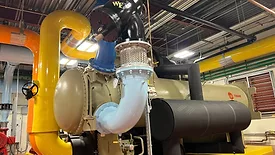
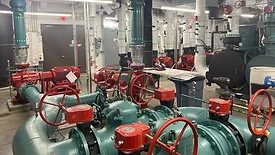
How Wake Forest University’s South Chiller Plant upgrade sets a new standard for campus infrastructure – boosting cooling capacity, preserving campus land, and blending cutting-edge engineering with iconic architecture.
This upgrade will replace major plant components, including chillers, cooling towers, primary pumps, and the energy-management system, with high-efficiency technology and artificial intelligence-ready automation.
Harnessing Trane’s systems knowledge and expertise, the chiller plant controller converts complex programming into a simplified, efficient solution that can be customized to meet unique needs, a press release from the company said.
Chillers use the principles of thermodynamics to remove heat from a conditioned space. But “chiller” is a broad term that encompasses system configurations, refrigeration technologies, and methods of rejecting captured heat. Experts take a closer look.
Campus physical plants that have become internets of things — requiring cloud-based management, machine learning, and visualization tools — could serve as more than unseen controllers of the classroom environment. They could be the classroom.
For buildings that have up to three chillers with a combined cooling capacity of 400 to 2,000 tons
October 4, 2016
Optimum Energy has released OptimumEDGE™, a patented, quick-start HVAC optimization solution designed to shave chiller plant energy use by 13 percent on average — and cut water use as well — without affecting building operations or occupant comfort, said the company.
Waste Management is seeing about a 100 kWh drop in monthly power utilization
August 3, 2015
Data centers continue to evolve and become more efficient. The need for efficient HVAC is essential to ensure cost-effective, reliable operation given servers generate significant amounts of heat. As part of a facility upgrade, Waste Management replaced its chiller plants to serve its production data center facility in Austin, Texas.
The Carrier ChillerVu plant control system is able to control Carrier 19, 23, or 30 series chillers (air- or water-cooled) and includes full integration capabilities, allowing it to monitor and control other equipment in the chiller plant, including non-Carrier chillers.