Troubleshooting tips for steam heat exchangers
In order to correctly diagnose problems, we must have a good understanding of the heat exchanger and components that make up the overall system.
Many different types of heat exchangers are available today, such as shell and tube, plate and frame, coil, tank heaters, and plate coils.
All of these designs use the same basic principles and use similar controls.
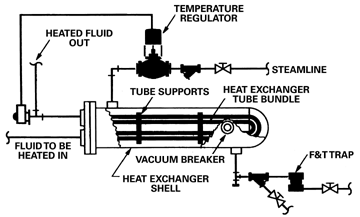
In the following examples, we will consider the shell-and-tube style, although most elements of our system will apply to all types of steam heat exchangers.
System function and 'stall'
Steam heat exchangers use steam to heat a fluid (water, glycol, oil, or some other process fluid) to a desired temperature. This can be done using a variety of methods, including:- Batch process: A vessel of fluid is heated to a set temperature over a period of time.
- Instantaneous: Fluid reaches a set temperature after passing once through the exchanger and is then pumped to a user location (e.g., domestic instantaneous hot water system). This type of set-up will create problems if a recirculation pump is used to maintain temperature in the lines. This recirculation load is a small fraction of full load and results with the exchanger opening at “high turndown” (a fraction of its design capabilities). See Figure 1.
-
Recirculation: Constant recirculation of a fluid for a process/industrial application (for example, quenching water for metal parts).
A steam heat exchanger should be sized for full-load operation. But any time a heat exchanger is forced to work at high turndown, the system can “stall” and encounter problems such as poor temperature control, water hammer, and corrosion.
This stall occurs because inlet pressure after the heat exchanger’s control valve is equal to (or less than) the back pressure after the steam trap.
Next week: System components, back pressure, and the effects of stall.
Looking for quick answers on air conditioning, heating and refrigeration topics? Try Ask ACHR NEWS, our new smart AI search tool. Ask ACHR NEWS
Looking for a reprint of this article?
From high-res PDFs to custom plaques, order your copy today!


