ACHR News
search
Ask ACHR NEWS AI
cart
facebook twitter instagram linkedin youtube
  • Sign In
  • Subscribe
  • Sign Out
  • My Account
ACHR News
  • NEWS
    • Breaking News
    • New HVAC Products
    • Featured Products
    • Manufacturer Reports
    • HVAC Data
    • Legislation
    • ACHR NEWS Centennial
  • RESIDENTIAL
    • Air Conditioners
    • Furnaces
    • Residential Heat Pumps
    • Ductless
    • Residential IAQ
    • Testing, Monitoring, Tools
    • Components & Accessories
  • COMMERCIAL
    • Air Handlers
    • Rooftop Units
    • Chillers and Cooling Towers
    • Commercial Heat Pumps
    • Boilers and Hydronics
    • VRF/Ductless
    • Commercial IAQ
  • REFRIGERATION
    • Refrigerants
    • Refrigerant Regulations
    • Leak Management
  • CONTRACTOR PRO
    • Geothermal
    • Homeowner Study
    • VRF and VRV Ductless
    • Unitary Trends
  • EDUCATION
    • Training and Education
    • Business Management
    • Service and Maintenance
    • Continuing Education
    • Market Research >
      • HVAC Brand Awareness Report
      • VRV, VRF, VRVZ Report
      • Unitary Trends Report
      • Water Heat Professionals Report
    • Webinars
    • Sponsor Insights
    • eProducts Info
    • White Papers
  • EVENTS
    • HVAC Contractor Forum
    • Industry Events and Webinars
  • MEDIA
    • Videos
    • AHR Expo 2025 Videos
    • Podcasts >
      • ACHR News Podcast
      • HARDI Podcasts
      • AHR Expo Podcasts
      • ACCA Podcasts
    • Interactive Spotlights
    • Quizzes
    • eBooks
    • HVAC Talkback
  • HVAC GROUP
    • ACHR NEWS >
      • Current Issue
      • Digital Edition
      • Subscribe
    • Distribution Trends
    • SNIPS NEWS >
      • Join SNIPS NEWS
    • Engineered Systems News >
      • Join ES News
    • HVACR Directory
    • Contests
    • Newsletters
    • Contact
    • Advertise
    • My Account

HEPA Filtration Key In Duct Cleaning

March 14, 2003
Liability is a major issue today in the HVAC industry. In particular, the emergence of liability issues related to mold contamination has increased the stakes for contractors, consultants, building owners, and insurers.

Studies have shown that more than two out of three IAQ problems involve the operation or maintenance of HVAC systems. Dirty ductwork and high humidity or moisture conditions can make these systems an ideal breeding ground for molds and other microbial contaminants that may be disturbed during the duct cleaning process.

Today, high-efficiency particulate arrestance (HEPA)-filtered vacuum units can provide duct cleaning professionals with the ability to capture microbial contaminants removed from the HVAC system, but it is essential that this equipment and the HEPA filters are designed and built to provide true HEPA operating efficiency.

Gas-Powered Equipment

From the 1950s until the late 1980s, most duct cleaning contractors used truck mounts, trailer mounts, and other gasoline-powered equipment for “source-removal” duct cleaning. This method involves the use of special compressed air tools to blast loose dirt and debris, and a vacuum unit to pull dislodged materials out of the building.

The unit is parked outside of the building. Long lengths of ducting are used to connect to the HVAC system.

Gas-powered systems are effective, but they can pose potential problems related to recontamination. Most units can exhaust the entire air volume of a home in less than 10 minutes, which can place the entire home under negative (lower) pressure compared to the air pressure outdoors.

Since these units often are equipped with low-efficiency filter bags, users must take care that fine particulates that pass through the bags are not drawn back into the lower pressure building.
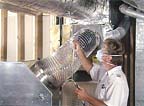
This tech is performing an air sweep in ductwork near an air handler.

HEPA-Filtered Vacuums

The development of electric-powered, portable duct cleaning vacuums eliminated the negative pressure recontamination issue. Since 1990, the vast majority of duct-cleaning professionals have opted to use electric units.

Like gasoline units, electric portable vacuums are used to place the ductwork under negative pressure. However, instead of pulling conditioned air outdoors, these units recirculate filtered air back into the building. Because the air is not exhausted from the building, electric units do not create negative pressure indoors.

However, in order to safely recirculate filtered air back into the occupied indoor space, it is essential that the vacuum’s filtration system be capable of capturing virtually 100 percent of the particulates pulled out of the duct system. This level of performance requires that the vacuum be equipped with a true HEPA filter to function as the last line of defense against potentially health-threatening contaminants. Use of a filter that does not meet HEPA performance requirements can have serious consequences.

Looking for quick answers on air conditioning, heating and refrigeration topics? Try Ask ACHR NEWS, our new smart AI search tool. Ask ACHR NEWS →

Testing helps to ensure that the HEPA filter has not been damaged in any way and that it is properly sealed to the unit. This filter is defective.

What Is A True HEPA Filter?

HEPA filters were originally developed for the Atomic Energy Commission during World War II to capture microscopic radioactive particles in facilities involved with the Manhattan (atomic bomb) Project. These filters are specified today for a wide range of critical filtration applications.

According to the most current definition, a HEPA filter is “an extended-medium, dry-type filter in a rigid frame, having a minimum particle-collection efficiency of 99.97 percent for 0.3-micron particles of thermally generated DOP (dioctyl phthalate) or specified alternate aerosol.”

To put 0.3-micron particle size in perspective, the diameter of a human hair is 50 to 200 microns. Most of us can’t see particles smaller than 10 to 20 microns.

To achieve a 99.97-percent efficiency rating, the penetration (leakage) of the test aerosol through the filter must not exceed 0.03 percent. In other words, no more than three out of 10,000 particles can pass through.

Close doesn’t count. For example, a 99.5-percent-efficiency filter might sound pretty good, but such a filter would allow almost 17 times more penetration than a true HEPA filter.

Would you want to disturb this? Dirty ductwork and high-moisture conditions can make HVAC systems ideal breeding grounds for molds and other microbial contaminants.

HEPA Regulations And Guidelines

Leading manufacturers of HEPA filters follow the Institute of Environmental Sciences and Technology (IEST) “Recommended Practices” governing HEPA filter manufacturing and testing. The most pertinent of these practices include:

  • IEST-RP-CC001.3 (HEPA and ULPA filters); and

  • IEST-RP-CC021.1 (Testing HEPA and ULPA filter media).

    There are six categories of HEPA filters under the IEST standards: Type A, B, C, D, E, and F. Minimum efficiency requirements range from 99.97 percent at 0.3 microns (Type A) to 99.999 percent at 0.1 to 0.2 microns (Type F).

    The IEST guidelines encompass a number of standards developed by other standards-generating organizations, including Underwriters Laboratories (UL), ASTM (American Society for Testing Materials), and ANSI (American National Standards Institute). For example, flammability requirements are specified in the UL900 standard. At a minimum, filters used in HVAC applications should meet UL900, Class II requirements.

    A filter that does not meet at least Type A IEST requirements cannot be accurately classified as a true HEPA filter. These requirements include:

  • True HEPA media — To build a true HEPA filter, the filter manufacturer must first start with true HEPA filter media in accordance with IEST-RP-CC021.1.

  • 100 percent testing of completed filters — Manufacturing a filter using HEPA media does not ensure that the completed filter meets HEPA requirements. Only 100 percent testing of the completed filters can enable the filter manufacturer to ensure users that the filter efficiency meets IEST requirements.

  • Filter labeling — Once tested, each filter must have a label affixed to it indicating the manufacturer, filter model/serial numbers, test airflow, pressure drop, airflow direction, and the percent penetration.

    Completed filter testing and labeling are the most crucial steps in the process, and the ones where shortcuts are most often taken. An untested filter could leak like a sieve due to breaches in the HEPA media or leakage between the pleated HEPA media pack and the filter frame.

    Particleboard-Frame Filters And Mold

    Particleboard-frame HEPA filters are not recommended for duct cleaning or for other HVAC applications. These filters are typically 20 percent to 30 percent less expensive than filters constructed with metal frames. However, this material has some significant inherent disadvantages in HVAC applications.

    First of all, particleboard can support microbial growth. It can also off-gas volatile organic compounds (VOCs) such as formaldehyde, and is subject to warping, swelling, and cracking when exposed to high moisture or humidity levels, or to temperature extremes.

    Since these conditions may be present in an HVAC system, and because these are precisely the conditions that generally accompany mold problems, metal frame filters are a must for duct-cleaning vacuums.

    Test The Machine

    Regular testing of the overall filtration efficiency of electric duct-cleaning vacuums is also a very good practice whenever the HEPA filter is replaced, or if the unit appears to be damaged in any way.

    Ongoing testing helps to ensure that the HEPA filter has not been damaged in any way, and that it is properly sealed to the unit. This testing can pinpoint specific problem areas, so filter leaks can be repaired prior to using the machine.

    Testing of the vacuum also helps ensure that problems unrelated to filter leakage have not compromised the overall integrity of the machine.

    Don’t Cut Corners

    Using substandard or untested filters can save a few bucks, but with all that is at stake, why risk it? Here are a few commonsense recommendations that could save you a lot of money and provide greater peace of mind:

  • Clearly specify that HEPA filters purchased for original equipment or as replacements meet IEST-RP-CC001.3 requirements for 99.97-percent efficiency, Type A HEPA filters.

  • Require your equipment supplier to certify in writing that the filters you purchase meet the IEST performance requirements. In particular, require certification from them that each and every completed filter has been individually penetration tested in accordance with IEST-RP-CC001.3.

  • Inspect incoming HEPA filters to ensure that they have been tested and labeled as required.

  • Purchase only HEPA filters authorized by the manufacturer for use in that device.

  • Make certain that all duct-cleaning vacuum filters are tested and certified to meet the flammability requirements of UL 900, Class II (including prefilters), and that the filters are so labeled.

  • Test HEPA filtration de-vices regularly and make necessary repairs before using the equipment.

  • Use only metal-frame HEPA filters in HVAC applications.

  • Add expanded metal face guards to protect the exposed side of the filter media. These guards help minimize damage to the media and are well worth the modest added cost.

  • Don’t be penny wise and pound foolish. As with automobiles, the quality, reliability, and performance of duct cleaning vacuums is all over the map. Use only quality products purchased from reputable manufacturers, and beware of bargain deals or used equipment.

    Here’s a good rule of thumb: If it seems like a deal is too good to be true, it probably is.

    Shagott is president of Abatement Technologies Inc. For more information, visit www.abatement.com and www.moldabatementproducts.com. Shagott can be reached at 800-634-9091 or iaqinfo@abatement.com.

    Publication date: 03/17/2003

  • Share This Story

    Looking for a reprint of this article?
    From high-res PDFs to custom plaques, order your copy today!


    Recommended Content

    JOIN TODAY
    To unlock your recommendations.

    Already have an account? Sign In

    • HVAC-enrollment

      The Trades Are Back: HVACR Programs See Nearly 30% Enrollment Spike

      A new wave of future technicians is entering the pipeline.  
      Training and Education
      By: Matt Jachman
    • 2025 Top 40 Under 40

      2025 Top 40 Under 40 HVACR Professionals List

      The 11th annual Top 40 Under 40 list highlights those...
      HVAC Commercial Market
      By: Hannah Belloli-Oster
    • LG Ductless Mini-Split Systems

      The 9 Types of Heat Pumps

      As the U.S. moves toward electrification, heat pumps are...
      News
      By: Joanna R. Turpin
    Subscription Center
    • Create an Account
    • Start a Subscription
    • Manage My Account
    • Sign Up for Newsletters
    • Visit Customer Service
    • Update Preferences

    More Videos

    Sponsored Content

    Sponsored Content is a special paid section where industry companies provide high quality, objective, non-commercial content around topics of interest to The News audience. All Sponsored Content is supplied by the advertising company and any opinions expressed in this article are those of the author and not necessarily reflect the views of The News or its parent company, BNP Media. Interested in participating in our Sponsored Content section? Contact your local rep!

    close
    • Piggy Bank
      Sponsored byWatercress Financial

      Energy Prices, Inflation, and HVAC: What Today’s Homeowners Care About

    • Refrigerated Food
      Sponsored bySolstice Advanced Materials

      R-455A Refrigeration: A Cold Storage Solution for the Future

    • Airex Rooftop Units
      Sponsored byAirex Manufacturing Inc

      Consolidating Roof Penetrations: A Growing Trend in Multifamily HVAC Design

    Popular Stories

    Refrigerants-and-gauge.jpg

    HVAC Industry Warns of Counterfeit Refrigerants Entering U.S. Supply Chain

    U.S. Supreme Court building

    95% Furnace Efficiency Rule to Get New Hearing

    Data_Center_facility.jpg

    HVAC Manufacturers Respond to Growing Data Center Backlash

    Midea-training.jpg

    HVAC Workforce Crisis Expands Beyond Technicians to Instructor Shortages

    HVAC Minute retail refrigeration system

    EPA Final Rule’s Impact on R-410A Deadlines

    View The ACHR NEWS
    Centennial Anniversary Timeline

    The ACHR News Timeline Chart
    Submit a Letter
    Submit a letter to our editors.

    Events

    November 6, 2025

    Next-Gen Data Center Cooling: HVAC Innovation and Real-World Solutions

    On Demand As AI workloads and high-density computing push traditional cooling methods to their limits, the data center industry is accelerating the adoption of next-generation HVAC technologies.

    June 23, 2026

    HVAC Duct Sealing Mastics: Why Selection Matters

    In this webinar we will detail what HVAC material buyers and technicians need to know when selecting duct mastics, including matching mastic to substrate, alternatives to liquid mastic, and where UL 181 Listings fit into real world installations.

    View All Submit An Event

    Poll

    Summer Staff

    Are you fully staffed for the summer season?
    View Results Poll Archive

    Products

    BNI Mechanical/Electrical Square Foot Costbook, 2026 Edition

    BNI Mechanical/Electrical Square Foot Costbook, 2026 Edition

    See More Products
    HVAC Duct Sealing Mastics: Why Selection Matters - Free Webinar - 6/23/2026

    Related Articles

    • reme-halo.jpg

      CARB Certifies RGF REME-HALO In-Duct Air Cleaning Device

      See More
    • Reputable Duct Cleaning In High Demand

      See More
    • Rotobrush BrushBeast.

      Duct Cleaning Gets HVAC Contractors Into the Home

      See More

    Related Products

    See More Products
    • 1966.gif

      HVAC Duct Construction Standards - Metal and Flexible

    • DUCT DESIGN.gif

      HVAC Systems Duct Design

    See More Products

    Related Directories

    • Biltwel Duct Cleaning Equipment Mfg. Inc.

      Biltwel duct cleaning equipment Manufactures truck mounted duct, cleaning equipment Direct drive gas engine units and PTO Drive units.
    ×

    Sign Up. Stay Informed.

    The #1 trusted source for the HVACR industry since 1926

    SUBSCRIBE
    • RESOURCES
      • Advertise
      • Contact Us
      • Advisory Board
      • Classifieds
      • Submit a Letter
      • Directories
      • Store
    • ACCOUNT CENTER
      • Create an Account
      • Start a Subscription
      • Manage My Account
      • Sign Up for Newsletters
      • Visit Customer Service
      • Update Preferences
    • SERVICES
      • Marketing Services
      • Reprints
      • Market Research
      • List Rental
      • Survey/Respondent Access
    • STAY CONNECTED
      • LinkedIn
      • Facebook
      • Instagram
      • YouTube
      • X (Twitter)
    • PRIVACY
      • PRIVACY POLICY
      • TERMS & CONDITIONS
      • DO NOT SELL MY PERSONAL INFORMATION
      • PRIVACY REQUEST
      • ACCESSIBILITY

    Copyright ©2026. All Rights Reserved BNP Media, Inc. and BNP Media II, LLC.

    Design, CMS, Hosting & Web Development :: ePublishing