ACHR News
search
Ask ACHR NEWS AI
cart
facebook twitter instagram linkedin youtube
  • Sign In
  • Subscribe
  • Sign Out
  • My Account
ACHR News
  • NEWS
    • Breaking News
    • New HVAC Products
    • Featured Products
    • Manufacturer Reports
    • HVAC Data
    • Legislation
    • ACHR NEWS Centennial
  • RESIDENTIAL
    • Air Conditioners
    • Furnaces
    • Residential Heat Pumps
    • Ductless
    • Residential IAQ
    • Testing, Monitoring, Tools
    • Components & Accessories
  • COMMERCIAL
    • Air Handlers
    • Rooftop Units
    • Chillers and Cooling Towers
    • Commercial Heat Pumps
    • Boilers and Hydronics
    • VRF/Ductless
    • Commercial IAQ
  • REFRIGERATION
    • Refrigerants
    • Refrigerant Regulations
    • Leak Management
  • CONTRACTOR PRO
    • Geothermal
    • Homeowner Study
    • VRF and VRV Ductless
    • Unitary Trends
  • EDUCATION
    • Training and Education
    • Business Management
    • Service and Maintenance
    • Continuing Education
    • Market Research >
      • HVAC Brand Awareness Report
      • VRV, VRF, VRVZ Report
      • Unitary Trends Report
      • Water Heat Professionals Report
    • Webinars
    • Sponsor Insights
    • eProducts Info
    • White Papers
  • EVENTS
    • HVAC Contractor Forum
    • Industry Events and Webinars
  • MEDIA
    • Videos
    • AHR Expo 2025 Videos
    • Podcasts >
      • ACHR News Podcast
      • HARDI Podcasts
      • AHR Expo Podcasts
      • ACCA Podcasts
    • Interactive Spotlights
    • Quizzes
    • eBooks
    • HVAC Talkback
  • HVAC GROUP
    • ACHR NEWS >
      • Current Issue
      • Digital Edition
      • Subscribe
    • Distribution Trends
    • SNIPS NEWS >
      • Join SNIPS NEWS
    • Engineered Systems News >
      • Join ES News
    • HVACR Directory
    • Contests
    • Newsletters
    • Contact
    • Advertise
    • My Account

Guidelines for Flushing Contaminated Systems
November 25, 2000


From time to time, refrigeration and air conditioning systems suffer failures that result in contamination. The most common such failure is a compressor burnout. During such an event, the refrigeration system becomes contaminated with large quantities of disintegrating particulate, sludge, acids, carbon residues, and possibly moisture. All of these contaminants must be removed before the system is returned to duty.

In earlier years, these systems were flushed with the popular CFC-based solvent R-11. Non-flammable, plastic-safe, and with a very low boiling point, this material was favored because it was safe to use, cleaned efficiently, and was easily removed from the system.

Unfortunately, R-11 was a major ozone depleter and was gradually phased out of production. Since that time, many companies have attempted to market alternative flushing agents based on terpene, hydrocarbon cleaners, acid flushes, and oil additives.

Among products on the market today that have been found to be effective is Rx11-flush™. (For more information, see sidebar.)

Whichever product you choose, it is necessary to flush the contaminated system.


GENERAL GUIDELINES

When flushing a system:

  • Use only the appropriate refrigerant, proper recovery equipment, component parts, tools and lubricants.
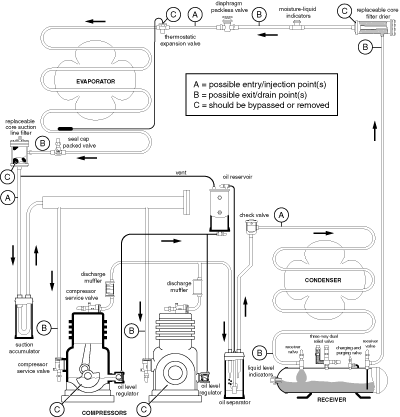
  • Do not inject the solvent into the compressor itself. In fact, the compressor should be removed or bypassed. Only the supporting refrigeration system should be flushed.
  • Large systems or systems with unusual configurations that could trap the solvent should be disassembled and flushed section by section.
  • A single canister will flush a 5- to 7-ton system. However, the exact amount of flush required will vary by the internal design of the system, the nature of the system failure, the degree of contamination in the system, and the temperatures at which the failure occurred.
  • If the system to be flushed includes large components, such as a receiver, it is recommended to use a visual inspection. If these components appear to be contaminated, and they are small enough to be flushed, then do so. If they are too large to economically flush, then the use of additional solvent (such as degreasing solvent) is advised.


  • EQUIPMENT REQUIRED

    The following equipment is required for each flushing operation:
  • New canisters of flushing solvent. For a typically soiled system, you will need one canister for every 5-7 tons of cooling capacity.
  • An injection tool and standard refrigerant charging hose to inject the solvent into the system. The charging hose and injection tool should be dedicated and retained for future flushing.
  • A small, resealable, waste container that will hold the solvent after it is flushed through the system. Ideally the solvent in the container must be visible, so it can be inspected during the flushing process. This enables a technician to determine when the solvent begins to run clean, indicating that the system has been thoroughly purged.
  • A tank of clean compressed nitrogen, regulated to 120-150 psig. This tank should be equipped with a dispensing hose and will be used to purge the solvent from the system.
  • A vacuum pump with the appropriate hoses and clamps.
  • Clean wipes or swabs to remove any residual oils or liquids that may drip or be spilled while purging the system.
  • Safety equipment; never flush a system without eye protection and rubber gloves. Convoluted piping in certain systems can cause momentary spikes in the solvent flow during the flushing process, resulting in erratic purges, which can splash into eyes and onto skin.


  • SPECIFIC INSTRUCTIONS

    1. Confirm you have all the required components for the service as well as for the flushing operation prior to beginning.

    2. If the system is still operational, remove the existing refrigerant and lubricant using the appropriate methods and recovery equipment.

    3. Review the configuration of the system. On larger systems, disassemble sections of the system so those individual portions can be cleaned section by section.

    4. De-energize all of the electrical leads and ensure they are safely positioned. Remove the following components: Disconnect the old compressor and remove it from the system. Remove filter-drier cores. (If it is easier or more cost-effective, install a bypass loop around the filter-drier accumulators, etc.) On heat pumps, remove check valves and four-way reversing valves. Again, configure and install bypass loops.

    Looking for quick answers on air conditioning, heating and refrigeration topics? Try Ask ACHR NEWS, our new smart AI search tool. Ask ACHR NEWS →

    5. Connect a waste container to a discharge port to capture the contaminated flushing solvent. As this solvent exits the system, it will contain oils, condensed water, acids, particulate, and possibly other mechanical residues. While not normally hazardous, such residues need to be captured for proper disposal.

    6. Connect your charging hose onto the system to be flushed. Make sure openings upstream — except the discharge port — are closed. Connect the injection tool to the canister. It is a good idea to restrict the drain or discharge point, so that the flushing solvent is prohibited from passing through so quickly. This will improve the cleaning process.

    7. When ready to inject the flush, connect the canister to the charging hose. Open valve on tool; the flush will start entering the system.

    8. Discharging the flush should take approximately 10 minutes, depending upon temperature. Before the tank is empty, some small quantity of solvent should begin to flow into the discharge container. Also, the canister has been designed to empty itself completely only when it is standing in an upright position. Do not attempt to flush the system with a canister inverted or on its side.

    9. Using the compressed nitrogen tank, connect the tank to the system and blast it into the system behind the flush solvent. The nitrogen will push the solvent through the entire system, agitating it and “scrubbing” the inside of the system. Eventually, all of the solvent will flow into the receiving container on the other side of the system. In this step, it is recommended that the nitrogen be used at a low pressure at first, with the pressure being allowed to increase gradually.

    10. Observe the solvent being captured by the receiving container. If it is running clean and clear, the system has been successfully flushed. If the solvent is murky or still contains particulate, flush again.

    11. Make your repairs. Remove any bypass loops you installed. Tie in the expansion devices. Replace the filter-drier cores. Secure the system.

    12. Evacuate the system to a low micron pressure range with the vacuum pump and leak-check the system. This will evacuate any residual liquid solvent from the system. As the internal pressure drops, the solvent will boil into vapor and be removed from the system. Time for pulling the vacuum should be approximately 15 minutes for a 5-ton system.

    13. As a final step, recharge the system with refrigerant and lubricants as recommended by the compressor or equipment manufacturer and the system instructions. Reconnect electrical and electronic connections. Test the operation of the system. Wipe down the system, leaving the work area neat and clean.


    SAFETY Procedures AND ADDITIONAL POINTS

    The waste solvent will contain used oils and other organic contamination. Pour the contaminated solvent into a waste oil drum for proper disposal. If the solvent needs to be transported, care should be taken to ensure the container is properly sealed to prevent spillage.

    If a second canister is required to fully purge a larger system, you do not need to disconnect the injection tool from the refrigeration system. Simply close the valve on injection tool and remove it from the first flush canister. Replace it with a new canister to continue flushing. Canisters may be recycled.

    Do not smoke or use an open flame around these materials.

    Lawler is director of Product Management for Nu-Calgon. For more information, contact the company at 2008 Altom Court, St. Louis, MO 63146; 314-469-7000; 800-554-5499.

    One Possible Flushing Agent

    Formulated by the same chemists who produced the original R-11, Rx11-flush was created to offer the benefits of R-11 without the environmental concerns.

    It is considered ozone-safe, non-toxic, nonflammable, and compatible with most materials in a refrigeration system. The cleaner itself is packaged in a pressurized container, designed to purge a moderately contaminated 5- to 7-ton air conditioning or refrigeration system.

    According to the manufacturer, it dries quickly, has a low boiling point, has no aroma, and will not attack components.

    Its low boiling point enhances complete evaporation. It can be used for new system cleaning or retrofits. The solvent is approved as part of the United States Environmental Protection Agency’s (EPA’s) Significant New Alternatives Program (SNAP).

    Publication date: 12/04/2000

    Share This Story

    Looking for a reprint of this article?
    From high-res PDFs to custom plaques, order your copy today!


    Recommended Content

    JOIN TODAY
    To unlock your recommendations.

    Already have an account? Sign In

    • HVAC-enrollment

      The Trades Are Back: HVACR Programs See Nearly 30% Enrollment Spike

      A new wave of future technicians is entering the pipeline.  
      News
      By: Matt Jachman
    • 2025 Top 40 Under 40

      2025 Top 40 Under 40 HVACR Professionals List

      The 11th annual Top 40 Under 40 list highlights those...
      HVAC Light Commercial Market
      By: Hannah Belloli-Oster
    • LG Ductless Mini-Split Systems

      The 9 Types of Heat Pumps

      As the U.S. moves toward electrification, heat pumps are...
      Ground Source Heat Pumps
      By: Joanna R. Turpin
    Subscription Center
    • Create an Account
    • Start a Subscription
    • Manage My Account
    • Sign Up for Newsletters
    • Visit Customer Service
    • Update Preferences

    More Videos

    Sponsored Content

    Sponsored Content is a special paid section where industry companies provide high quality, objective, non-commercial content around topics of interest to The News audience. All Sponsored Content is supplied by the advertising company and any opinions expressed in this article are those of the author and not necessarily reflect the views of The News or its parent company, BNP Media. Interested in participating in our Sponsored Content section? Contact your local rep!

    close
    • Piggy Bank
      Sponsored byWatercress Financial

      Energy Prices, Inflation, and HVAC: What Today’s Homeowners Care About

    • Refrigerated Food
      Sponsored bySolstice Advanced Materials

      R-455A Refrigeration: A Cold Storage Solution for the Future

    • Airex Rooftop Units
      Sponsored byAirex Manufacturing Inc

      Consolidating Roof Penetrations: A Growing Trend in Multifamily HVAC Design

    Popular Stories

    Refrigerants-and-gauge.jpg

    HVAC Industry Warns of Counterfeit Refrigerants Entering U.S. Supply Chain

    U.S. Supreme Court building

    95% Furnace Efficiency Rule to Get New Hearing

    Midea-training.jpg

    HVAC Workforce Crisis Expands Beyond Technicians to Instructor Shortages

    Data_Center_facility.jpg

    HVAC Manufacturers Respond to Growing Data Center Backlash

    HVAC Minute retail refrigeration system

    EPA Final Rule’s Impact on R-410A Deadlines

    View The ACHR NEWS
    Centennial Anniversary Timeline

    The ACHR News Timeline Chart
    Submit a Letter
    Submit a letter to our editors.

    Events

    November 6, 2025

    Next-Gen Data Center Cooling: HVAC Innovation and Real-World Solutions

    On Demand As AI workloads and high-density computing push traditional cooling methods to their limits, the data center industry is accelerating the adoption of next-generation HVAC technologies.

    June 23, 2026

    HVAC Duct Sealing Mastics: Why Selection Matters

    In this webinar we will detail what HVAC material buyers and technicians need to know when selecting duct mastics, including matching mastic to substrate, alternatives to liquid mastic, and where UL 181 Listings fit into real world installations.

    View All Submit An Event

    Poll

    Summer Staff

    Are you fully staffed for the summer season?
    View Results Poll Archive

    Products

    BNI Mechanical/Electrical Square Foot Costbook, 2026 Edition

    BNI Mechanical/Electrical Square Foot Costbook, 2026 Edition

    See More Products
    HVAC Duct Sealing Mastics: Why Selection Matters - Free Webinar - 6/23/2026

    Related Articles

    • May 17, 2002: Feds Issue Guidelines For Protecting Ventilation Systems From Terrorists

      See More
    • Guidelines For Troubleshooting R-410A Systems

      See More
    • Health Canada Releases Guidelines for Domestic Reclaimed Water

      See More

    Related Products

    See More Products
    • SMACNA-logo8.gif

      Residential Sheet Metal Guidelines

    • ShowISBNImage.jpg

      Electricity, Electronics, and Control Systems for HVAC, 4/e

    • HVACR-Troubleshooting-Fundamentals-Cover-Image-One-Sheet.jpg

      HVACR Troubleshooting Fundamentals - Refrigeration & Air Flow Systems Training Package for Instructors & Service Managers

    See More Products

    Events

    View AllSubmit An Event
    • September 30, 2025

      HVAC Pumping Systems for Commercial Building Applications

      On Demand Join us for an exclusive webinar on the latest advancements in parallel commercial HVAC pumping solutions designed to simplify installation and improve system efficiency.
    View AllSubmit An Event

    Related Directories

    • Association for Facilities Engineering-AFE

      AFE provides education, certification, technical information and other relevant resources for plant and facilities operations, engineering and maintenance professionals worldwide.
    ×

    Sign Up. Stay Informed.

    The #1 trusted source for the HVACR industry since 1926

    SUBSCRIBE
    • RESOURCES
      • Advertise
      • Contact Us
      • Advisory Board
      • Classifieds
      • Submit a Letter
      • Directories
      • Store
    • ACCOUNT CENTER
      • Create an Account
      • Start a Subscription
      • Manage My Account
      • Sign Up for Newsletters
      • Visit Customer Service
      • Update Preferences
    • SERVICES
      • Marketing Services
      • Reprints
      • Market Research
      • List Rental
      • Survey/Respondent Access
    • STAY CONNECTED
      • LinkedIn
      • Facebook
      • Instagram
      • YouTube
      • X (Twitter)
    • PRIVACY
      • PRIVACY POLICY
      • TERMS & CONDITIONS
      • DO NOT SELL MY PERSONAL INFORMATION
      • PRIVACY REQUEST
      • ACCESSIBILITY

    Copyright ©2026. All Rights Reserved BNP Media, Inc. and BNP Media II, LLC.

    Design, CMS, Hosting & Web Development :: ePublishing