the NEWS
Advertisement:
HVACR Directory | Extra Edition | Learning Center | Editorial Blogs | Product Gallery
  Home
  About the NEWS
  Subscription Info
  e-Newsletters
  Contact Us
  Resources
  Archived Editorial
  Blogs
  Career Center - Employers
  Career Center - Job Seekers
  Columns
  Distributor Corner
  Calendar of Events
  HVACR Directory
  Industry Links
  Learning Center
  Letters
  Manufacturer Reports
  Regional Reports
  Reprints
  Survey Says
  Training Track
  Webinars
  AEC Store
  Market Research
  Extra Edition
  HVACR Forum
  Legal forum
  Business Management
  Dot Comment
  Energy Matters
  Features
  Newsline
  People
  Service Hotline
  Service & Maintenance
  Technical
  Advertising
  Ad Index
  Media Kit
  Submit Press Release
  Services
  Classifieds
  Digital Edition
  Post Cards
Search in: EditorialProductsCompanies
Using Air Intake Filtration to Optimize School IAQ


July 10, 2006

ARTICLE TOOLS
EmailEmailPrintPrintReprintsReprintsshareShare


Good indoor air quality is a critical element that contributes to a favorable learning atmosphere and helps ensure that all students and staff are working in a healthy environment.

With continuing escalation in fuel and energy costs, school systems recognize the importance of optimizing the insulation of school buildings and sealing the building to prevent loss of heating and cooling. When buildings have been effectively sealed, the heating and ventilation system is a key element in regulating a safe internal environment.

According to the American Lung Association, poor indoor air quality can trigger asthma episodes and a myriad of other health-related problems. Poor air quality is becoming increasingly costly for schools due to expensive mechanical and environmental consulting fees, rising energy cost, building and mechanical equipment failure and repair, and increased liability cost. For these reasons, proper maintenance of HVAC equipment that supports a high-quality indoor air environment is more than just a budget issue; it’s a health and safety issue.

With schools faced with increasingly tight budgets and the need to optimize returns on facility and IAQ improvements, use of technologies that help to optimize HVAC efficiencies while reducing maintenance cost is a “common sense” approach that can help everyone breathe a little easier.


AIR INTAKE FILTRATION TECHNOLOGY

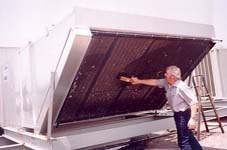
Air intake filter on air-handling unit.


When air-handling units draw fresh air into buildings, the air typically travels through banks of internal pleated filters which capture small airborne particulates before they get inside the building. However, when large debris such as cottonwood seed, dandelion seed, leaves, insects, paper, construction debris, and other matter get into the fresh air openings, the internal filters can become prematurely fouled by the “blanketing effect” of large debris, rendering the internal filters significantly less effective at capturing the small particulate they were designed to stop. To solve this problem, the use of air intake filtration is an effective way to isolate large debris on the outside of the equipment where it can be easily removed. By stopping larger debris on the outside of the air-handling unit, it can increase the life of internal filters by up to 60 percent and that means a savings in filter cost and an improvement in indoor air quality.


Air intake filter on coils.


When used on air-cooled chillers and condenser units, air intake filtration helps to optimize the efficiency of equipment by preventing airborne debris from getting into the coils. Keeping condenser coils clean means that cooling systems will run less frequently and for shorter periods of time while providing the building with the cooling output needed to effectively manage indoor temperatures. When coils get dirty and clogged, cooling equipment loses its cooling capacity and consumes more energy because it must work harder and run longer to reach set temperature points. Deferring coil maintenance on coil-based systems can lead to compressor failure and complete loss of cooling.

Schools using cooling towers for environmental cooling must recognize that keeping debris out of the cooling tower is critical to safety and system efficiency. When you think of cooling towers, it is important to realize that they are very large and efficient “air scrubbers” — all airborne matter that happens to float past the draft of the tower gets drawn into the cooling water and can compromise the entire system by plugging strainers and heat exchangers, reducing water flow, and thwarting the heat exchange process. Furthermore, when debris gets into the fill material, it can reduce the cooling tower’s ability to cool the water to the designed temperature point before being recirculated through the cooling loop. When cooling water exceeds the designed temperature point when introduced into the chiller unit, it increases the load on the chiller, reduces the heat exchange capacity, and can lead to chiller failure.


Cooling tower intake filter.


Another problem that can result from debris getting into a cooling tower is a reduction in the effectiveness of water treatment chemicals. The reason for a reduction in effectiveness is in large part due to what is known as “chemical absorption” — this is where debris absorbs water treatment chemicals, locking them inside the debris and making them unavailable to the surrounding water; this has a direct impact on chemical efficiency. To compensate for absorption, more chemicals are needed. Also, when debris gets into the water and decomposes, it can create an environment conducive to bacteria growth (including Legionella). If the system isn’t properly maintained, Legionella and other bacteria can proliferate and come into contact with maintenance workers and others that may get near the tower. Additionally, bacteria can get into the building air intake openings when contaminated water from a poorly maintained cooling tower is picked up by the wind and is drawn into fresh air intake openings, thus exposing building occupants and posing a serious health risk.

By using air intake filters, with a well-managed water treatment regimen, a cooling tower will stay clean and operate efficiently.

Air Intake Filtration Features:

  • Simple to install — installs on outside of equipment.

  • Specially engineered mesh designed for high durability and use on HVAC and cooling tower systems.

  • Low impact on airflow (very low static pressure impact).

  • Mold and mildew resistant, UV resistant, and flame resistant.

  • Filters are easy to clean using a broom, brush, or shop vacuum. Removal not required for cleaning.

  • Designed to deliver up to 15 years of service.

    Benefits of Air Intake Filtration on:

    Air-Handling Units

  • Prevents premature fouling of internal pleated or bag filters.

  • Optimizes the efficiency of internal filters.

  • Increases life of internal filters up to 60 percent.

  • Reduces internal filter changes.

  • Reduces internal filter cost.

  • Protects louver actuators.

    Air-Cooled Chillers and Condenser Coils

  • Prevents debris from getting into the coils.

  • Reduces/eliminates the need for power washing and hazardous cleaning chemicals which can damage coils.

  • Reduces cleaning effort by up to 75 percent.

  • Helps reduce energy cost because equipment runs clean and efficiently.

    Cooling Towers

  • Isolates debris on the outside of the cooling tower where it is easy to clean.

  • Helps prevent sludge buildup.

  • Prevents fouling of fill, strainers, and heat exchangers.

  • Diffuses sunlight, reducing algae growth.

  • Reduces water treatment chemical consumption.

  • Reduces scheduled cleaning work effort by up to 50 percent.

  • System runs efficiently all season long.

    School facility managers and maintenance engineers seeking ways to improve indoor air quality would be well served by integrating air intake filtration technology into their preventative maintenance program.

    Randy Simmons is vice president of Air Solution Co., a manufacturer of air intake filtration systems for chiller and condensing coils, cooling towers, rooftop units, and other high-volume/high-velocity air intake systems. For more information, call 513-860-9784 or 248-676-9418, e-mail airsolutioncompany@hotmail.com, or visit www.airsolutioncompany.com.

    Publication date: 07/10/2006


  • |PrintEmail

    Did you enjoy this article? Click here to subscribe to the magazine.


    © 2010 BNP Media. All rights reserved. | Privacy Policy
    Your Feedback