U.S. Navy Studies Oil-Free Compressor Technology
POTENTIAL TO REDUCE ENERGY CONSUMPTION
The evaluation is being undertaken under the auspices of the Navy's Techval Program, which is operated out of the Naval Facilities Engineering Service Center in Port Hueneme. The program was created by the Navy to assess the effectiveness and viability of technologies that have potential to reduce energy consumption, pursuant to the goals set forth in the Energy Policy Act of 2005 (EPACT05).EPACT05 requires all Federal agencies to exhibit leadership in implementing energy efficiency improvements, considering all technologies based on their life-cycle cost effectiveness and their potential for conserving energy. The Navy's Techval program has numerous ongoing activities studying installations of actual equipment, comparing their efficiency and reliability with conventional technology, in actual installations.
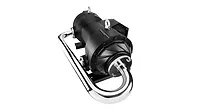
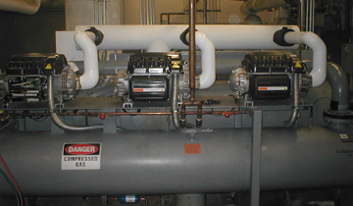
The specific project referred to is an ongoing side-by-side comparison of the performance of a chiller retrofitted with three Turbocor oil-free centrifugal compressors, manufactured by Danfoss Turbocor, versus existing conventional chiller technology. The San Diego installation is in Building 1, the Fleet Industrial Supply Center (FISC). Here there were two identical 360-ton screw chillers, each on 275-ton frames. One of the chillers was initially retrofitted with two 80-ton Turbocor oil-free compressors with a third compressor added later. The second of the two screw chillers was retained and operated with the same parameters to allow a direct head-to-head comparison.
This installation took place in 2004. The new equipment was started up and ran satisfactorily for several months in the second half of the year, but there was a problem with a failing cooling tower, so operation was temporarily discontinued. The cooling tower was replaced and the chillers are back on-line. The analysis of the results looks very promising.

COMPARATIVE EFFICIENCY STANDS OUT
According to Kistler, the opportunity to compare the standard technology and the oil-free compressor in the same location is valuable. "We look for these situations where we can do a direct comparison in order to get a very clear idea of the performance." Although the current data is still ongoing, the comparative efficiency stands out.For example, in the first month of documented operation after the cooling tower replacement, the chiller retrofitted with the two Turbocor compressors operated at an average load of 71 tons at efficiency of 0.49 kW/ton. The companion conventional screw compressor chiller operated at an average load of 67 tons at efficiency of 0.93 kW/ton.
THREE-YEAR PAYBACK AND REDUCED GREENHOUSE GAS EMISSONS
This is preliminary information and the performance of the plant through the season will be more conclusive. However, Kistler said, "There clearly is an efficiency improvement here. The current project indicates a simple payback for the project of approximately three years." He noted that because the Navy was able to secure an energy efficiency rebate from the local utility, the actual payback may be less than a year.A three-year payback would be viewed positively by many owners, especially if they already had aging chillers with reliability issues. For the Navy, the acceptable payback is 10 years. In addition, the reduced energy consumption provides a way to reduce utility generated greenhouse gas emissions, which is also a goal of the U.S. Navy.

OPERATES NOTICEABLY QUIETER WITH LOW MAINTENANCE
Another observed characteristic of the compressors is that they operate noticeably quieter than screw compressors. In a number of installations, because the chillers are located beside occupied spaces, this is advantageous. In addition, the workers are not subject to elevated noise levels.The Turbocor compressor features a number of technological innovations that contribute to its efficiency, characteristics that the Navy's Techval Program was designed to test. One of these innovations is that the compressor is totally oil-free. This eliminates oil-related maintenance and prevents efficiency robbing oil contamination of the evaporator. This is accomplished by the use of magnetic bearings. In addition, this compressor uses a direct-drive, two-stage centrifugal chiller complete with a variable frequency drive (VFD). This is why its efficiency, especially at part load, is 30 percent better than typical screw compressors, according to Danfoss Turbocor.
The compressor, which is available in 60 to 160 ton sizes, is also extremely light and compact (less than 300 pounds), and has been successfully used in a number of retrofit and new equipment installations. Both the oil-free characteristic and the magnetic bearing system contribute to the high efficiency and the quiet operation of the compressor. For the same reasons, the compressors require very little routine maintenance compared to compressors that operate in oil.
Looking for quick answers on air conditioning, heating and refrigeration topics? Try Ask ACHR NEWS, our new smart AI search tool. Ask ACHR NEWS
The evaluation by the Navy is not yet complete, but the results to date are promising. If this technology continues to show high efficiency and reliable operation, it is one more indication that oil-free centrifugal compressors will have a significant place in the future of HVAC systems.
For more information, contact Danfoss Turbocor Compressors Inc. at 888-440-0523 or visit www.turbocor.com.
Publication date: 02/20/2006
Looking for a reprint of this article?
From high-res PDFs to custom plaques, order your copy today!