Beating the Heat
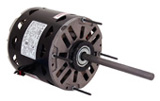
Here is an example of a PSC design that is more efficient than a previous design, and uses about 14 percent few amps. If the two motors were compared just based on amps, it might be incorrectly concluded that the previous design was a stronger motor, which is not the case.
Alas, the world we live in is far from perfect, and that imperfection extends to the motor as well. Advances in technology have brought today’s motor closer to the ideal of 100 percent efficiency, but the best the manufacturers have been able to produce so far reaches the low 90s. As a result, whenever you energize a motor, you will get two outputs: a desirable one (work) and one that is not so desirable (heat). That can be a real issue in many cases. For example, many motors used in single-phase applications (such as shaded pole motors), barely rise above the 50 percent mark in efficiency. So you know these types of motors will use almost as many input watts to produce heat as produce work.
Equipped with this knowledge, you can understand why one of the criteria you must consider when selecting a motor for an application is the effect of operating temperatures on that motor.
A number of universal factors come into play when you deal with operating temperatures, no matter what the application. These include:
• The electrical efficiency of the motor in question;
• The ambient temperature for which the motor is rated;
• The ambient temperature in which it will operate;
• The temperature rise the motor will undergo when it is working as well as its nameplate-rated temperature rise;
• The class of electrical insulation with which the motor is made; and
• The motor’s service factor.
One of the most fundamental design criteria relating to motor lifespan is the selection of materials used to insulate the electrical parts of the motor and the capacity of those materials to withstand heat. Insulation is critical to the safe and consistent operation of the motor. If the insulation system fails, the electrical parts become short circuited which causes the winding to break down. The result is motor failure.
To help you identify which system is right for a given application, insulating materials are grouped into classes designated with letters that identify the maximum temperature capability of the materials in that class. These identifying letters are virtually universal among motor manufacturers because they are specified by the trade organization, the National Electrical Manufacturers Association (NEMA). For example, Class A insulation materials are designed to withstand a maximum temperature of 95°C (approximately 205°F) in most motor applications. Class B insulating materials must be capable of withstanding maximum temperatures of 110°C (or about 230°F). These are the two most common classes of insulation for general-purpose motors. Other classes (for example, Class F, Class H) exist for unusual, high-temperature applications.
Consider a motor that is operating normally. The temperature of its insulation will be the sum of two components. The first is the ambient temperature (in other words, the temperature of the environment surrounding the motor when it is at rest). If that motor is operating in a room, the ambient temperature would be room temperature. The second component is the temperature rise that motor experiences when it converts some of its input power to heat rather than work.
It is common practice for a manufacturer to rate the maximum ambient temperature in which a motor is designed to operate. Thanks to our friend NEMA, this maximum ambient temperature is commonly specified at 40°C (or 80°F) unless the motor is designed for a specific duty.
Using this bit of information, you can now begin to figure out the limits of temperature rise on a motor. Take, for example, a motor with a Class B insulation system. You know that its maximum rated temperature is 110°C, and you know its maximum ambient temperature is 40°C. This tells us the temperature rise is limited to 70°C if it is operating at its maximum ambient temperature.
You can use this knowledge in a number of ways when installing or replacing motors. For example, if the motor in question is capable of reaching its nameplate horsepower without its temperature rise reaching the maximum for its insulation class, you can think of that motor as having “spare” temperature capacity. That excess capacity can be translated into the capability of delivering more horsepower than the nameplate specifies without exceeding the maximum insulation temperature.
This spare horsepower is sometimes expressed as service factor. The service factor number found on the nameplate (for example, 1.25) can be used to multiply the motor’s nameplate horsepower to give you a maximum horsepower that exceeds the nameplate rating without exceeding the temperature capability of the motor.
But what if the motor must operate in an environment that is warmer than its rated ambient temperature? In that case, the temperature rise must be reduced if the motor is to stay within the temperature capacity of the insulation. In these cases, you may use a motor in an environment that is warmer than its rated ambient temperature provided you reduce the load horsepower.
It’s also important to realize that the operating conditions of the motor may also affect ambient temperature. If the motor is enclosed (in a furnace, for example, or within a protective housing such as a pump housing), the ambient temperature that motor experiences is actually the temperature of the air immediately surrounding the enclosure. This suggests you will have to consider dissipating the temperature within the enclosure by passive or positive ventilation. If you are comparing an enclosed motor with a similarly rated open and ventilated motor, you will need to consider the difficulty involved in dissipating the heat involved in the operation of the enclosed motor.
Temperature considerations rank right up there with mechanical parts failures in shortening the life expectancy of a motor. Understanding all of the factors involved in temperature can help you make intelligent choices when installing or replacing motors in the field.
Publication date: 09/10/2007
Looking for a reprint of this article?
From high-res PDFs to custom plaques, order your copy today!