Performance Contracting
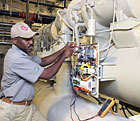
Hill York service technician maintains a water-cooled chiller. Thanks to the contractor’s data-collection capabilities, clients can see how maintenance affects the amount of energy a system uses. (Photo courtesy of Hill York.)
Performance contracting is changing for the better, at a time when it can do great good for contractors and their commercial customers. It’s a far cry from mid-1980s performance contracting in which an HVAC contractor would go into a commercial building and install an energy management system, and/or replace energy-wasting equipment. The contractor’s work was paid from energy savings. “Contractors” needed deep pockets in order to make it work.
Today’s methods for delivering performance contracting have been modified to make it a much more feasible proposition. Some commercial contractors think it’s ready for a comeback.
One contractor, Hill York, started up a performance group this past March called Hygreen. “A couple of years ago, we saw the construction economy going in a direction that was not good for us,” said president Jeff Phillabaum. “We started looking at where the future of Hill York was going. What was the most beneficial new market? Energy and performance was an area we wanted to grow. We really started looking into developing a business that we focus around that.”
PERFORMANCE OF THE PAST
Energyservicescoalition.org describes performance contracting as “a mechanism to implement resource efficiency improvements with minimal up-front costs. It uses savings resulting from the efficiency project to pay for the work over time.” The coalition stated, “You enter into an agreement with a private energy service company (ESCO). The ESCO will identify and evaluate energy-saving opportunities and then recommend a package of improvements to be paid for through savings. The ESCO will guarantee that savings meet or exceed annual payments to cover all project costs - usually over a contract term of seven to 10 years. If savings don’t materialize, the ESCO pays the difference, not you. To ensure savings, the ESCO offers staff training and long-term maintenance services.”Under the old method, “if the owner saved $4,000 a year, the contractor might get 50 percent of that until the work was paid for,” explained consultant Steve Howard, president of The ACT Group. “The problem with that is the contractor typically doesn’t have the ability to buy equipment and finance it for five years. The people doing that were the big guys like Johnson Controls and Honeywell.
“In the 1970s and ’80s, we learned that getting paid was the hard part,” Howard said. “You needed deep pockets. The average contractor didn’t have that ability. He still doesn’t.”
FRIENDLIER FINANCING
The face of performance contracting is changing, thanks to new financing options and energy-monitoring technologies. Some of the prerequisites are the same.“The first thing that has to happen is the contractor has to understand how the building uses energy,” said Howard. It’s all about energy use. “Most contractors do not understand how a building uses energy,” he said. “About one-half of a commercial building’s energy use goes to heat and cool the building. Energy costs are rising, and most peak energy use is generated by natural gas.”
The second aspect, he said, is to get building owners asking, “‘What’s going to happen to my energy costs in the future?’ If nothing else, they’re going to have to cut back someplace else, but as soon as they do that, they’re cutting profits.” Howard predicted “much higher energy prices” over the next 20 years. This is something that should already be on most building owners’ radar.
The third component of today’s performance contracting, he said, is for the contractor to recognize that “it’s not an air conditioning decision on the customer’s part; it’s a financing decision. Understand finance at a basic level; know how to talk to those people. That’s who will make the decision.
“Today’s performance contracting requires new skill sets,” he said. “It requires understanding how the building uses energy, the financial aspect, turning airflow into cash flow, and turning energy savings into income.”
The ACT Group advises contractors to start with their existing customers. “You know their problems and possibilities. You understand what their energy-wasting products are now; develop a strategy to replace the equipment, all or some, through a proposal. We’re selling return on investment,” Howard said.
“We’ve got a formula using running amps converted to kWh,” he said. “We figure the hours of operation; let’s say the old unit is 6 EER, the new one’s going to be 12 EER. We have savings of $6,000. Then we divide that by 12 to get our monthly savings, $500.” The contractor could lease the equipment for $700 per month. “The customer is getting a brand new air conditioning system for $200 per month, or $12,000 over five years. After it’s paid for, those savings go into your pocket. The customer has positive cash flow from day one.
“It’s not about replacing air conditioning,” he said. “It’s about increasing cash flow.”
At the end of the lease period there is a $1 buyout. “It’s treated differently from the financial standpoint under IRS rules,” Howard said. “It’s not a capital expenditure. A lease can be a whole lot better for the owner.” It’s better for the contractor as well. “The old way they got paid, they were counting on a check each month. For a leased program, you’re using that third party, a bank, or whatever.” The customer makes an easy, monthly payment.
For Hill York’s project funding, “We’ve gotten a great deal of third-party finance people who are interested because of the payback,” said Phillabaum. “On several projects, we are providing a shared savings. What we don’t want to do is dictate to the owner how he has to operate the building. Our intent is to make the recommendations and let them look at our Web-based software. We make the recommendation.”

Hill York focuses on the design-build components of a project and follows through with service, maintenance, and monitoring-metering. The contractor provides a convenient, turnkey suite of capabilities and fosters long-term client relationships.
FRIENDLIER TECHNOLOGIES
Performance contracting doesn’t necessarily require the installation of new equipment on a large scale. “Smart contractors could go into at least 50 percent of the buildings today, and make changes to the hours of operation, shut off equipment that doesn’t need to be running, and work on economizers, and save considerable money without installing anything,” Howard said. “Change the chilled-water temperatures, fans that shouldn’t have been running, and save $1,300 per month, $156,000 per year, on a 20-story building. The same concept applies to light-tonnage equipment. Look at equipment run times, fix it with a time clock.”“The monitoring aspect is the Achilles heel,” said Howard. “We used to put in kW counters, we could tell exactly how many kWs the air conditioner was using. I can count the kWs, but I don’t know what the unit I took out would be doing.”
Contractor Hill York was able to overcome the monitoring-hurdles by adopting a method called Building Oversight Management, which is powered by the technology of Utilivisor. Building Oversight Management is an advanced monitoring system for managing real-time costs of delivering a healthy, productive, and comfortable environment as defined by the customer. Utilivisor is a real-time, online, Web-based observation resource that monitors HVAC control systems, utility use, alarms, and equipment, and calculates total resource operations costs. The entire system offers real-time performance numbers with validation.
According to Phillabaum, Utilivisor creates its energy reports in Excel format, making it easily accessible to upper-level building managers. The spreadsheets “let you look at where the energy is being used, how much is being used, and you can sort that into various formats,” he said. “You can look at all different types of things that affect energy use and drill down into specifics of equipment. It’s a very easy-to-identify format that you can really optimize.”
Until Hill York had this product, “we never really had the technology to see what the real performance of their equipment was,” said Phillabaum. “Now we continually see what the water flow is to the equipment. We really provide a continual sustainability and verified performance of the equipment once it’s installed. Typically the contractor installs equipment, a test-balance contractor comes in, and everybody walks away. It’s assumed by the owner that all of these parameters are maintained. This program allows them to see it on an ongoing basis.”
In addition to the Web-based interface, the system gathers information using a number of data-collection points installed by the contractor. Utilivisor’s 24/7 point-monitoring system provides data calculation for critical HVAC installations, monitoring and verification of operations and conditions, HVAC system troubleshooting, identification of design issues, correction of systems performance, and custom report generation.
“The technology has really become the backbone of this division and product,” said Phillabaum. “It’s unique in the ability to create an easy-to-manipulate system. This is not a control system; it’s a measuring-monitoring type of system that picks points on set intervals. Up to 20 fields can be displayed on a timeline graph. It’s very user-friendly.
“We sell energy savings, monitoring, and verification with our projects. We look at that as one of our competitive advantages” on all projects.
The contractor sees this as being a bit different from more traditional, ESCO-based performance contracting. “It’s more of a hybrid type of performance contracting,” Phillabaum said. “We can typically save the average large user close to 15 percent of their energy costs. That relates into most of these projects that we presented.”
The contractor has established an operation center to manage the system. “We can optimize system performance. Then we can lock in the parameters. If it goes outside those parameters, it sends an alarm to them and us. We can offer very sophisticated facility engineers that can make recommendations. They have a super facilities management available.”
“It’s not as much of an ESCO model,” said Larry Clark, business development manager for the Hill York Performance Group. “What we’re looking for is more shared savings. I think the trend is reversing.”
With today’s new performance contracting, “as the economy slows down, what if contractors actually embraced this, helped their customers save energy, and get paid for it,” asked Howard. “The customer is going to win, there will be increased cash flow and increased earnings. It gets exciting.”
Publication date: 09/15/2008
Looking for a reprint of this article?
From high-res PDFs to custom plaques, order your copy today!


