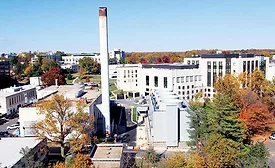
This month’s B2B will focus on the renovation of the office space (not part of B2B test) and replacement of the building’s existing baseboard radiation to new overhead radiant heat panels to be installed in the ceiling around the perimeter of the single-story 40,000-sq-ft building.
Recently, a much younger engineer than I asked if we could meet and discuss an energy retrofit project she was working on but was not familiar with the application.
With failing boilers and increasing tenant complaints for more heat, a 32-unit apartment complex in Kingsford, MI required major upgrades to its heating system. High-efficiency boilers provided the remedy needed as well as significant fuel savings.
Located on the Piscataquis River in Maine, The Mill at Dover-Foxcroft is a 60,000-sq-ft complex comprising nine structures built between 1841 and 1944.
This design environment keeps moving, but the performance and cost pressures remain. Weigh air-side and water-side economizers carefully: not just one or the other, but the options within each approach.
Modern data centers are evaluated not just on reliability but also on the efficiency of the cooling plant that supports them, so the cost to cool data center space is a key issue that must be addressed during design and system selection.
Due to the Base Realignment and Closure (BRAC) program, Department of Defense facilities across the country were consolidated to improve efficiency and reduce operating costs.
This month’s Facility File will focus on the B2B November test for HVAC applications to replace an existing cooling tower at a pharmaceutical facility.
When a large national retailer wanted to reduce energy costs at one of its new distribution centers in Topeka, KS, it turned to Cambridge Engineering and its High Temperature Heating & Ventilation (HTHV) technology to help them out.
The U.S. Energy Information Administration claims that as much as 40 percent of a building’s operating costs are tied to HVAC and other mechanical systems.