Data Center Cooling Strategies
This design environment keeps moving, but the performance and cost pressures remain. Weigh air-side and water-side economizers carefully: not just one or the other, but the options within each approach.
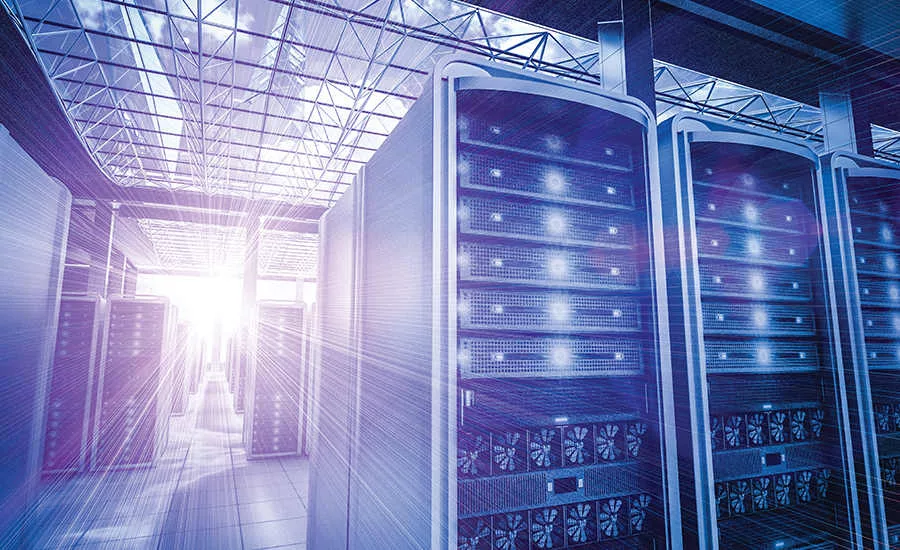
Modern data centers are evaluated not just on reliability but also on the efficiency of the cooling plant that supports them, so the cost to cool data center space is a key issue that must be addressed during design and system selection. Finding cooling strategies that are cost-effective while still maintaining the overall reliability of the mechanical and electrical systems remains a common challenge for engineers. If the server in the data center overheats, it will turn off in an effort to protect itself from damage. A successful data center cooling strategy saves money in the long run by preventing damage and keeping the data center running smoothly.
The Evolution of Data Center Technology
The data center market is in a constant state of evolution. What was new and hot four years ago can quickly become old technology. In the same way, cooling strategies for data centers have evolved rapidly in the past several years. With changes to temperature and humidity parameters increasing the range of allowable operating conditions, it has opened the door to creative and cost-effective solutions.
Until 2008, the allowable range for temperature was 68ºF to 77ºF, and the allowable range for relative humidity was 40% rh to 55% rh. These ranges were modified in 2008 and 2011, and again in 2015. The new allowable range for temperature is 64.4ºF to 80.6ºF, and the allowable relative humidity range is approximately 20% rh to 60% rh. The actual rh range is further defined as a low wet bulb of 15.8ºF and a high wet bulb of 59ºF. The extended ranges allow for location relative system options, since local weather does play a role in the effectiveness of the system.
The focus of this article is on medium-to-large data centers, 2,000 sq ft and larger. With that in mind, cooling strategies to maximize energy efficiency have evolved into two fundamental strategies: air-side economizer and water-side economizer.
Cooling Strategy #1: Air-Side Economizer
An air-side economizer works by cooling the data center with outside air when the outside air has the capacity to cool the IT equipment. The dry bulb and wet bulb need to be monitored to ensure the proper relative humidity is maintained in the space. With the maximum supply temperature to the IT equipment inlet being raised to 80.6 ºF, there are regions of the United States that can cool the entire year without mechanical cooling. In most of the country, mechanical cooling via chilled water is needed to cool the outside air to an acceptable temperature.
There are two common types of air-side economizer. The first involves custom AHUs with the appropriate controls, filters, and fan technology to reduce energy consumption. The second type is custom AHUs that utilize indirect evaporative cooling. This process uses a heat exchanger with the evaporative cooling on one side and the outside air on the other.
Another consideration is occupant comfort. Data centers are often viewed as unoccupied space, but in reality IT techs and facilities maintenance staff spend a lot of time in the space. The hot aisle can be as hot as 125ºF, so this is something to consider in discussions with your IT and facilities staff.
A limitation of about 20 KW/rack appears to be the high end for an air-side economizer. Another issue to consider is outdoor air quality. If you are in a region with high dust or pollen levels, the cost to maintain a filter can be prohibitive. Additionally, the added pressure drop to move these high volumes of air through filters can partially offset savings by increasing motor horsepower and associated fan energy.
If you are anticipating high-performance computing (HPC) where rack loads can reach 40 KW/rack, supplemental cooling is required. This can be accomplished with in-row cooling or rear cabinet doors with an integral chilled water coil and fans.
- In-row cooling. In-row cooling is a chilled water device that utilizes multiple variable speed fans and a chilled water coil to take air from the hot aisle and move it to the cold aisle. The in-row cooling units are design to fit in between racks in a row.
- Chilled water doors. The chilled water door device replaces the rear door that comes with the rack, instead providing a door that has a chilled water coil and multiple fans to assist the airflow. This product is capable of cooling up to 40 KW/rack. They consist of a system with a heat exchanger and secondary pumps, designed to allow for segregation of chilled water system pressure and also to adjust the secondary chilled water supply system to eliminate the possibility of condensation.
Due to the increased efficiency of the energy with air movement, hot- or cold-aisle containment is required. This is accomplished using racks with chimneys that channel the hot air from the rack up to the return plenum ceiling and back to the return on the air handling equipment without mixing it with the cool supply air. There are also packaged systems that create hot aisles with the use of material that reaches from the top of the cabinet to the ceiling; these systems include end-of-aisle doors to contain the hot air. This method would also use the return ceiling plenum to channel the hot air back to the air handling equipment without mixing it with the cool supply air. This is called hot-aisle containment. Alternatively, you can create cold-aisle containment with the same packaged containment materials.
Cooling Strategy #2: Water-Side Economizer
The water-side economizer process consists of a chilled water plant either in parallel or series with a water-side economizer loop. Key components are a cooling tower, heat exchanger to separate the cooling tower water with the building chilled water, and a condenser water pump to move the cooling tower water to and through the heat exchanger and back to the cooling tower.
- Parallel operation. With this arrangement, the waterside economizer sits in parallel with the chilled water plant so that the building is either cooled with chilled water from the plant or from the water-side economizer. It is a proven system that has been deployed for years, but it is not as efficient as series operation.
- Series operation. With this arrangement, the water-side economizer is in series with the chiller plant. Let’s look at a sample project that was completed in 2014. The design separated cooling and humidity control for the space allowing for elevated chilled water. Chilled water was supplied at 68ºF to the computer room air conditioning units, which delivered air to the space at 75ºF in the cold aisle and returned air from the hot aisle at 105ºF.
The use of a 30ºF delta T allowed for an approximate 50% reduction in airflow and associated fan energy. The high return air conditions allowed for a 25ºF delta T on the chilled water, resulting in significant energy savings.
During the periods of the year when the water-side economizer cannot maintain 68ºF chilled water, the water is processed in series with the chilled water plant. For this project, the water-side economizer was able to meet all the chilled water requirements approximately 67% of the year, and partial economizer the remainder of the year, with the chilled water plant assisting in cooling the return chilled water.
The elevated chilled water temperatures and using the water-side economizer to “pre-cool” the chilled water reduced the cost of operating the chilled water plant by 50%.
Which is Best for Your Project?
With the large capital investment required to build a data center, it is now standard design practice to do a total cost of ownership (TCO) analysis, taking into account first cost, operating costs, maintenance costs, and the cost to decommission and upgrade equipment.
Key issues to consider when doing a financial analysis are:
- The cost of electricity: Rates can be as low as $.05/KWh and has high as $.15/KWh.
- The cost of water and sewer: Rates can be as low as $2/1,000 a gallon and as high as $12/1,000 a gallon.
- The cost of maintenance: Every UPS system and HVAC system has distinctive and predictable maintenance costs.
- The cost to decommission and upgrade equipment: Often overlooked is the cost to decommission systems that have a fixed life and then replace them with new equipment.
Factors in calculating TCO are:
- Construction cost (This can be first year or spread over time on a data center that has a planned growth path over time for IT cooling load and associated MEP equipment)
- A defined time frame for the life of the facility
- Cost of electricity and escalation rate
- Cost of water and escalation rate
- Calculated annual energy usage for each option in the analysis
- Annual maintenance cost and escalation
- Discount rate on money to do a net present value calculation for each option
- Costs for decommissioning MEP equipment and upgrades base on the useful life of the equipment
Other key tools are a cost estimator or construction manager with a database of costs of construction, and input from the owner on operating and maintenance costs.
The TCO will enable the owner to make an informed decision on cooling system options before design even starts. It sounds like a daunting process to compare systems, and it can be without the right tools. It is critical to have a design firm with the skillset to do TCO calculations. For the firm, it is a fairly straightforward process to build a spreadsheet that will compare systems.
Conclusion
In conclusion, there are several factors and design decisions to consider. When using the airside economizer strategy, you will need to decide on your strategy for hot aisle containment. When using the water-side economizer strategy, the density of the rack loads will influence your decision between in-row cooling and chilled doors. All are important factors to consider after completing the total cost of ownership evaluation — a valuable practice which can yield surprising results.
Looking for a reprint of this article?
From high-res PDFs to custom plaques, order your copy today!