Decentralized Ventilation and the Hard Truths of Office-to-Residential HVAC Conversions
Lessons from the Field with Tarang Patel of TRV Mechanical
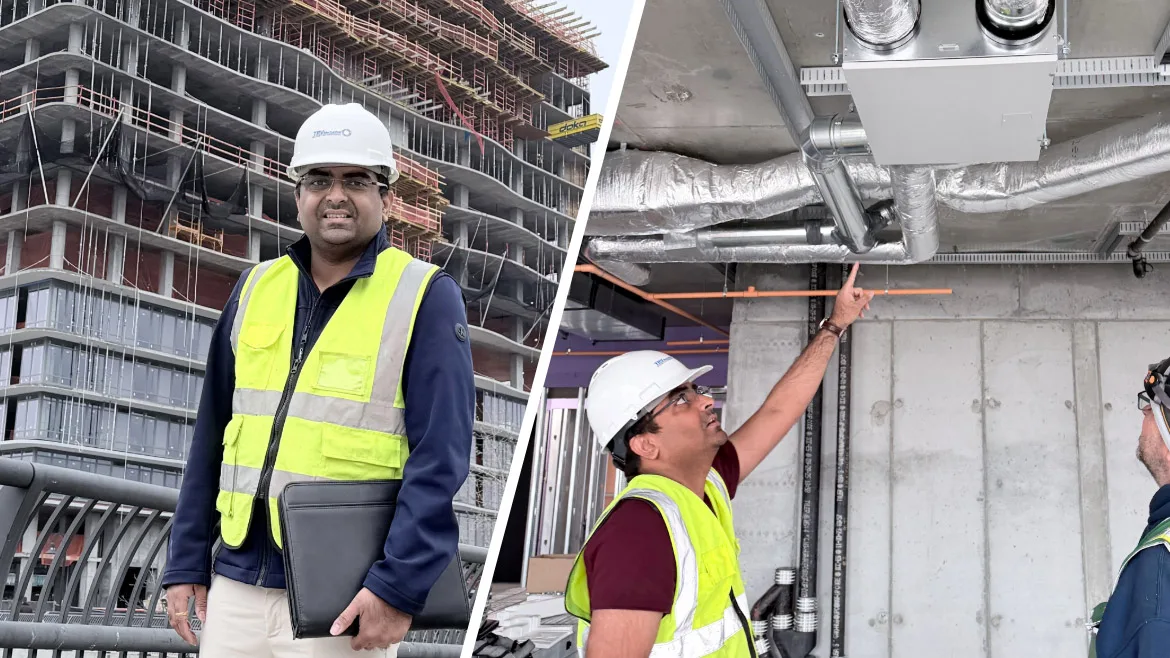
DECENTRALIZE: Decentralized ventilation stabilizes pressure in every apartment – making code compliance and air quality achievable from the lobby to the penthouse, says Tarang Patel of TRV Mechanical Contractors.
In the high-stakes world of high-rise construction, few HVAC engineers have challenged convention – and proven it in the field – like Tarang Patel. A Master of Engineering graduate who serves as head of mechanical engineering at TRV Mechanical Contractors, an ACCA Quality Assured-certified mechanical contracting firm in Kenilworth, NJ, Patel's approach to large-scale residential towers and complex office-to-residential conversions is quickly becoming a reference point for the broader industry. With more than $36 million in active projects – including the 50-story 20 Long Slip in Jersey City and the 760,000-square-foot Sky Three development in Brooklyn – Patel's team has delivered results that manufacturers and developers alike are now studying and replicating. Major HVAC manufacturers Broan-NuTone and eFlow USA have each published formal case studies documenting his engineering innovations as industry benchmarks, with documented outcomes including a 25 percent reduction in HVAC energy waste and six-figure construction savings..
Stack Effect: A Physics Problem, Not a Controls Problem
Ask Patel about the most misunderstood aspect of high-rise HVAC design, and you'll get a blunt answer: "The biggest misconception about stack effect is that it's a controls problem. Engineers try to solve it with sensors and automation, but it's fundamentally a physics problem."
Patel points to pressure differentials that can reach 0.8 inches of water column or more across a 50-story building under winter design conditions – an engineering barrier that makes centralized ventilation systems drift out of ASHRAE Standard 62.2 compliance on upper floors as stack pressure shifts seasonally. No amount of electronic compensation can reliably overcome a physics problem at that scale. His answer? Stop treating the building as one monolithic system. "Instead of treating the building as one system, I design it as many small zones – each apartment effectively becomes its own controlled environment." By decentralizing ventilation, each space stabilizes its own pressure, making code compliance and indoor air quality manageable from lobby to penthouse.
Decentralization: Simpler, Smarter, Cheaper
Centralized systems come with a well-known list of headaches: duct losses, balancing nightmares, and inefficiencies that ripple from floor to floor. Patel's answer has been to specify fully decentralized ERVs (energy recovery ventilators), with factory-calibrated units serving individual apartments. "A centralized system introduces too many variables – duct losses, balancing issues, inefficiencies. Individual systems eliminate those problems."
At Sky Three, Patel's specification of factory-calibrated Constant Air Regulators (CARs) in place of traditional volume dampers eliminated weeks of balancing and recalibration, reducing installation time and delivering a documented 25 percent reduction in HVAC-related energy waste across all three towers – results independently published by eFlow USA in a formal case study. At 20 Long Slip, a separate product engineering decision generated its own significant financial outcome: Patel identified that the originally specified ERV units would require a separately installed drywall ceiling access panel in each of the building's 530 apartments. By substituting to the Broan ONE Interior Ready ERV – which incorporates an integrated access door as a standard product feature – he eliminated 530 individual access panel installations, generating $185,000 in direct construction cost savings and removing 12 to 16 weeks of carpentry coordination from the project schedule. That recommendation, documented by Broan-NuTone in a published case study, is now cited as a replicable model across comparable high-rise residential installations in the region.
"Engineering design is often the easy part. The real challenge is making sure it actually works in the field," Patel said, noting that "when you use factory-calibrated devices, you're not commissioning in the traditional sense – you're verifying performance."
Passive vs. Active: Why Simplicity Wins
Pushback is common: aren't passive systems risky at scale? Patel disagrees. "People assume passive systems are risky because they're simple – but in reality, simplicity makes them more reliable. If a passive component fails, it costs $30 to replace. If an electronic control fails, you're talking thousands." In practice, what seems like a premium upfront becomes the most conservative and cost-effective option over the life of the building – a lesson many owners only learn the hard way
Zero Clashes: BIM as Discipline, Not Box-Checking
Patel's coordination work at projects like Hoyt Tower – a 15-story, 203-unit residential tower in Newark, NJ – has resulted in the rarest of field achievements: zero mechanical clashes across all trades. The secret isn't software, but discipline. "Zero clashes only happen when coordination starts before construction begins. We treat every clash as critical – no exceptions. If you solve the problems in design, you don't have to fight fires in the field."
Electrification and Local Law 97: Build Compliance In, Don’t Bolt It On
The industry's push toward electrification – especially under New York City's Local Law 97 carbon emission mandates – has forced contractors to rethink systems that were never designed for all-electric operation. Patel is direct: "The key is building compliance into the design, not adding it at the end. If you do it right upfront, you avoid costly retrofits later." At Neptune Towers, that meant specifying heat pump-based VRF systems and energy-efficient duct sealing from day one – a mechanical design strategy that was the determining factor in the project achieving LEED Silver certification across all three towers.
Office-to-Residential: Conversions Are Never Plug-and-Play
The industry is seeing a surge in office-to-residential conversions as New York City's housing needs intensify and zoning policy opens new pathways. Patel cautions against underestimating the mechanical complexity: "The biggest mistake is assuming an office building can easily convert to residential – it almost never can without major system changes." Office buildings are built for open, centralized HVAC systems serving large floor plates at predictable occupancy schedules. Residential demands something fundamentally different: distributed, individualized solutions serving independent units around the clock, every day of the year.
The biggest hurdles? Kitchen ventilation and moisture control. "Most office buildings simply don't have the infrastructure for kitchen exhaust. Moisture is another problem – residential generates far more humidity than commercial." Ceiling space constraints, missing mechanical shafts, and duct routing present constant challenges, compounded by building code requirements and the electrification mandates that apply equally to converted buildings. "Electrification is a big puzzle in conversions. You have to upgrade panels, coordinate inspections, and factor in loads for kitchens, laundries, and all those new residential HVAC zones."
Old vs. New: Stack Effect and Air Control
Older commercial buildings present their own stack effect challenges that differ from new construction. "Back in the 1990s, buildings had big shafts and elevator openings – there's always going to be uncontrolled air movement between floors." In converted buildings, the vertical airflow paths built into the commercial structure remain even after the floor plates are subdivided into residential units – creating stack effect conditions that can be harder to control than in purpose-built residential towers. "New construction lets you seal the envelope, apply fire caulking, and use blower door testing to make sure you're not losing air anywhere." In conversions, those same sealing measures must be retrofitted into an existing structural framework that was never designed for them.
Long-Term Thinking: Beyond Code Minimums
For developers evaluating mechanical system choices, Patel's advice is clear: "Minimum code requirements are just the legal floor – they're not a design goal. A successful system looks at lifecycle performance, not just upfront cost." Energy recovery ventilators, decentralized ERVs, passive CAR balancing, and premium corrosion-resistant components all deliver long-term value by reducing energy bills, minimizing maintenance requirements, and avoiding the capital replacement cycles that mid-tier specifications generate within a decade.
Advice for the Next Generation
For engineers entering the field, Patel's advice is hard-won and specific: "Document everything. Don't stop at 'it works' – ask why it works, and how it can work better. True expertise comes from being able to explain and replicate your results, not just achieving them once." The Broan-NuTone and eFlow USA case studies that now document his work at 20 Long Slip and Sky Three are evidence of that discipline applied in practice: innovations that were recorded, verified, and published at a level that makes them reproducible across the industry.
As New York City's skyline continues to evolve and the pressure for sustainable, energy-efficient housing intensifies, Patel's field-tested, contractor-focused approach is a blueprint the industry is increasingly studying – and beginning to replicate at scale.
Looking for a reprint of this article?
From high-res PDFs to custom plaques, order your copy today!