Half of the Make-Up Air Units in QSR Kitchens Are Failing, but the Industry has no Way to Know
Following survey results from restaurants across the country, Budderfly's senior energy engineering manager says the answer is more diagnostics – not more ventilation
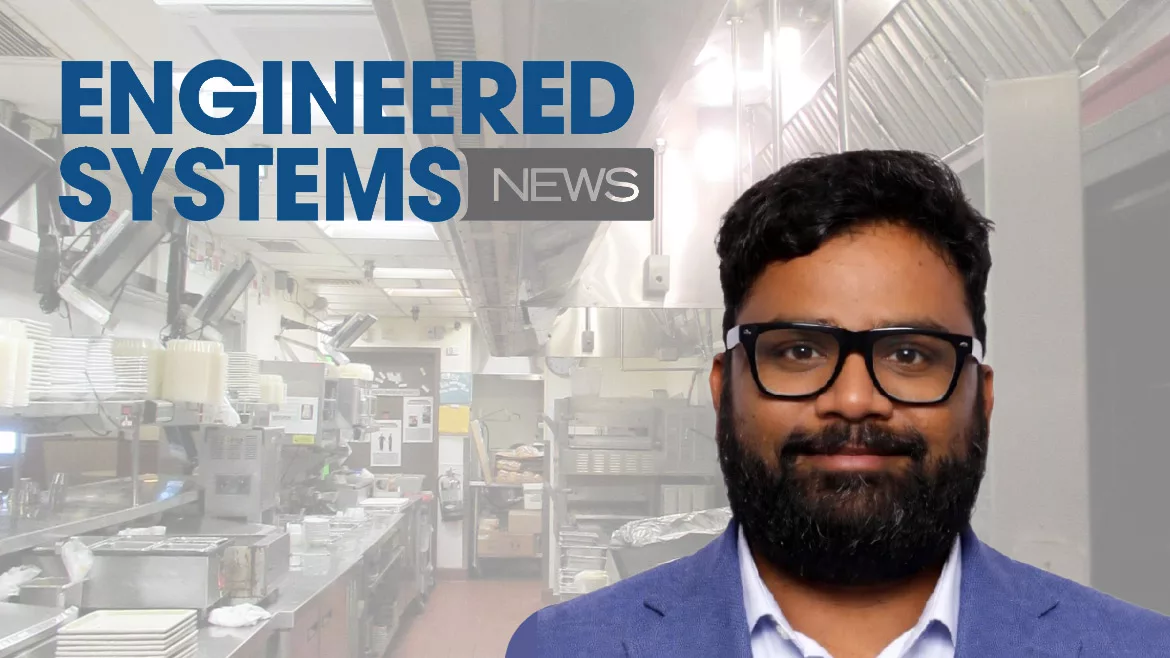
KITCHEN: Inside a kitchen – the focus of Budderfly's study on ventilation imbalance – where the interplay between hoods and make-up air systems quietly shapes restaurant operations.
Walk into the back of almost any quick-service restaurant during the lunch rush, and you will hear what sounds like a healthy kitchen. Hood fans pulling, fryers running, the front door pushed open by a pressure differential strong enough to draw conditioned air from the dining room straight up the flue. To most operators, that constant whoosh means the system is working. However, when it comes to your energy bill, what that sound really means is the building is paying to cool a kitchen exhaust stack.
My team at Budderfly completed a field study across 251 quick-service restaurant sites, spanning fifteen national and regional QSR brands across twelve states and six ASHRAE climate zones. The study found that the noise of a working exhaust fan is one of the most misleading signals in commercial kitchen ventilation and that a high percentage are experiencing serious performance issues.
The results of the data are uncomfortable. By code, the restaurants we studied were commissioned and balanced. But the reality we found on-site told a different story.
Twenty-one of the forty-four cataloged make-up air units (MAUs) were not operational at the time of test-and-balance. Forty-four of forty-eight kitchens were running net-negative pressure, with a median absolute imbalance of 1,717 CFM. The single worst site was off-balance by more than 5,200 CFM. Across the sites we observed, the modeled extra annual cooling load attributable to imbalance alone was roughly half a million kilowatt hours, a figure that does not include the heating penalty in cold-climate stores.
These are not edge cases. These are the everyday operating conditions of typical restaurants.
What 251 Hoods Told Us
| Field Metric | Value |
| Sites studied
|
251 across 30+ states, 7 climate zones, 40 QSR brands
|
| Make-up air units (MAUs) not working at TAB
|
70 of 152 (46%) |
| Sites running net-negative pressure
|
217 of 238 (91%)
|
| Median absolute imbalance (kitchen) | 1,865 CFM |
| Worst single-site imbalance observed
|
11,565 CFM
|
| Modeled extra annual cooling load (sample total)
|
≈ 2.7 million kWh / yr |
| RTU tonnage non-working at survey | 398 of 4,172 tons (9.5%)
|
| Average TAB measurement confidence
|
0.94 (high)
|
A QSR can be code-compliant on the day of inspection and badly out of balance every operating day after that. The imbalances we observed were overwhelmingly negative. That is, the kitchen exhaust hoods were pulling more air out than the MAUs were supplying. In a QSR with a drive-through window cracked open and dining-room doors cycling continuously, that gap caused by imbalance becomes a free-running exhaust path for already-conditioned air. Every cubic foot of dining-room air that crosses the kitchen line and exits the flue is conditioned air the rooftop unit has paid to cool or heat. When conditioned air is pulled out of the building, that means the energy used to cool it was wasted.
The TAB measurement confidence, a quality flag we apply during commissioning based on instrument calibration, repeat readings, and signal stability, averaged 0.80 across the fleet.
How a “Designed – Balanced” Kitchen Drifts
Static commissioning, dynamic operation. TAB is performed once, usually at startup, with the equipment running at a nominal design point. Real kitchens are not static. Burners cycle, prep periods are quiet, peak hours blow through design CFM. A system that was balanced at design is not the system operating at 12:30 p.m. on a Friday.
Filter loading and belt slip. Hood filter media loads up, and the same happens in supply-side filters in the MAU. Belt-driven MAUs start losing revolutions per minute (RPM) to slip long before customers or employees might notice a change in the environment and complain. The exhaust fan, often direct drive, holds its rate. The result is a slow, asymmetric drift toward negative pressure.
Hoods that never turn off. Kitchen staff often turn hoods on at open, off at close, and sometimes leave them running 24/7. Constant exhaust during non-cooking hours causes two compounding problems.
First, while the hood pulls air at full rate around the clock, the make-up air unit on the other side of the building wears down faster than the exhaust fan because it is doing the work of conditioning every cubic foot it brings in. The MAU degrades, the hood does not, and the gap between supply and exhaust widens month by month. Second, every hour the hood runs without cooking is an hour the building is paying to expel conditioned air for no operational reason.
Demand-control kitchen ventilation (DCKV) addresses both problems when it is installed and commissioned correctly, which in QSR retrofits is rarer than the design specifications suggest.
RTUs pressed into MAU duty. In several sites in our sample, a packaged rooftop unit was being asked to deliver make-up air – either because the dedicated MAU had failed and never been replaced, or because the original site design relied on the RTU's outside-air damper as the make-up source rather than installing a separate unit.
RTUs are designed to recirculate and condition air; they are not built to supply 100 percent outside air at the rates a 600-CFM hood demands. The unit overworks, under-delivers, and quietly fails earlier than its rated service life.
No alerting layer. There is no software monitoring the hood or MAU to ensure the kitchen is still in balance, so when balance is lost, no one is alerted.
The energy consequence of these failures leads to overworked equipment and impacts the bottom line. Commercial kitchen hoods commonly operate at 1,000 to 4,000 CFM. In a ten-by-ten kitchen with a ten-foot ceiling, 1,000 CFM exhausts one full room volume every minute. When the make-up air system cannot keep up, the difference is replaced by air the rest of the building has paid to condition, and the HVAC system uses more energy to make up for the loss.
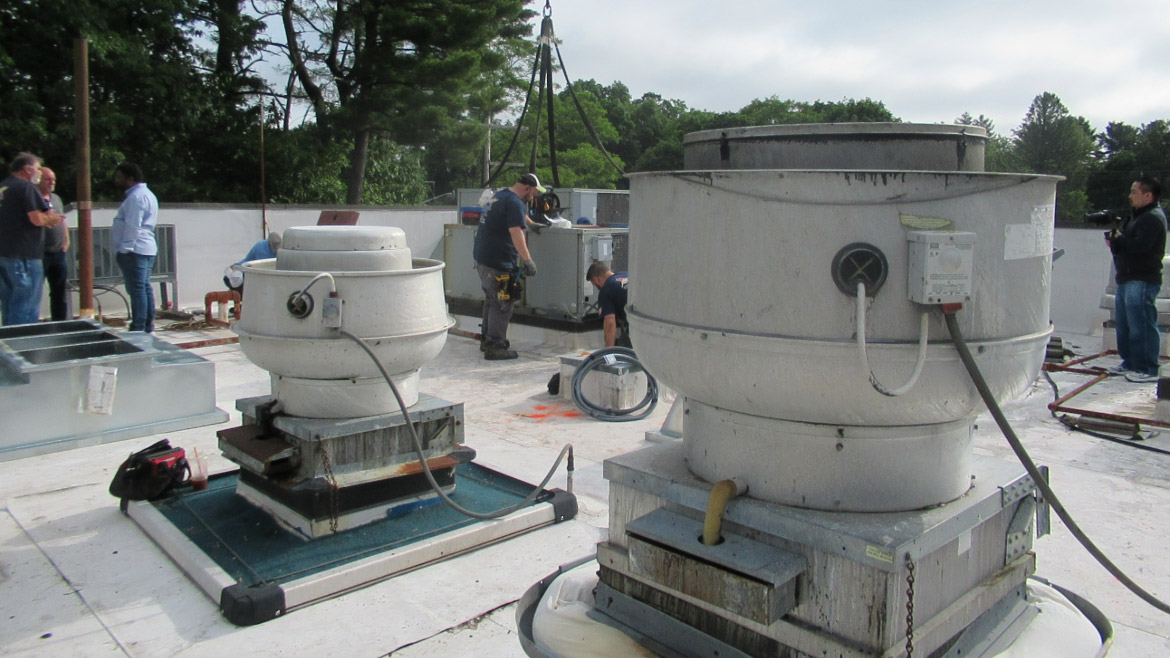
VENT: Technicians perform rooftop ventilation work above a quick-service kitchen. (Courtesy of Budderfly)
The Code Floor Is Not the Performance Ceiling
ASHRAE 154 and IMC Chapter 5 define the floor for commercial kitchen ventilation. They specify minimum exhaust rates by appliance duty, minimum replacement air, and the obligation to balance the kitchen at commissioning. None of these standards require continuous monitoring, fault detection, or alerting on imbalance once the building is occupied.
Title 24 in California and the most recent IECC commercial provisions push DCKV adoption further but still focus on the design-phase ventilation rate and control approach. They do not address the operational fault state of the system three years into service. The industry has, in effect, optimized the front end of the ventilation lifecycle and largely abandoned the back end.
This is the gap that field data like ours expose, and it is the gap the next generation of restaurant controls has to close.
From One-Time Commissioning to Continuous Diagnostics
The TAB study described above is a one-time snapshot. To close the gap between design intent and three-years-in operating reality, the snapshot has to become a stream.
An emerging architecture for continuous fault detection in kitchen ventilation has begun appearing in commercial control patents and in pilot deployments across the QSR segment. It pairs a network of sensors at the hood, MAU, and room (exhaust detection, CFM measurement on both supply and exhaust sides, room pressure, supply-air temperature, and cooking-state inference from the appliance temperature signature) with cloud-based control software that does three things in real time.
First, it modulates exhaust and make-up air fan speeds together to maintain a target room pressure. Second, it compares measured airflow against expected airflow to surface specific fault modes. Third, it generates contextual alerts that distinguish a clogged filter from a failed fan from a thermostat fault on the MAU heater.
The diagnostic logic is the part that matters most for fleet operators. If exhaust CFM is below expectation while the exhaust fan is commanded to full speed, the system flags a blocked filter or failing fan, not a generic MAU problem. If supply CFM does not match exhaust CFM within tolerance, the system flags imbalance and identifies which side is short. If supply temperature drifts outside acceptable bounds during shoulder seasons, the heating or cooling section of the MAU is suspected, with the relevant component called out.
Each of these diagnoses, in our 251-site sample, was being made by hand by a TAB technician with a Magnehelic gauge and an anemometer. The premise of continuous diagnostics is that what a TAB technician determines on a Tuesday afternoon visit, a cloud-connected controller should be determining every minute of every operating day, and pushing the result to whoever in the operating company can act on it.
A Five-Step Field Playbook for QSR Operators
For operators, especially those with a fleet of more than ten sites, there are a handful of concrete steps you can take to close the gap and ensure balance in your kitchens.
- Treat MAU fault detection as a first-class metric. If you cannot answer the question “how many of my MAUs are running in fault right now?” you are likely wasting energy and money on cooling too much air.
- Reject RTU-as-MAU configurations on retrofits. A packaged rooftop unit pressed into make-up service is not a long-term answer, it is a deferred capital expense. Make sure you get a dedicated MAU on every retrofit, sized to the active hood CFM at peak.
- Demand imbalance data before and after every commissioning. The standard TAB sheet is necessary but not sufficient. Add a single row: net imbalance in CFM at peak cooking. Anything outside ±200CFM demands immediate attention
- Pair DCKV with continuous monitoring, not just controls. DCKV alone reduces fan energy. DCKV plus continuous fault detection prevents the slow drift back to constant-volume override that we observed at multiple sites in the sample.
- Push the alert to the operator, not the maintenance manager. The alert architecture should reach the operator on shift, not a regional facilities inbox that is only sporadically monitored, so faults can be addressed quickly.
Monitoring Is the Solution
The technology to balance, modulate, and monitor a commercial kitchen ventilation system has existed for at least a decade. What has been missing is a continuous, automated layer that watches the balance every minute, distinguishes the four or five common failure modes well enough to send the right technician with the right part on the first truck roll, and keeps doing so for the operating life of the building.
The exhaust path is one of the largest single energy flows in a quick-service restaurant. Treating it as an unmonitored utility, balanced once at commissioning and never again, is leading to overworked equipment and costing QSRs thousands of dollars in wasted energy.
Methodology Note
Field data were collected from 251 QSR sites between October 2023 and March 2026 using calibrated TAB instrumentation. Sites span ASHRAE climate zones 1 through 7 and more than thirty U.S. states. Imbalance is defined as MAU supply CFM minus kitchen exhaust fan CFM at peak cooking. Modeled extra annual cooling load is computed using bin-method weather data weighted by climate zone and a fixed indoor setpoint of 80 °F, and reflects the subset of sites for which both supply and exhaust airflow were measured. Site-level data is anonymized at the brand level for confidentiality.
Looking for a reprint of this article?
From high-res PDFs to custom plaques, order your copy today!


