The Effect of COVID-19 on Refrigeration and Air Conditioning Loads in Restaurants Across California
The World Health Organization (WHO) indicated that people can catch COVID-19 from others who have the virus. The disease spreads primarily from person to person through small droplets from the nose or mouth, which are expelled when a person with COVID-19 coughs, sneezes, or speaks. These droplets are relatively heavy, do not travel far, and quickly sink to the ground. People can catch COVID-19 if they breathe in these droplets from a person infected with the virus.1
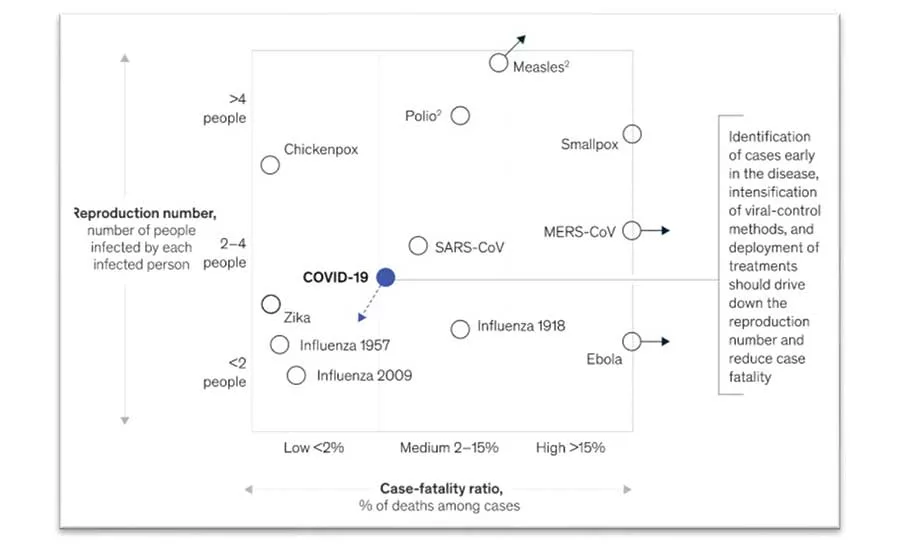
The virus is also highly transmissible. Both observed experience and emerging scientific evidence show that the virus causing COVID-19 is significantly more transmissible than seasonal flu.2
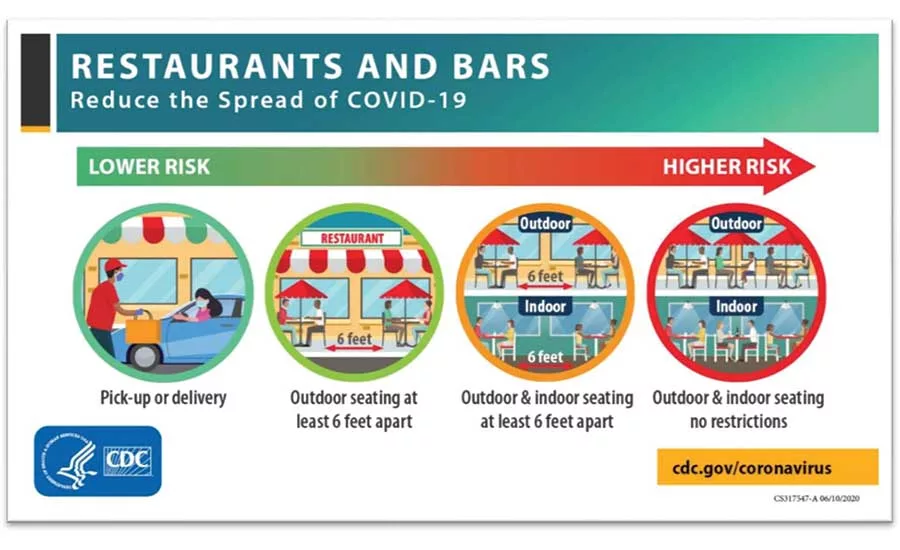
Because of this risk transmission, The Centers for Disease Control and Prevention (CDC) issued its “Considerations for Restaurants and Bars” recommending that restaurants operate with seating capacity reduced to allow tables to be spaced at least 6 feet apart.4
While some states have limited restaurant seating capacity at 25%-50%, California strayed from implementing an occupancy cap. Instead, Gov. Gavin Newsom said that California is focusing on physical distancing rather than one-size-fits all seating caps.6
California has more than 90,000 restaurant locations that have been impacted by these changes from different angles.7 This article explores how these mandated capacity changes are affecting, and will continue to affect, the restaurants' energy consumption.
The Energy Model
The energy model used in all the simulations was the Full Service Restaurant model from the DOE Commercial Building Benchmark Models as developed by the U.S. Department of Energy (DOE), Lawrence Berkeley National Laboratory (LBNL), Pacific Northwest National Laboratory (PNNL), and the National Renewable Energy Laboratory (NREL) under the Net-Zero Energy Commercial Building Initiative8.
The energy analysis was done using the latest publicly available version of EnergyPlus (9.3.0), which was also developed by the DOE and the National Renewable Energy Laboratory (NREL).
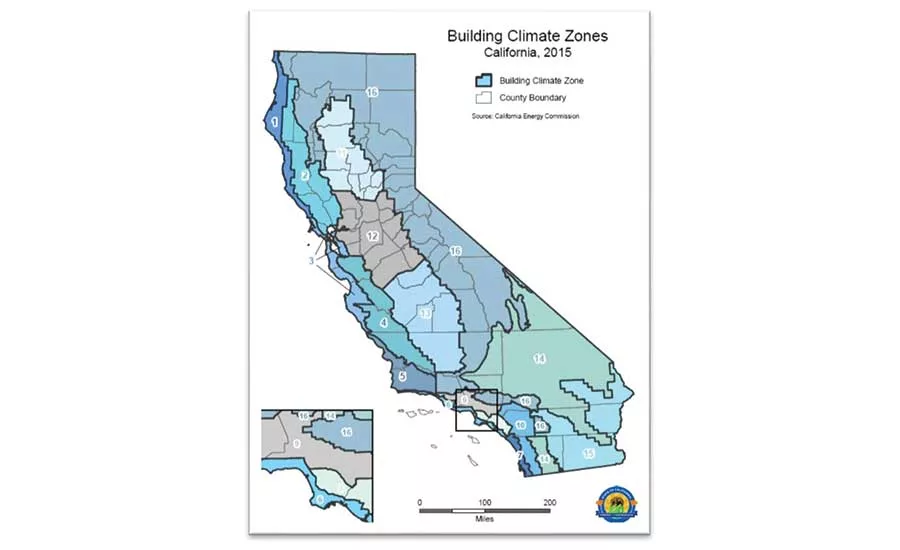
A total of 16 different California climate zones were modeled covering the entire range of the State’s microclimate conditions as shown in Figure 3 below.
Three different occupancy scenarios were used: full occupancy (100%), half occupancy (50%), and quarter occupancy (25%).
The data was captured for 365 days a year, 24 hours a day and in 10 minutes intervals each hour, for 16 climate zones with three occupancy options; a total of more than 2.5 million simulations.
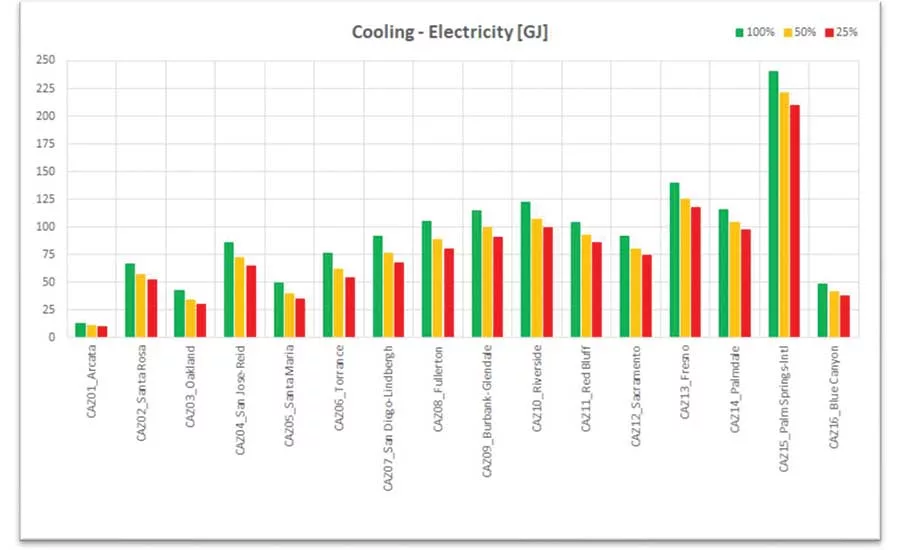
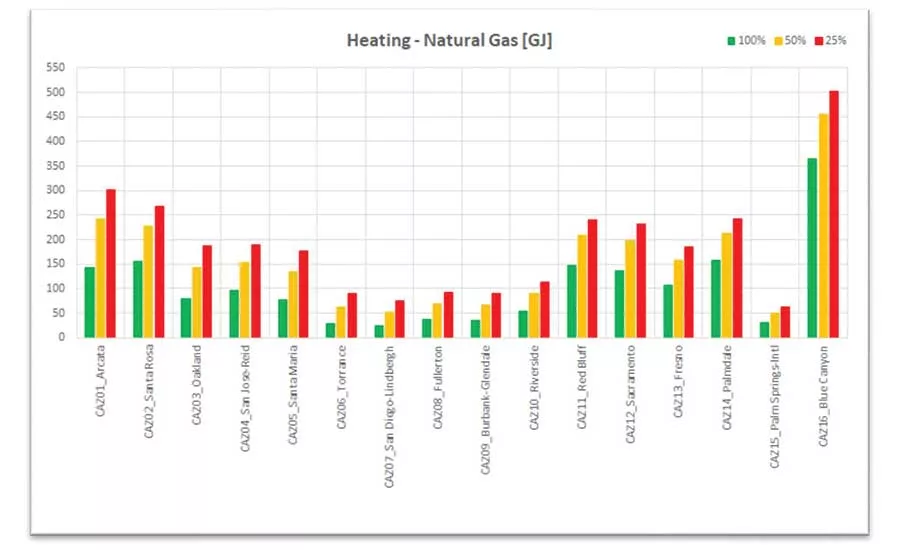
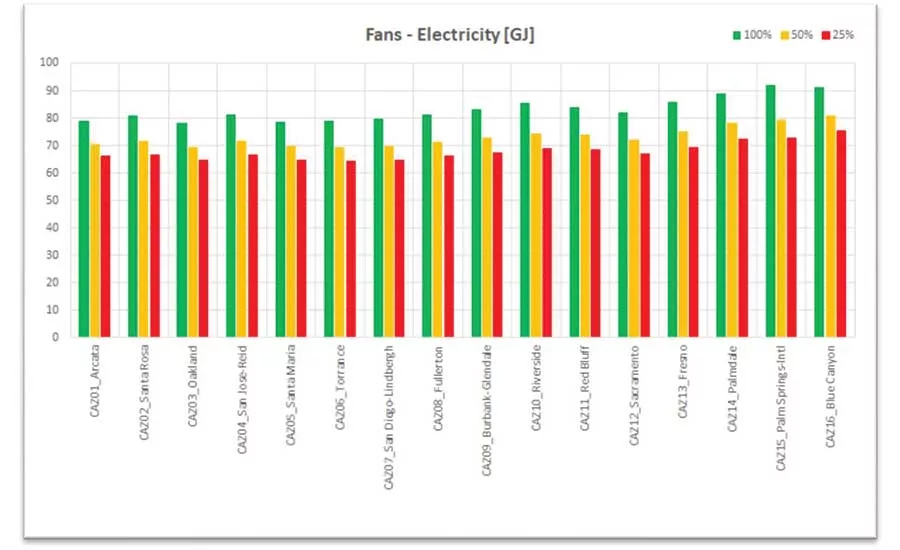
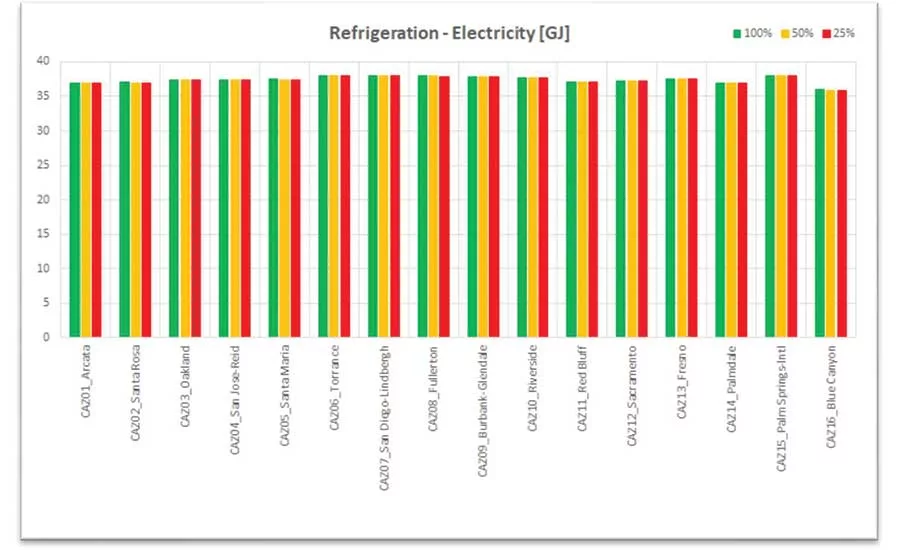
In each simulation, the energy consumption for four different systems was captured. These systems are: HVAC cooling, HVAC heating, ventilation, and refrigeration. Figure 4, Figure 5, Figure 6, and Figure 7 illustrate the energy consumption of these different systems respectively.
As may have been predicted, the analysis clearly illustrates that the HVAC cooling load as well as the ventilation energy consumption will potentially go down with the reduced occupancy. However, the HVAC heating load is projected to increase with reduced occupancy. This is partially due to the reduced lighting load as well as the occupants’ load. The refrigeration system energy consumption will almost remain flat since quite a bit of restaurants’ refrigeration systems are limited in their ability to shed loads with reduced service.
An important point here though is that the change in energy consumption is not linearly proportional with the change in occupancy. For example, when dropping the capacity by 50%, the HVAC cooling energy consumption went down by an average of 15% only, ventilation went down by 12% while the heating went up by an average of 65%. Dropping down to quarter capacity with 25% occupancy resulted in an average of only 22% reduction in the cooling energy consumption, 18% reduction in the ventilation energy consumption, and more than doubling of the heating energy consumption (110%).
Adapt to the New Reality
This analysis may be perceived as bad news for restaurant owners and operators as their lingering or hysteresis costs related to their utilities may are not scaling to their reduced revenue, but it shouldn’t.
The aim of this article is not to give designers, owners, or operators a direct how-to manual for their restaurants. The objective rather is to provide another angle to consider when assessing the operations of their HVAC and refrigeration systems.
Though this is not intended to be a managerial article but rather a technical one, a closing managerial suggestion may be appropriate here.
It will be quite some time before we understand the full impact of this pandemic. But the history of such shocks tells us two things. First, even in severe economic downturns and recessions, some companies are able to gain advantage. Second, crises produce not just a plethora of temporary changes (mainly short-term shifts in demand) but also some lasting ones. In times of crisis, it’s easy for organizations to default to old habits — but those are often the times in which new approaches are most valuable. As companies position themselves for the new normal, they cannot afford to be constrained by traditional information sources, business models, and capital allocation behaviors. Instead, they must highlight anomalies and challenge mental models, revamp their business models, and invest their capital dynamically to not only survive the crisis but also thrive in the post-crisis world.9
References
- “Q&A on Coronaviruses (COVID-19),” August 18, 2020, who.org
- “COVID-19: Briefing note #2,” March 9, 2020, mckinsey.com
- Ibid.
- “Considerations for Restaurants and Bars,” August 18, 2020, cdc.gov
- Ibid.
- “California releases restaurant reopening guidelines with 'flexibility' on occupancy.” May 12, 2020, Nation’s Restaurant News
- “COVID-19 Restaurant letter to Governor Gavin Newsom and the state legislature,” March 27, 2020, calrest.org
- The Benchmark buildings are available from the U.S. Department of Energy website at
- http://energy.gov/eere/buildings/commercial-reference-buildings
- See also Torcellini, P. et al. (2008). DOE Commercial Building Benchmark Models. National Renewable Energy Laboratory.
- Jacobides, M. and Reeves, M., 2020, “Adapt Your Business to the New Reality,” September-October, Harvard Business
- Review.
Looking for a reprint of this article?
From high-res PDFs to custom plaques, order your copy today!