ACHR News
search
Ask ACHR NEWS AI
cart
facebook twitter instagram linkedin youtube
  • Sign In
  • Subscribe
  • Sign Out
  • My Account
ACHR News
  • NEWS
    • Breaking News
    • New HVAC Products
    • Featured Products
    • Manufacturer Reports
    • HVAC Data
    • Legislation
    • ACHR NEWS Centennial
  • RESIDENTIAL
    • Air Conditioners
    • Furnaces
    • Residential Heat Pumps
    • Ductless
    • Residential IAQ
    • Testing, Monitoring, Tools
    • Components & Accessories
  • COMMERCIAL
    • Air Handlers
    • Rooftop Units
    • Chillers and Cooling Towers
    • Commercial Heat Pumps
    • Boilers and Hydronics
    • VRF/Ductless
    • Commercial IAQ
  • REFRIGERATION
    • Refrigerants
    • Refrigerant Regulations
    • Leak Management
  • CONTRACTOR PRO
    • Geothermal
    • Homeowner Study
    • VRF and VRV Ductless
    • Unitary Trends
  • EDUCATION
    • Training and Education
    • Business Management
    • Service and Maintenance
    • Continuing Education
    • Market Research >
      • HVAC Brand Awareness Report
      • VRV, VRF, VRVZ Report
      • Unitary Trends Report
      • Water Heat Professionals Report
    • Webinars
    • Sponsor Insights
    • eProducts Info
    • White Papers
  • EVENTS
    • HVAC Contractor Forum
    • Industry Events and Webinars
  • MEDIA
    • Videos
    • AHR Expo 2025 Videos
    • Podcasts >
      • ACHR News Podcast
      • HARDI Podcasts
      • AHR Expo Podcasts
      • ACCA Podcasts
    • Interactive Spotlights
    • Quizzes
    • eBooks
    • HVAC Talkback
  • HVAC GROUP
    • ACHR NEWS >
      • Current Issue
      • Digital Edition
      • Subscribe
    • Distribution Trends
    • SNIPS NEWS >
      • Join SNIPS NEWS
    • Engineered Systems News >
      • Join ES News
    • HVACR Directory
    • Contests
    • Newsletters
    • Contact
    • Advertise
    • My Account

What You Need to Know About Motor Speed

June 20, 2001
Figure 1. Two-pole motor.
An important part of determining the correct replacement motor for a particular application is understanding motor speed. In this article, I’ll discuss some of the basic concepts behind ac induction motor speed. We’ll look at multispeed motors in a future article.

Every motor has magnetic poles, just like a permanent magnet. These poles are created by bundles of magnet wire wound together in the slots of the stationary part of the motor (the stator core).

Look inside an electric motor and you can count the number of poles or windings (see the photos that accompany this article). The number and alignment of these bundles of wires creates magnetic poles, and the number of poles in the motor determines the motor’s speed, stated in revolutions per minute (rpm).

Keep in mind, no-load rpm is a factor of motor poles and power frequency, not voltage, horsepower, or motor diameter.

With that knowledge in mind, you may surmise that every four-pole ac induction motor runs at the same speed. This is in fact the case. You can determine this speed by using the following formulas:

For 60-Hz electrical systems — 7,200 divided by the number of poles gives you the no-load rpm.

For 50-Hz systems — 6,000 divided by the number of poles gives you the no-load rpm.

(For the purpose of this article, I’ll use the North American [60-Hz] system.)

Another important element to remember from this formula is that I’ll be giving you the no-load rpm in the following examples. You should note that under load, the rotating parts of the motor fall behind, or “slip,” the magnetic speed.

Looking for quick answers on air conditioning, heating and refrigeration topics? Try Ask ACHR NEWS, our new smart AI search tool. Ask ACHR NEWS →
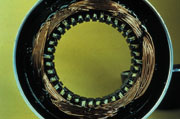


Figure 2. Four-pole motor.

Motor Types, Applications

Using the standard formula, you can determine that a four-pole motor operating under no-load conditions will run at 1,800 rpm (7,200 divided by four poles). Loaded, the motor will slip to between 1,600 and 1,750 rpm. Four-pole designs are the most common pole configuration for ac induction motors and are typically found in belted applications such as blowers, fans, air-handling equipment, compressors, commercial garage door openers, and conveyors.

A two-pole motor will operate at 3,600 rpm unloaded and between 3,000 and 3,450 rpm under load. Such speeds are commonly found in pump applications, such as submersible pumps, sump pumps, and pool or water recirculating equipment.

Another typical application is small ventilating fans. To the untrained ear, two-pole motors appear to need servicing because they sound somewhat noisier when running. This is principally due to the higher rpm. As a service technician, you should be aware of the different “normal” sounds a motor makes that are related to speed.

Six-pole motors run at 1,200 rpm unloaded and between 1,050 and 1,175 rpm loaded. They are often used for air-handling equipment, direct-drive applications, window fans, furnace blowers, room air conditioners, heat pumps, residential garage door openers, and other equipment.

As you can imagine, lower mechanical speeds often result in quieter designs, which makes an eight-pole motor well-suited for many residential applications where noise is a factor. These motors operate at 900 rpm unloaded (between 800 and 875 rpm loaded), and are being used more extensively today in room air conditioning, outdoor heat pumps, and residential garage door openers.

A less common design is the 12-pole motor. This motor, which runs at 600 rpm unloaded, is used in washing machines and other equipment that requires a slow cycle.



Figure 3. Six-pole motor.

Pole to Pole

Here’s the important point to remember: When replacing a motor, you must select a replacement with the same number of poles as the original.

In changing, say, from a four-pole to a six-pole design, the speed mismatch is likely to create significant problems.

Now that you understand the principles behind motor speed, you’re ready to learn about multispeed motors and their uses. That will be tackled in a future Motor Doctor article.

Simon, The News’ “Motor Doctor,” is with A.O. Smith Corp., Milwaukee, WI; 414-359-4104; 414-359-4064 (fax).

Publication date: 06/25/2001

Share This Story

Looking for a reprint of this article?
From high-res PDFs to custom plaques, order your copy today!


Recommended Content

JOIN TODAY
To unlock your recommendations.

Already have an account? Sign In

  • HVAC-enrollment

    The Trades Are Back: HVACR Programs See Nearly 30% Enrollment Spike

    A new wave of future technicians is entering the pipeline.  
    Training and Education
    By: Matt Jachman
  • 2025 Top 40 Under 40

    2025 Top 40 Under 40 HVACR Professionals List

    The 11th annual Top 40 Under 40 list highlights those...
    HVAC Residential Market
    By: Hannah Belloli-Oster
  • LG Ductless Mini-Split Systems

    The 9 Types of Heat Pumps

    As the U.S. moves toward electrification, heat pumps are...
    News
    By: Joanna R. Turpin
Subscription Center
  • Create an Account
  • Start a Subscription
  • Manage My Account
  • Sign Up for Newsletters
  • Visit Customer Service
  • Update Preferences

More Videos

Sponsored Content

Sponsored Content is a special paid section where industry companies provide high quality, objective, non-commercial content around topics of interest to The News audience. All Sponsored Content is supplied by the advertising company and any opinions expressed in this article are those of the author and not necessarily reflect the views of The News or its parent company, BNP Media. Interested in participating in our Sponsored Content section? Contact your local rep!

close
  • Piggy Bank
    Sponsored byWatercress Financial

    Energy Prices, Inflation, and HVAC: What Today’s Homeowners Care About

  • Refrigerated Food
    Sponsored bySolstice Advanced Materials

    R-455A Refrigeration: A Cold Storage Solution for the Future

  • Airex Rooftop Units
    Sponsored byAirex Manufacturing Inc

    Consolidating Roof Penetrations: A Growing Trend in Multifamily HVAC Design

Popular Stories

Lennox equipment

Platinum Equity to Sell Heat Controller to Lennox

HVAC-tech-van.jpg

Report: Only 65% of HVAC Technician Time is Billable Hours

HVAC Minute retail refrigeration system

EPA Final Rule’s Impact on R-410A Deadlines

Lovato-refrigerant-rooftop_AC_Units_.jpg

When Refrigerants Change, So Do the Contactors

Dealer_Couple2_Kitchen_Estimate.jpg

Predicting the Next Service Call

View The ACHR NEWS
Centennial Anniversary Timeline

The ACHR News Timeline Chart
Submit a Letter
Submit a letter to our editors.

Events

November 6, 2025

Next-Gen Data Center Cooling: HVAC Innovation and Real-World Solutions

On Demand As AI workloads and high-density computing push traditional cooling methods to their limits, the data center industry is accelerating the adoption of next-generation HVAC technologies.

July 28, 2026

How Top Home Services Companies Turn Every Conversation Into Predictable Revenue

In this webinar, we'll outline how top contractors are turning every conversation into predictable revenue by coaching every comfort advisor visit, not just the ones a manager rides along on.

View All Submit An Event

Poll

Summer Staff

Are you fully staffed for the summer season?
View Results Poll Archive

Products

BNI Mechanical/Electrical Square Foot Costbook, 2026 Edition

BNI Mechanical/Electrical Square Foot Costbook, 2026 Edition

See More Products
Designing Systems Using A2L Refrigerant - Free Webinar - 7/22/2026

Related Articles

  • What you need to know about California's Proposition 65 law

    See More
  • Boilers

    What You Need to Know About The EPA’s New Boiler Rules

    See More
  • Intellyx 2019

    What You Need to Know — and Ignore — About Machine Reasoning

    See More

Related Products

See More Products
  • new cover.jpg

    Profit is An Attitude: The Strategies You Need to Optimize Profits

  • The ACHR News - June 30, 2025

    ACHR NEWS June 30, 2025, Issue

See More Products

Events

View AllSubmit An Event
  • April 14, 2026

    Inside HVAC Lending: What Contractors Need to Know to Close More Sales

    On Demand From this webinar, attendees will learn how to use financing as a strategic sales tool for growth in a repair market. 
View AllSubmit An Event

Related Directories

  • SpeedClean

    SpeedClean manufactures and markets HVAC maintenance tools like portable coil cleaning systems, biodegradable coil cleaners, tube cleaners, mini-split cleaning systems and much more.
×

Sign Up. Stay Informed.

The #1 trusted source for the HVACR industry since 1926

SUBSCRIBE
  • RESOURCES
    • Advertise
    • Contact Us
    • Advisory Board
    • Classifieds
    • Submit a Letter
    • Directories
    • Store
  • ACCOUNT CENTER
    • Create an Account
    • Start a Subscription
    • Manage My Account
    • Sign Up for Newsletters
    • Visit Customer Service
    • Update Preferences
  • SERVICES
    • Marketing Services
    • Reprints
    • Market Research
    • List Rental
    • Survey/Respondent Access
  • STAY CONNECTED
    • LinkedIn
    • Facebook
    • Instagram
    • YouTube
    • X (Twitter)
  • PRIVACY
    • PRIVACY POLICY
    • TERMS & CONDITIONS
    • DO NOT SELL MY PERSONAL INFORMATION
    • PRIVACY REQUEST
    • ACCESSIBILITY

Copyright ©2026. All Rights Reserved BNP Media, Inc. and BNP Media II, LLC.

Design, CMS, Hosting & Web Development :: ePublishing