ACHR News
search
Ask ACHR NEWS AI
cart
facebook twitter instagram linkedin youtube
  • Sign In
  • Subscribe
  • Sign Out
  • My Account
ACHR News
  • NEWS
    • Breaking News
    • New HVAC Products
    • Featured Products
    • Manufacturer Reports
    • HVAC Data
    • Legislation
    • ACHR NEWS Centennial
  • RESIDENTIAL
    • Air Conditioners
    • Furnaces
    • Residential Heat Pumps
    • Ductless
    • Residential IAQ
    • Testing, Monitoring, Tools
    • Components & Accessories
  • COMMERCIAL
    • Air Handlers
    • Rooftop Units
    • Chillers and Cooling Towers
    • Commercial Heat Pumps
    • Boilers and Hydronics
    • VRF/Ductless
    • Commercial IAQ
  • REFRIGERATION
    • Refrigerants
    • Refrigerant Regulations
    • Leak Management
  • CONTRACTOR PRO
    • Geothermal
    • Homeowner Study
    • VRF and VRV Ductless
    • Unitary Trends
  • EDUCATION
    • Training and Education
    • Business Management
    • Service and Maintenance
    • Continuing Education
    • Market Research >
      • HVAC Brand Awareness Report
      • VRV, VRF, VRVZ Report
      • Unitary Trends Report
      • Water Heat Professionals Report
    • Webinars
    • Sponsor Insights
    • eProducts Info
    • White Papers
  • EVENTS
    • HVAC Contractor Forum
    • Industry Events and Webinars
  • MEDIA
    • Videos
    • AHR Expo 2025 Videos
    • Podcasts >
      • ACHR News Podcast
      • HARDI Podcasts
      • AHR Expo Podcasts
      • ACCA Podcasts
    • Interactive Spotlights
    • Quizzes
    • eBooks
    • HVAC Talkback
  • HVAC GROUP
    • ACHR NEWS >
      • Current Issue
      • Digital Edition
      • Subscribe
    • Distribution Trends
    • SNIPS NEWS >
      • Join SNIPS NEWS
    • Engineered Systems News >
      • Join ES News
    • HVACR Directory
    • Contests
    • Newsletters
    • Contact
    • Advertise
    • My Account

Troubleshooting Compressors With a DMM

May 15, 2006
The core of a refrigeration system is the compressor. It is designed to pump cool refrigerant gas from the evaporator into the condenser. To accomplish this task, the compressor raises the temperature and pressure of the low superheated gas, forcing it into the condenser.

The compressor should never pump liquid. This not only damages the compressor, but it also can create a potential safety hazard.

Similar to the human heart, the refrigeration compressor needs to be properly maintained and requires periodic inspection and testing. Unfortunately, the compressor is often ignored until it malfunctions or stops running altogether, at which time it gets replaced and the system is back up and running - temporarily. Often the culprit is not the compressor, but a system failure or design problem with accessory equipment that killed the compressor prematurely.

Below are steps to follow for troubleshooting a compressor and the associated problems that can cause a system to fail prematurely.
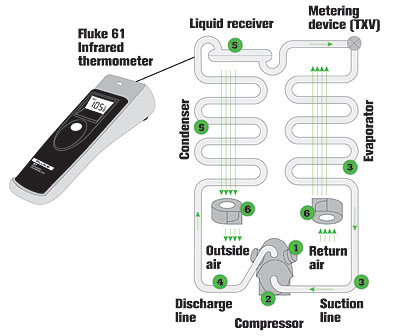
FIGURE 1. You can quickly survey a refrigeration system by scanning the temperatures of various components with an infrared (IR) thermometer.

SUCTION AND DISCHARGE PRESSURE

Both the suction and discharge pressures at the compressor are normally measured with a standard set of refrigeration gauges. An explanation of how to measure both pressures on the suction and high side of the system with a digital multimeter (DMM) and a pressure/vacuum module, with or without standard gauges is included here. If the gauges are left on the system and used in conjunction with this test, the module will verify the accuracy of the standard manifold gauges.

To measure the pressures on your DMM in conjunction with standard manifold gauges:

1. Attach the pressure/vacuum module hose fitting to the refrigerant service hose on the manifold gauge set (usually the yellow hose).

2. Attach the pressure/vacuum module to a DMM and set the module function to cm/in. Hg.

3. Install the blue and red hoses to the suction side and high side of the system, just as during any normal service process.

To read suction pressure on the DMM, open the blue handle on the manifold gauges. This puts the system suction pressure into the pressure/vacuum module. Read the pressure on the digital readout and compare it to the gauge pressures. Don't be alarmed if the pressures don't match exactly. Today's DMMs, like the Fluke PV350, are typically much more accurate than a standard set of refrigeration gauges.

Looking for quick answers on air conditioning, heating and refrigeration topics? Try Ask ACHR NEWS, our new smart AI search tool. Ask ACHR NEWS →

To read the discharge pressure on the DMM, close the blue valve on the gauges and open the red handle on the manifold gauges. This puts the system discharge pressure into the module.

To remove the module, reverse the process followed when installing the unit.

(Caution: Be sure to close the high-side port of the gauges first, and remove the refrigerant from the high-side gauge by allowing the compressor to run and pull excess refrigerant into the low side of the system.)

To measure the pressures on the DMM and pressure/vacuum module without installing the manifold gauges:

1. Attach the module hose fitting to any standard refrigerant service hose.

2. Connect the refrigeration hose to the service port on the compressor.

3. Open up the service port and read the refrigerant pressure directly on the pressure/vacuum module.

It is possible to read one pressure at a time using a single pressure/vacuum module. Technicians will need to record the suction or discharge pressure one at a time. Or, if using a DMM with a minimum/maximum (min/max) feature, such as a Fluke 179, they can record the suction pressure as the minimum value, then record the discharge pressure as the maximum value.

To remove the pressure/vacuum module, reverse the process followed when installing the unit. (Caution: Be careful when removing the high-side port of the gauges as it can be under very high pressure.)

To minimize refrigerant loss, learn to practice safe refrigerant-handling habits when removing the module from the high side of the system. Shut off the compressor prior to gauge removal and allow the pressure to equalize. When removing the gauge from the low side of the system, it is not necessary to shut down the compressor first.

Suction and discharge pressures at the compressor can be measured on the suction and high side of the system with a digital multimeter (DMM) and a pressure/vacuum module, with or without standard gauges.

COMPRESSOR DISCHARGE LINE TEMPERATURES

Pressure and temperature are fundamental tests that can be performed to determine what is happening inside the compressor.

To measure the temperature of the compressor, take the following steps:

  • Use a pipe clamp accessory with a DMM to measure the discharge line temperature at the discharge of the compressor. Temperatures above 275° to 300°F (135° to 148°C) will slowly destroy lubricant qualities and with it, the performance of the compressor.

    High-temperature conditions can be caused by high condensing temperatures/pressures, insufficient refrigerant charge, noncondensibles within the system, high superheat from the evaporator, restricted suction line filters, or low suction pressure. These conditions cause the compressor to have a higher-than-normal compression ratio, work harder, generate hotter internal hermetic motor windings, and as a result, cause compressor wear, fatigue, and failure.

    A temperature survey is a critical part of the service technicians' job. A quick check of a system's components not only helps diagnose troubles, but also allows the technician to anticipate failures by regular monitoring of critical temperatures. Use an infrared thermometer to do a quick survey of: compressor head temperatures; compressor oil sump temperatures; evaporator coil and suction line temperatures; discharge line temperatures; condenser coil and liquid line temperatures; and fan motor temperatures.

    Technicians can quickly survey a refrigeration system by scanning the temperatures of various components with an infrared (IR) thermometer (see Figure 1). While touching each component may do this, a noncontact infrared tool is faster and much more accurate. By keeping good records, technicians may detect trends that indicate impending failure.

    (Note: IR instruments read best when they are measuring an object with a dull surface. If the surface is shiny, dull it with black markers, nongloss paint, masking tape, electrical tape, etc.)

    RECORDING TEMPERATURE OVERNIGHT

    When working on refrigeration systems, it is often useful to record temperatures in the refrigerated space. This enables technicians to detect problems that would go unnoticed with a single system check.

    By recording min/max temperatures in key locations over a period of time, technicians can make sure that air circulation and refrigeration capacity meet the application's requirements. Digital recording thermometers allow these temperatures to be recorded over extended periods of time. Some DMMs can also measure min/max of a single temperature, and have the benefit of a 100-hour relative time stamp to record when the min/max occurred. Dual channels can record two temperatures at the same time.

    Being able to record temperature differences across a coil for extended periods of time comes in handy for troubleshooting erratic problems where the technician may not be able to wait until the problem occurs.
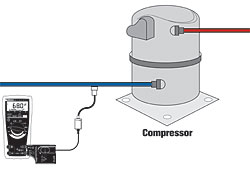
    FIGURE 2. To test for internal valve leakage in small hermetic and semi-hermetic compressors medium- and low-temp applications, attach a pressure/vacuum module to a DMM and set the module to cm/in. Hg. Connect the module at the suction line service port. Close the compressor off from the low side of the system by front seating the suction service valve. Run the compressor two minutes. Turn off the compressor and observe the reading.

    COMPRESSOR VALVE PERFORMANCE

    The following method can be used to test for internal valve leakage in small hermetic and semihermetic compressors used in medium- and low-temperature applications. (See Figure 2.)

    1. Attach a pressure/vacuum module to a DMM and set the module to cm/in. Hg.

    2. Connect the module at the suction line service port.

    3. Close the compressor off from the low side of the system by front seating the suction service valve.

    4. Run the compressor two minutes.

    5. Turn off the compressor and observe the reading. It should have pulled down to at least 16 inches (410 mm) of Hg. If the vacuum reading starts weakening toward 10 inches (254 mm) of Hg vacuum, the discharge valves of the compressor may be leaking and will probably need to be replaced.

    If the compressor doesn't pull a vacuum below 16 inches Hg, the suction valves are weakening and may need to be replaced. If the compressor is welded or hermetically sealed and these conditions exist, a new compressor is the only possible remedy.

    (Caution: Whenever replacing a compressor with faulty valves, be sure to diagnose the complete refrigeration system before and after a new compressor is installed to avoid repeat compressor failures.)

    Duane Smith is a Fluke specialist on digital multimeters. A 30-year veteran, Smith trains test tool users, troubleshoots field applications, and helps develop new DMMs and electrical testers. He may be contacted at 425-446-5681; duane.smith@fluke.com.

    Publication date: 05/15/2006

  • Share This Story

    Looking for a reprint of this article?
    From high-res PDFs to custom plaques, order your copy today!


    Recommended Content

    JOIN TODAY
    To unlock your recommendations.

    Already have an account? Sign In

    • HVAC-enrollment

      The Trades Are Back: HVACR Programs See Nearly 30% Enrollment Spike

      A new wave of future technicians is entering the pipeline.  
      Training and Education
      By: Matt Jachman
    • 2025 Top 40 Under 40

      2025 Top 40 Under 40 HVACR Professionals List

      The 11th annual Top 40 Under 40 list highlights those...
      HVAC Contracting
      By: Hannah Belloli-Oster
    • LG Ductless Mini-Split Systems

      The 9 Types of Heat Pumps

      As the U.S. moves toward electrification, heat pumps are...
      HVAC Residential Market
      By: Joanna R. Turpin
    Subscription Center
    • Create an Account
    • Start a Subscription
    • Manage My Account
    • Sign Up for Newsletters
    • Visit Customer Service
    • Update Preferences

    More Videos

    Sponsored Content

    Sponsored Content is a special paid section where industry companies provide high quality, objective, non-commercial content around topics of interest to The News audience. All Sponsored Content is supplied by the advertising company and any opinions expressed in this article are those of the author and not necessarily reflect the views of The News or its parent company, BNP Media. Interested in participating in our Sponsored Content section? Contact your local rep!

    close
    • Piggy Bank
      Sponsored byWatercress Financial

      Energy Prices, Inflation, and HVAC: What Today’s Homeowners Care About

    • Refrigerated Food
      Sponsored bySolstice Advanced Materials

      R-455A Refrigeration: A Cold Storage Solution for the Future

    • Airex Rooftop Units
      Sponsored byAirex Manufacturing Inc

      Consolidating Roof Penetrations: A Growing Trend in Multifamily HVAC Design

    Popular Stories

    Refrigerants-and-gauge.jpg

    HVAC Industry Warns of Counterfeit Refrigerants Entering U.S. Supply Chain

    Lennox equipment

    Platinum Equity to Sell Heat Controller to Lennox

    HVAC Minute retail refrigeration system

    EPA Final Rule’s Impact on R-410A Deadlines

    HVAC-tech-van.jpg

    Report: Only 65% of HVAC Technician Time is Billable Hours

    Dealer_Couple2_Kitchen_Estimate.jpg

    Predicting the Next Service Call

    View The ACHR NEWS
    Centennial Anniversary Timeline

    The ACHR News Timeline Chart
    Submit a Letter
    Submit a letter to our editors.

    Events

    November 6, 2025

    Next-Gen Data Center Cooling: HVAC Innovation and Real-World Solutions

    On Demand As AI workloads and high-density computing push traditional cooling methods to their limits, the data center industry is accelerating the adoption of next-generation HVAC technologies.

    July 28, 2026

    How Top Home Services Companies Turn Every Conversation Into Predictable Revenue

    In this webinar, we'll outline how top contractors are turning every conversation into predictable revenue by coaching every comfort advisor visit, not just the ones a manager rides along on.

    View All Submit An Event

    Poll

    Summer Staff

    Are you fully staffed for the summer season?
    View Results Poll Archive

    Products

    BNI Mechanical/Electrical Square Foot Costbook, 2026 Edition

    BNI Mechanical/Electrical Square Foot Costbook, 2026 Edition

    See More Products
    Designing Systems Using A2L Refrigerant - Free Webinar - 7/22/2026

    Related Articles

    • Danfoss Compressor.

      The Art of Troubleshooting Compressors

      See More
    • Troubleshooting Inefficient Compressors

      See More
    • Troubleshooting-puzzle

      Troubleshooting Puzzle: A Furnace with a Flashing Fault Code

      See More

    Related Products

    See More Products
    • Semi-Hermetic Compressors: Testing, Servicing & Isolating DVD

    • Troubleshooting Tips for Servicing Refrigeration Systems

    • HVAC/R Electrical Troubleshooting: Deciding where to begin DVD

    See More Products

    Related Directories

    • Danfoss Turbocor Compressors

      Danfoss Turbocor is the world's leading manufacturer of oil-free, variable speed, magnetic bearing centrifugal compressors that deliver industry leading efficiency, low sound with zero performance degradation.
    • Carlyle Compressor

      Count on Carlyle. Carlyle compressors can be found around the world - from the first nuclear sub to your grocer's freezer to entire bus fleets.
    ×

    Sign Up. Stay Informed.

    The #1 trusted source for the HVACR industry since 1926

    SUBSCRIBE
    • RESOURCES
      • Advertise
      • Contact Us
      • Advisory Board
      • Classifieds
      • Submit a Letter
      • Directories
      • Store
    • ACCOUNT CENTER
      • Create an Account
      • Start a Subscription
      • Manage My Account
      • Sign Up for Newsletters
      • Visit Customer Service
      • Update Preferences
    • SERVICES
      • Marketing Services
      • Reprints
      • Market Research
      • List Rental
      • Survey/Respondent Access
    • STAY CONNECTED
      • LinkedIn
      • Facebook
      • Instagram
      • YouTube
      • X (Twitter)
    • PRIVACY
      • PRIVACY POLICY
      • TERMS & CONDITIONS
      • DO NOT SELL MY PERSONAL INFORMATION
      • PRIVACY REQUEST
      • ACCESSIBILITY

    Copyright ©2026. All Rights Reserved BNP Media, Inc. and BNP Media II, LLC.

    Design, CMS, Hosting & Web Development :: ePublishing