The Benefits And Limitations Of Corrosion Coupons
The end product, which is commonly referred to as rust, is simply the result of an electrochemical reaction through which the higher energy processed metal is slowly reverted back into its naturally occurring chemical form - metal ore.
Tremendous Costs
Even with the proper application of available countermeasures, the estimated cost for repairing corroded piping systems in the United States alone stands well in excess of $50 billion annually - making corrosion one of the most potentially damaging losses to any commercial, private, or industrial property next to fire.An estimated one sixth of all steel production worldwide is used to replace corroded metal - much of it at cooling and process water piping systems.

Testing Methods
While various options exist, such as ultrasonic testing, metallurgical analysis, spool pieces, and instantaneous electronic measurement, corrosion coupons still remain the most widely used form of corrosion measurement and monitoring today.Corrosion coupons are carefully machined small thin bars of various metals which are inserted into an external "coupon rack" or zigzag layout of piping to the main circulating loop.
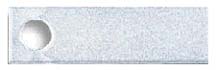
After exposure, the coupons are removed and returned to the place of purchase, corrosion consultant, or sent to an independent laboratory for analysis. Longer or shorter test periods may apply.

The corrosion rate of the coupon in mils per year (MPY) can then be estimated based upon the weight of material lost over its time in service.
A large variety of metal alloys are available in various physical configurations, although for HVAC and process cooling applications, rectangular bars of mild carbon steel and soft copper are the primary materials used.
Benefits Of Coupons
Corrosion coupons offer an excellent source of information to any building owner or plant operator - especially if monitoring is continuously maintained and a history of coupon test results is accumulated. Though limited in many respects, coupons will often provide the only indication of corrosion status, and the only inside look at the conditions and type of deposits existing within a piping system.Corrosion coupons become an even more valuable predictive maintenance tool when results are compared to confirmed wall loss information, such as provided through ultrasonic thickness testing, spool piece measurement, or actual pipe removal and metallurgical analysis. Where regular testing under rigorously controlled conditions exists, corrosion coupons will provide an excellent indication of whether the potential for corrosion to occur is increasing or decreasing.
Looking for quick answers on air conditioning, heating and refrigeration topics? Try Ask ACHR NEWS, our new smart AI search tool. Ask ACHR NEWS
Corrosion coupons will quickly document if a chemical inhibitor is present by an absence of significant wall loss, or similarly show whether the recommended inhibitor is effective for providing protection to a particular metal.
Another great benefit is to provide short-term corrosion rate data, such as might be required during a harsh chemical cleaning or chemical program evaluation.
Due to a wide variety of reasons, however, corrosion coupons generally fail to produce corrosion rate values relative to actual pipe wall loss. At best, they offer an estimate of the corrosivity of the fluid, rather than a measurement of the true metal lost from the pipe.
Coupon Rack Placement
The corrosion coupon rack itself, installed externally to the piping system, limits many of the influences acting against any circulating water system.Variations in water flow can dramatically influence corrosion estimates by as much as five to tenfold. In addition, materials of construction, rack layout, pipe size, or filtering of the coupon rack assembly can significantly alter corrosion rate estimates.
Test layouts constructed of PVC will greatly eliminate any possible galvanic activity. Even the physical location of the coupon rack itself, at the top or bottom of the system, can produce significant differences in measured corrosion rate.
Draining Down
With no water flow available, corrosion coupons cannot be used to measure the always higher corrosion activity occurring during a winter lay-up or periodic drain down - documented in many cases to reach 10 times that of water filled pipe.The exact same 12-inch piping system, having a wall thickness of 0.335 inches where filled, can actually show only 0.125 inches at the roof where drained over 20 years. Yet with only the water filled area tested, this potential for failure will always remain hidden.
System Dependent
What degree of corrosion activity may exist is greatly dependent upon the type of piping system involved. Closed systems typically show the lowest corrosion and pitting activity, while open condenser or cooling tower loops show the highest.An open circulating system also typically shows the greatest fluctuation in test result - which means that wall thickness is more likely to vary from top to bottom, at large and small pipe, at supply and return, and at other extremes of the system. This increases the risk that any corrosion coupon testing performed at one area is not representative of the overall system.
Galvanic Influence
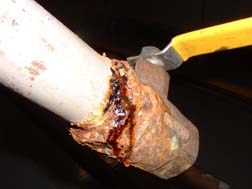
Since corrosion coupons are typically isolated from any metal-to-metal contact through the use of a center located plastic or galvanic insulator, they are totally unaffected by the many anode/cathode electrochemical reactions always present in an established piping system.The well recognized steel pipe to brass valve or copper pipe effect is a common example of galvanic forces which always exist to some degree in most piping systems. Lesser galvanic forces exist where different steels meet as well.
As a result, a major corrosion mechanism responsible for a significant amount of material loss is never measured.
No Flow Conditions
Some of the most severe corrosion and pitting conditions are found at areas of no flow. This is common at bypass lines, future lines, lead and lag equipment, out-of-service equipment, as well as at the very end of some small diameter piping distribution systems.Cooling tower bypass lines, closed at the downstream end and open at the supply side, are notorious for providing a settlement area for deposits, and then very severe pitting underneath. With no flow available, corrosion coupon testing is, by definition, impossible - leaving the most vulnerable areas of the entire piping system unaddressed.
Surface Differences
The typically mirror smooth, polished surface of a corrosion coupon minimizes the adhesion of iron oxide, dirt, and microorganisms. As a result, they are rarely attacked in the same manner as an aged piping system having an irregularly worn and pitted interior surface.For an older piping system typically worn and pitted, new corrosion coupons bear no resemblance to the pipe surface, thereby further amplifying reporting error.
Testing Interval
The most common test interval for corrosion coupons is between 30 and 90 days. In reality, 30 days is too soon for the coupon to develop a passivating layer of rust protection and can actually lead to the reporting of falsely high corrosion rates.On the opposite end, 90 days is far too short of a time period necessary for the smooth surface of the coupon to accumulate any microbiological or deposit buildup typically existing in an actual piping system.
Both scenarios are well recognized and accepted as factors in the underreporting or overreporting of corrosion activity using corrosion coupons as a test method, yet are all too often used to explain away a high or elevated test result. Low corrosion rate results are rarely questioned.
Surface Deposits
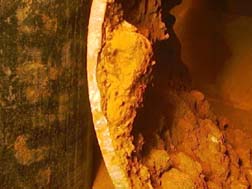
By far, the accumulation of interior deposits is the greatest limitation in corrosion coupon testing. Once a solid layer of iron oxide or scale deposits adhere to the pipe's interior, an entirely new set of corrosion mechanisms typically form which simply cannot be duplicated, nor measured, by any remotely located corrosion coupon.For that reason, most authorities recognize that as pipe surface deposits increase, the correlation between the actual corrosion rate and the corrosion coupon measured rate significantly decreases.
Mild deposits will, depending upon their thickness, impede contact of the water treatment chemicals to the base metal, and therefore reduce their effectiveness to some degree.
Heavy deposit buildup, however, will likely isolate the pipe from any chemical protection whatsoever. This often results in random areas of pipe having deep wall loss - often at the lowest areas of the system and at long horizontal runs. Smallest diameter piping is especially vulnerable.
A 5 MPY corrosion rate against 12-inch schedule 40 steel pipe, for example, will actually remove 64 pounds of metal into the circulating system for every 100 linear feet of pipe, and for every year of service.
Oxidized, this same steel reverts back into approximately 2.6 cubic feet of iron oxide that will settle into the system if not filtered out. And while an open cooling tower system may flush some of those deposits away or at least signal a corrosion problem, closed systems hide their problems.
Secondary Corrosion Problems
Accumulated internal deposits often create a localized and severe secondary metal loss known as "concentration cell" or "oxygen cell" corrosion, and may create conditions favorable to microbiologically influenced corrosion or MIC.While the volume of metal lost in MPY may be often viewed as acceptable, often overlooked are the consequences of high volumes of iron oxide settling into the piping system. For any circulating system, therefore, the removal of all interior pipe surface deposits should be a priority.
Many experts believe that it is virtually impossible to provide adequate corrosion protection to any piping system already heavily fouled with iron oxide deposits, and that the preliminary and total removal of such deposits is fundamental to reducing high corrosion and pitting rates.
Interrupted Monitoring
Should corrosion coupons remain in place for sufficient time to deteriorate toward the surface texture and condition of the actual pipe and accumulate deposits, they are rarely re-weighed and returned in that worn and pitted condition. Instead, they are typically replaced with new test coupons and the entire testing process started over from the very beginning.This unfortunately negates monitoring one of the most important contributors in all examples of high corrosion loss - the pitted and irregular interior pipe wall surface.
More Coupon Error
Some additional sources of corrosion coupon error include:False Security
In a majority of ultrasonic investigations in which I have been involved, a property owner or plant operator will, for years, mistakenly believe they have a corrosion rate of well under 1 MPY based entirely upon corrosion coupon results. In fact, wall losses may actually be 5 MPY and significantly above.Reported open system corrosion rates under one tenth of a mil per year are not uncommon for corrosion coupon testing, yet are not even remotely feasible.
Often, when presenting conflicting MPY statistics between corrosion coupons and ultrasonic testing, building or plant owners and operators will choose to rely on the less reliable coupon based information. This is wishful thinking perhaps, and an often mistaken and regretted decision after true corrosion losses have been confirmed.
The sudden appearance of a leak, rust deposits, chip scale, or other operating problem ultimately signals a corrosion condition hidden over an extended time, and further investigation begins. Unfortunately, this is usually discovered only after years of concealed and underreported piping damage.
Overall, corrosion coupons offer some excellent diagnostic information, though with very clear limitations. A comparison of results to other more direct testing methods, therefore, is always recommended.
Bill Duncan is president of CorrView International LLC, Landing, N.J. For more information, call 973-770-7764, e-mail info@corrview.com, or visit www.corrview.com.
Publication date: 04/19/2004
Looking for a reprint of this article?
From high-res PDFs to custom plaques, order your copy today!