ACHR News
search
Ask ACHR NEWS AI
cart
facebook twitter instagram linkedin youtube
  • Sign In
  • Subscribe
  • Sign Out
  • My Account
ACHR News
  • NEWS
    • Breaking News
    • New HVAC Products
    • Featured Products
    • Manufacturer Reports
    • HVAC Data
    • Legislation
    • ACHR NEWS Centennial
  • RESIDENTIAL
    • Air Conditioners
    • Furnaces
    • Residential Heat Pumps
    • Ductless
    • Residential IAQ
    • Testing, Monitoring, Tools
    • Components & Accessories
  • COMMERCIAL
    • Air Handlers
    • Rooftop Units
    • Chillers and Cooling Towers
    • Commercial Heat Pumps
    • Boilers and Hydronics
    • VRF/Ductless
    • Commercial IAQ
  • REFRIGERATION
    • Refrigerants
    • Refrigerant Regulations
    • Leak Management
  • CONTRACTOR PRO
    • Geothermal
    • Homeowner Study
    • VRF and VRV Ductless
    • Unitary Trends
  • EDUCATION
    • Training and Education
    • Business Management
    • Service and Maintenance
    • Continuing Education
    • Market Research >
      • HVAC Brand Awareness Report
      • VRV, VRF, VRVZ Report
      • Unitary Trends Report
      • Water Heat Professionals Report
    • Webinars
    • Sponsor Insights
    • eProducts Info
    • White Papers
  • EVENTS
    • HVAC Contractor Forum
    • Industry Events and Webinars
  • MEDIA
    • Videos
    • AHR Expo 2025 Videos
    • Podcasts >
      • ACHR News Podcast
      • HARDI Podcasts
      • AHR Expo Podcasts
      • ACCA Podcasts
    • Interactive Spotlights
    • Quizzes
    • eBooks
    • HVAC Talkback
  • HVAC GROUP
    • ACHR NEWS >
      • Current Issue
      • Digital Edition
      • Subscribe
    • Distribution Trends
    • SNIPS NEWS >
      • Join SNIPS NEWS
    • Engineered Systems News >
      • Join ES News
    • HVACR Directory
    • Contests
    • Newsletters
    • Contact
    • Advertise
    • My Account

Managing Airflow In A Zoning System
By Joanna R. Turpin
July 21, 2005
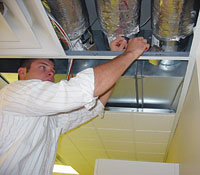
A zoning specialist from Bolls Heating and Cooling, Indianapolis, is shown installing a Comfort Systems™ Z-300 series zone control system from Jackson Systems (above and below).
Many homes around the United States have only one centrally located thermostat by which homeowners can control their heating and cooling. Having a single thermostat in a home, unless it's a very small home, almost guarantees that the occupants will not be comfortable in every part of the house.

A good example of this is a two-story house in the summertime. The upstairs is almost invariably warmer than the downstairs. To cool off the upstairs, the thermostat can be turned down, but by the time a comfortable temperature is reached upstairs, the occupants who are downstairs are usually freezing. This scenario can result in higher energy costs and frustrated, uncomfortable homeowners.

The solution to this problem is to install a zoning system, which divides a home into sections so the temperature can be controlled more accurately. A properly installed zoning system will ensure that the correct amount of airflow is delivered to each zone, so that occupants in every part of the house are comfortable at all times. There are several methods by which airflow can be managed, and it is up to the contractor to decide which technique should be used, depending on the application in question.

When installing zoning, it is always necessary to employ some way to relieve the excess air pressure that may build up in the system. There are several ways to do this, according to David Arneson, zoning product specialist, Honeywell, Golden Valley, Minn. "These methods include installing a bypass, oversizing ductwork, allowing damper leakage, or creating a dump or wild zone."

A static pressure bypass routes the extra air from supply to the return through a bypass loop. The volume of bypass air is controlled by a barometric weighted damper or a motorized damper controlled by a pressure switch. Bypass not only ensures that the right amount of air is delivered to each zone, it also ensures good airflow over the heat exchanger or A coil and prevents noise at the register.

"Bypass is recommended by Honeywell because it keeps homeowners comfortable and protects the equipment," stated Arneson. "Bypass works equally well with standard blowers or newer variable-speed blowers," Arneson continued.

Dennis Laughlin, president of Arzel Zoning Technology, said, "It should be noted that there are different types of bypass technology, and contractors should do their homework to ensure compatibility with all of today's sophisticated equipment."

In some cases, the bypass method may overheat or overcool the delivered air. "In this scenario, Honeywell recommends a discharge air temperature sensor, which senses the temperature of the discharge air," said Arneson. "If it gets too hot or cold, it will turn off the equipment but continue to allow the blower to drive air into the calling zones until the discharge air temperature moderates."

Using a discharge air temperature sensor is generally considered a good idea for many applications. However, it is subject to the individual design and must take in to account the size of the zones being served.

Looking for quick answers on air conditioning, heating and refrigeration topics? Try Ask ACHR NEWS, our new smart AI search tool. Ask ACHR NEWS →

A bypass isn't the only method available, though. "If you only have two zones that are pretty evenly split and the contractor can upsize the ductwork, then a bypass damper is not required," noted Tom Jackson, CEO, Jackson Systems LLC, Indianapolis. "But it's important to note that if the ductwork can't be oversized, doing so may introduce velocity and throw problems."

Laughlin said, "Most systems that use leaving air temperature sensors will not have any problem with the amount of air over the coil; then it all comes down to how much noise is acceptable by the homeowner, thus dictating some air management control."

Another way to relieve the excess air pressure is to allow the zone dampers to leak. This method, which is often used when there is no room for a bypass, prevents static pressure from rising when few zones call, as the excess air will bleed into non-calling zones.

"These zones then can become over-conditioned," noted Arneson, "but this method does manage airflow. Unfortunately, homeowners may complain that air is being delivered to zones that are not calling, and they are uncomfortable."

Dump and wild zones are areas in a home where the excess air is delivered to relieve static pressure. As with oversizing ductwork and damper leakage, dump and wild zones do manage airflow, but they often generate complaints and callbacks because occupants are not comfortable.

Utilizing one of these methods is crucial when installing a zoning system, because without proper airflow, occupants may complain that the system is too noisy or drafty. "It is also possible that improper airflow could slug a compressor or cause the furnace to trip out on high limit," stated Jackson. "For these reasons, it is always recommended that high and low limits are installed."

Retrofitting

Louis Agnolutto, president, Louis Heating and Cooling Service, Raleigh, N.C., installs zoning systems in new and existing homes. "In a new home, we do a Manual J and Manual D calculation in order to figure out the proper sizing of the ductwork to handle the airflow. If the ductwork isn't right, zoning isn't going to do the homeowners any good, because they will have a warm spot, or a cold spot, or a humid spot," said Agnolutto.

In an existing home, that's a little trickier because ductwork is often hidden behind walls. "We almost always have to do something to the ductwork in an existing home," stated Agnolutto.

"If we can get to it, most of the time we can do enough to make zoning worthwhile. We're not going to tear the walls up to replace what's embedded in there. We'll make that work out, then we'll go to the attic and pick that up again and redo it up there."

Agnolutto stated that homeowners often want to zone the upstairs from the downstairs, but they don't want two systems. If the system is over 15 or 20 years old, he encourages them to upgrade to new equipment, as well as add more insulation and fix leaky windows, if needed.

If the customer isn't willing to upgrade the insulation and windows but still wants a new system, then Agnolutto will size the ductwork to handle the airflow and base the heat load calculations on the projected losses, which are normally around the 40 percent mark, he noted.

Modifying the return air is something else Agnolutto often ends up doing in existing homes. "I'm big on proper return air," said Agnolutto. "There's no sense blowing air through a straw if you don't take in a deep breath - there's nothing to blow. That's my theory. If I can get that air to come back to the equipment, I can get the temperature difference a little closer to the comfort zone that we need to have. With proper return air, zoning and a seven-day programmable thermostat, homeowners will be very comfortable, and it's very economical."

Publication date: 07/25/2005

Share This Story

Looking for a reprint of this article?
From high-res PDFs to custom plaques, order your copy today!


Tn joanna 2017
Joanna Turpin is a Senior Editor at The ACHR NEWS. She can be contacted at 248-786-1707 or joannaturpin@achrnews.com. Joanna has been with BNP Media since 1991, first heading up the company’s technical book division before moving over to The ACHR NEWS, where she frequently writes about refrigerants and commercial refrigeration. She obtained her bachelor’s degree in English from the University of Washington and worked on her master’s degree in technical communication at Eastern Michigan University.

Recommended Content

JOIN TODAY
To unlock your recommendations.

Already have an account? Sign In

  • HVAC-enrollment

    The Trades Are Back: HVACR Programs See Nearly 30% Enrollment Spike

    A new wave of future technicians is entering the pipeline.  
    Training and Education
    By: Matt Jachman
  • 2025 Top 40 Under 40

    2025 Top 40 Under 40 HVACR Professionals List

    The 11th annual Top 40 Under 40 list highlights those...
    HVAC Light Commercial Market
    By: Hannah Belloli-Oster
  • LG Ductless Mini-Split Systems

    The 9 Types of Heat Pumps

    As the U.S. moves toward electrification, heat pumps are...
    HVAC Residential Market
    By: Joanna R. Turpin
Subscription Center
  • Create an Account
  • Start a Subscription
  • Manage My Account
  • Sign Up for Newsletters
  • Visit Customer Service
  • Update Preferences

More Videos

Sponsored Content

Sponsored Content is a special paid section where industry companies provide high quality, objective, non-commercial content around topics of interest to The News audience. All Sponsored Content is supplied by the advertising company and any opinions expressed in this article are those of the author and not necessarily reflect the views of The News or its parent company, BNP Media. Interested in participating in our Sponsored Content section? Contact your local rep!

close
  • Piggy Bank
    Sponsored byWatercress Financial

    Energy Prices, Inflation, and HVAC: What Today’s Homeowners Care About

  • Refrigerated Food
    Sponsored bySolstice Advanced Materials

    R-455A Refrigeration: A Cold Storage Solution for the Future

  • Airex Rooftop Units
    Sponsored byAirex Manufacturing Inc

    Consolidating Roof Penetrations: A Growing Trend in Multifamily HVAC Design

Popular Stories

Lennox equipment

Platinum Equity to Sell Heat Controller to Lennox

HVAC-tech-van.jpg

Report: Only 65% of HVAC Technician Time is Billable Hours

HVAC Minute retail refrigeration system

EPA Final Rule’s Impact on R-410A Deadlines

Trade groups challenge EPA refrigerant rule

HVACR Trade Groups Challenge EPA Refrigerant Rule in Federal Court

heat-pump-tech-customer.jpg

DOE Updates $8.8B Home Energy Rebate Program Guidance

View The ACHR NEWS
Centennial Anniversary Timeline

The ACHR News Timeline Chart
Submit a Letter
Submit a letter to our editors.

Events

November 6, 2025

Next-Gen Data Center Cooling: HVAC Innovation and Real-World Solutions

On Demand As AI workloads and high-density computing push traditional cooling methods to their limits, the data center industry is accelerating the adoption of next-generation HVAC technologies.

July 28, 2026

How Top Home Services Companies Turn Every Conversation Into Predictable Revenue

In this webinar, we'll outline how top contractors are turning every conversation into predictable revenue by coaching every comfort advisor visit, not just the ones a manager rides along on.

View All Submit An Event

Poll

Summer Staff

Are you fully staffed for the summer season?
View Results Poll Archive

Products

BNI Mechanical/Electrical Square Foot Costbook, 2026 Edition

BNI Mechanical/Electrical Square Foot Costbook, 2026 Edition

See More Products
Designing Systems Using A2L Refrigerant - Free Webinar - 7/22/2026

Related Articles

  • EE_Technical 1

    Installing a Forced-Air Zoning System is Easier Than Ever, Here's Why…

    See More
  • Emerson invests in HVAC market zoning system

    See More
  • Emerson invests in HVAC market zoning system

    See More

Related Products

See More Products
  • 0880690186-228x228.jpg

    Airflow in Ducts

  • Lessons Learned in a Boiler Room: A common sense approach to servicing and installing commercial boilers

  • Training-Managing-System-2017.jpg

    Customer Service Training & Managing System by Steve Coscia

See More Products

Related Directories

  • Full Airflow Zone System LLC (Manufacturer)

    Full Airflow Zone System zone control boards open one zone at a time based on priority. Perfect for multi-story and "Capacity Deployment System" applications.
  • Full Airflow Zone System LLC (Wholesaler)

    Full Airflow Zone System zone control boards open one zone at a time based on priority. Perfect for multi-story and "Capacity Deployment System" applications.
  • XCI Zoning Systems

    Residential/commercial zone dampers and electronic zone controllers. ISO 9008:2015.
×

Sign Up. Stay Informed.

The #1 trusted source for the HVACR industry since 1926

SUBSCRIBE
  • RESOURCES
    • Advertise
    • Contact Us
    • Advisory Board
    • Classifieds
    • Submit a Letter
    • Directories
    • Store
  • ACCOUNT CENTER
    • Create an Account
    • Start a Subscription
    • Manage My Account
    • Sign Up for Newsletters
    • Visit Customer Service
    • Update Preferences
  • SERVICES
    • Marketing Services
    • Reprints
    • Market Research
    • List Rental
    • Survey/Respondent Access
  • STAY CONNECTED
    • LinkedIn
    • Facebook
    • Instagram
    • YouTube
    • X (Twitter)
  • PRIVACY
    • PRIVACY POLICY
    • TERMS & CONDITIONS
    • DO NOT SELL MY PERSONAL INFORMATION
    • PRIVACY REQUEST
    • ACCESSIBILITY

Copyright ©2026. All Rights Reserved BNP Media, Inc. and BNP Media II, LLC.

Design, CMS, Hosting & Web Development :: ePublishing