John and Charlie Learn the Hard Way

FIGURE 1: John wedged ductboard under this leaky return platform, and sealed the joints. But did he stop the leakage?
John’s new helper had lots of potential. Charlie was always on time, worked hard, was conscientious, and willing to learn. The kid didn’t mind getting dirty either. John was sure he could count on Charlie to crawl around the attic and “pooky up” all the duct leaks, leaving John to focus on capturing the refrigerant from the old air conditioning unit they were replacing that day. John would call him down from the attic when he needed a hand to set the new 16 SEER condenser.
Little did John know that all the work Charlie was doing in the attic was not only a waste of time, but would actually have to be removed in order to do the job right.
NEW FRONTIERS
Duct sealing was something fairly new to their service and replacement company. They’d recently had a short installers’ meeting where the boss shared some things he’d just learned at a seminar.Researchers and contractors around the country have discovered that leaky ducts are much more detrimental than anyone ever thought. John found out that a new 16 SEER system, hooked up to the typical leaky duct system, would only work as well as a 12 SEER would on a tight system. He was blown away to learn that just a 10 percent return air leak from a hot attic would cut the capacity of an air conditioner by a whopping 30 percent. A 3-ton a/c unit would barely put 2 tons into the house.
John was intrigued to learn that high-efficiency, two-speed equipment with a variable-speed indoor fan motor is even more affected by duct leakage than the old clunker it replaces. It seems obvious, now that he thought about it. The pressures across the duct leaks were higher due to the more powerful motor, the fan would run more hours per day, and the homeowner might even run the fan all the time for better filtration since the motor is so efficient.
Surprise, surprise: more overall duct leakage.

FIGURE 2: Charlie went through five gallons of mastic on the supply side of the system. Unfortunately, he put it in the wrong place.
The air quality implications were also real. Duct leaks contribute to excessive summertime humidity and mold growth, excessive dust and particulates, combustion backdrafting, musty odors, and more.
While sealing duct leaks wasn’t very appealing, all agreed they couldn’t ignore these issues anymore. On the very next sales call, the boss had proposed sealing the old ducts when installing the new system. The homeowners - the Powers - agreed. A couple of cases of mastic showed up with the new high-efficiency, 4-ton a/c unit and variable-speed furnace.
The Powers’ furnace was an upflow on a platform in a mechanical closet. The boss had relayed to them how hot attic air usually gets sucked into the “studs and sheetrock” return plenum down the surrounding stud wall cavities. So, while Charlie was up in the attic, John lined the return by wedging in fiberglass ductboard scrap pieces, “masticing” the joints (see Figure 1).
At the end of the day, John poked his head up into the attic. The system had a wrapped metal supply plenum with flex duct branch runs. Since it looked like Charlie managed to paint more mastic on the supply ducts than on his uniform, John figured the job must be done right (see Figure 2).
They started up the new a/c system, collected the check, and called it a day. John and Charlie were confident they had done the best installation possible, and were looking forward to hearing from the Powers at the end of the season about how much they saved with the new system. John did wonder, though, why the system seemed noisier than usual.
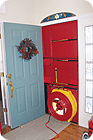
FIGURE 3: Test were performed, including an Infiltrometer blower door test.
TESTING OUT TEACHES
What John and Charlie didn’t know was that the boss had just invested in some new duct diagnostic instruments and training. He had a trainer coming in to teach them how to use their new toys, and the first duct system they were going to test was the one they had just sealed for the Powers. John didn’t see why they should bother.“That one’s already tight. Why don’t we start with one we haven’t sealed yet?” he asked.
But the boss had already set it up, so out they went.
Their trainer, David, showed them how to perform a battery of leakage, airflow, and pressure tests on the house and duct system (see Figure 3). And lo and behold, the Powers’ duct system still leaked.
With an infiltrometer blower door depressurizing the house, and the furnace circulating fan off, attic air was being sucked in and coming out of all the supplies and returns. David made it visible with a cool smoke puffer, explaining that if the system were tight, no air would be coming out.
“It’s as if we’re sucking on both ends of a straw at the same time,” explained David. “The only way air can come in from the attic is if there are leaks in the ducts.”
They then used an airflow capture hood to measure all the bad air coming in at a standard test pressure of 0.10 inches of water, while the infiltrometer was running. The result was 20 percent duct leakage. Not as bad as many systems, but still four times as much as the 5 percent considered acceptable for a new sealed system.
David inspected the sealing work and showed them what they had missed or done wrong. The biggest single problem was that neither worker understood an important rule: always seal at the duct system’s “air barrier.” Charlie had gone up into the attic and simply painted mastic over all the joints in the duct wrap, and also between the duct wrap and the outer jacket of the flex duct branch runs. Unfortunately, he had put five gallons of mastic in the wrong place.

FIGURE 4: A return chase sealed with the ductboard foil facing in. No bypass leakage, no exposed fibers.
SEAL IT WHERE IT LEAKS
“With a wrapped, metal duct system,” David explained, “the mastic must be applied under the wrap to the leaks in the metal. With a flex duct system, the mastic must be applied to leaks at the inner liner connections, not over the outer jacket. Sealing the outer wrap or jacket is mostly ineffective, as air will continue to leak out the actual leak and travel inside the wrap until it finds a tear or perforation.”All the mastic Charlie had applied would have to be cut through, the insulation peeled back, and new mastic applied to the dovetails, collars, end cap, and wyes. John vowed to never send another helper into an attic to seal ducts without this essential training: seal at the actual leak.
The next problem area was the ductboard lining under the plywood platform. The pieces John had wedged in had reduced the leakage, but air was still leaking in. Again, they hadn’t understood the importance of sealing at the duct’s air barrier. With fiberglass ductboard, the foil facing is the air barrier. When ductboard is used to build a new duct, the foil air barrier is, of course, on the outside. David explained, however, that if ductboard pieces are retrofitted with the fiberglass facing in, like John had done (see Figure 1), and the accessible seams “masticed,” outside air can still get sucked in through the hidden raw edges of the ductboard from the building cavity and bleed into the return airstream through the exposed yellow fibers (see Figure 4).

FIGURE 5: With the fibers facing in, air will still get sucked in through the edges of the ductboard plugs.
“Then you can seal the joints and be confident that the foil air barrier won’t get bypassed. An added benefit is that the fibers aren’t exposed and in the airstream.” (See Figure 5.)
In a case like the Powers’ where there’s already ductboard installed but it still allows diffuse leakage, John didn’t have to rip it all out and start over. David suggested fixing it by simply painting mastic over all of the exposed fiberglass.
David inspected the rest of the duct system and found a laundry list of other overlooked leaks: the boot to sheetrock joints; in the furnace and coil case; where the furnace sat on the plywood platform; where the refrigerant and condensate lines passed through the platform; and many more.
John and Charlie were surprised at how much they had missed, but were grateful for the training. They committed to sealing what they’d overlooked and to retesting until the results were acceptable. They had learned the hard way that there’s more to sealing duct leaks than they thought, and that testing out is essential to ensuring a quality job.
“That’s great, guys. Let me know how it turns out,” said David. “But before I go, let’s take a few more measurements. Have you ever been shown how to measure static pressure?”
In an upcoming issue: John and Charlie learn there is more to fixing a duct system than just sealing the leaks.
Publication date: 03/05/200
Looking for a reprint of this article?
From high-res PDFs to custom plaques, order your copy today!


