Identify Defects Through ‘Moisture Engineering’
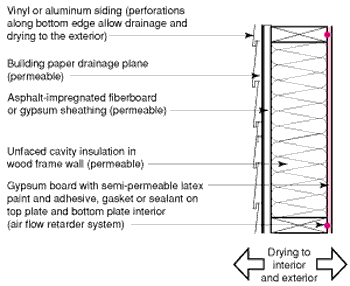
Lstiburek discussed various construction methods and materials that contribute to the problem of moisture retention.
“Construction is an inherently wet process,” he explained. “The drying potential has changed; the ability of materials to dry effectively has changed.
“Building assemblies get wet from the outside, get wet from the inside, and start out wet,” Lstiburek continued. “We must control wetting from the outside, control wetting from the inside, and let assemblies dry to the inside, or to the outside, or to both sides.
“Moisture accumulates in the building envelope when the rate of moisture entry into an assembly exceeds the rate of moisture removal. When moisture accumulation exceeds the ability of the assembly materials to store the moisture without significantly degrading performance or long-term service life, moisture problems result.
“The moisture storage capacity of a material depends on time, temperature, and material properties.”
Lstiburek said that wood with a 15% moisture content or less will not decay, nor will any mold form. At 16% and higher, mold will form, and at 20% moisture content, wood will begin to decay.
“In the average home, approximately 4,000 to 5,000 pounds of wood are found in the exterior walls,” Lstiburek said. “This yields a hygric buffer capacity of approximately 400 to 500 pounds of water, or approximately 45 to 50 gallons.
Looking for quick answers on air conditioning, heating and refrigeration topics? Try Ask ACHR NEWS, our new smart AI search tool. Ask ACHR NEWS
“From a performance perspective, the average home can easily accommodate 45 to 50 gallons of water via hygric redistribution. Most water leaks are not a problem because of this large capacity to store water.”
Wood has always been recognized as a superior building
material, he said, because of its ability to retain moisture and then dry out.
“Matters are considerably different when the exterior walls are constructed with steel studs and gypsum sheathing,” Lstiburek said. “There is no water-storage capacity in the steel studs, and the gypsum sheathing can store approximately 1% moisture content by weight before mold colonization occurs.
“Constructing the average home with steel studs and gypsum sheathing yields a hygric buffer capacity of 5 gallons,” he explained. “In this type of an assembly, even the smallest leak can lead to problems.
CLIMATE ZONES
“Buildings should be suited to their environment, both exterior and interior,” he said. “It is not desirable to construct the same manner of building in Montreal, Memphis, Mojave, and Miami. It’s cold in Montreal, it’s humid in Memphis, it’s hot and dry in Mojave, and it’s hot and wet in Miami. And that’s just the outside environment.“It is also not desirable to construct the same manner of building to enclose a warehouse, house, school, office, health club with a swimming pool, hospital, or museum. The interior environment clearly influences design of the building envelope and mechanical system.
“Building assemblies need to be protected from wetting via air transport and from vapor diffusion,” he said. “The typical strategies use vapor barriers, air barriers, air pressure control, and control of interior moisture levels through ventilation and dehumidification.
“Climate location and season determined the location of air barriers and vapor barriers, pressurization vs. depressurization, and ventilation vs. dehumidification.
“Moisture usually moves from warm to cold (driven by the thermal gradient) and from more to less (driven by the concentration gradient). In cold climates, moisture from the interior flows toward the exterior by passing through the building envelope. In hot climates, moisture from the exterior flows towards the cooled interior by passing through the building envelope.”
Sidebar: Specifications For Moisture Engineering
The following suggestions are recommended for moisture engineering:Publication date: 06/03/2002
Looking for a reprint of this article?
From high-res PDFs to custom plaques, order your copy today!


