ACHR News
search
Ask ACHR NEWS AI
cart
facebook twitter instagram linkedin youtube
  • Sign In
  • Subscribe
  • Sign Out
  • My Account
ACHR News
  • NEWS
    • Breaking News
    • New HVAC Products
    • Featured Products
    • Manufacturer Reports
    • HVAC Data
    • Legislation
    • ACHR NEWS Centennial
  • RESIDENTIAL
    • Air Conditioners
    • Furnaces
    • Residential Heat Pumps
    • Ductless
    • Residential IAQ
    • Testing, Monitoring, Tools
    • Components & Accessories
  • COMMERCIAL
    • Air Handlers
    • Rooftop Units
    • Chillers and Cooling Towers
    • Commercial Heat Pumps
    • Boilers and Hydronics
    • VRF/Ductless
    • Commercial IAQ
  • REFRIGERATION
    • Refrigerants
    • Refrigerant Regulations
    • Leak Management
  • CONTRACTOR PRO
    • Geothermal
    • Homeowner Study
    • VRF and VRV Ductless
    • Unitary Trends
  • EDUCATION
    • Training and Education
    • Business Management
    • Service and Maintenance
    • Continuing Education
    • Market Research >
      • HVAC Brand Awareness Report
      • VRV, VRF, VRVZ Report
      • Unitary Trends Report
      • Water Heat Professionals Report
    • Webinars
    • Sponsor Insights
    • eProducts Info
    • White Papers
  • EVENTS
    • HVAC Contractor Forum
    • Industry Events and Webinars
  • MEDIA
    • Videos
    • AHR Expo 2025 Videos
    • Podcasts >
      • ACHR News Podcast
      • HARDI Podcasts
      • AHR Expo Podcasts
      • ACCA Podcasts
    • Interactive Spotlights
    • Quizzes
    • eBooks
    • HVAC Talkback
  • HVAC GROUP
    • ACHR NEWS >
      • Current Issue
      • Digital Edition
      • Subscribe
    • Distribution Trends
    • SNIPS NEWS >
      • Join SNIPS NEWS
    • Engineered Systems News >
      • Join ES News
    • HVACR Directory
    • Contests
    • Newsletters
    • Contact
    • Advertise
    • My Account

Handling Harmonics With AC Drives

April 16, 2003
AC motors are abundant in the HVAC industry. Every fan and pump application requires an AC motor. For efficient and reliable control, adjustable-speed drives are becoming a common companion for these motors.

However, as drives are boosting production, they might also be contributing to electrical noise problems, such as line current harmonics.
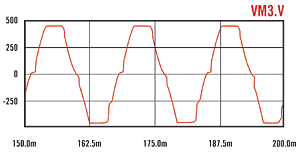
Figure 1. Severe flat-topping of voltage waveform.

What Are Harmonics?

Harmonics are deviations from the sinusoidal fundamental AC line voltage and current. Most electrical power in North America operates at a frequency of 60 Hz. A harmonic frequency is an integer multiple of this fundamental frequency. So in a 60-Hz system, the second harmonic would be 120 Hz, the third would be 180 Hz, and so on.

When any harmonic is added to the sinusoidal fundamental current or voltage, the result is distortion. The greater the amplitudes of the harmonics present, the greater the distortion in the electrical waveform. Very simply, whenever a voltage or current does not look like a perfect sinusoidal waveform, it contains harmonics.

Compared to DC motor drives, AC motor drives cause very few problems. However, poorly designed applications can result in power line voltage distortions, as shown in the flat-topped waves of Figure 1. These voltage distortions can cause problems for other equipment connected to the same power lines, resulting in erratic operation of controls, dimming of lights, audible noise on phone systems, and static on AM and FM radios.

The distribution transformers and cables feeding these drives will also experience additional heating, which reduces the power utilization of those components.
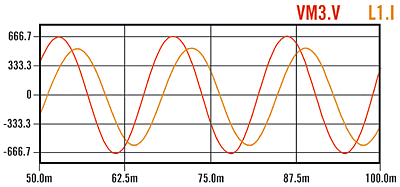
Figure 2. Motor load voltage and current.

What Causes Harmonics

Unlike an AC motor operating across the power line (Figure 2), the current drawn from a distribution transformer feeding a typical AC drive is far from a sinusoidal waveform. (See Figure 3.) This occurs because the drive is taking current from the transformer only during certain times of the cycle, to convert the AC line voltage to a fixed DC voltage within the drive.

The drive pulse-width modulates this fixed DC voltage into variable frequency, variable voltage for the motor. The AC to DC conversion causes the harmonics. Current flows only during part of the cycle and is off during other parts of the cycle, creating the odd-looking current waveform (Figure 3). This distorted current creates the voltage distortion.

As the number of drives employed in automation systems grows, so too does the misconception that drives are the only piece of the puzzle to harmonic problems. While they may comprise a sizable portion of nonlinear loads, they are only one element in the harmonic equation.

That’s why it’s important to analyze all electrical loads that could potentially cause problems for a system before making your final conclusions.

Looking for quick answers on air conditioning, heating and refrigeration topics? Try Ask ACHR NEWS, our new smart AI search tool. Ask ACHR NEWS →
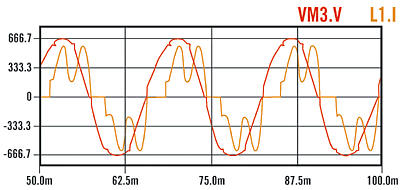
Figure 3. AC drive load voltage and current.

How Much Is Too Much

When other equipment is connected to secondary power terminals, voltage distortion may cause improper operation of the other equipment. So, how much current harmonic distortion will cause a problem? The Institute of Electrical and Electronic Engineers (IEEE) Std. 519-1992 recommends maximum current distortion levels caused by nonlinear loads to limit the voltage distortion they would create, minimizing the likelihood of equipment failure due to those harmonics. Tables 1 and 2, reproduced from the IEEE standard, illustrate the limits applicable for most typical drive systems.

To predict if a particular plant or system consisting of drives, motors, heaters, lights, and other equipment may have problems, only three pieces of information are needed:

1. Isc, short-circuit current of the transformer feeding the system:

Isc = kVA x 1,000/(Vsec x 1.732 x Z)

Where kVA is the rating of the transformer feeding the system, Vsec is the secondary line-to-line voltage of the transformer, and Z is the decimal impedance of the transformer (in other words, 5.3 percent translates to 0.053). All of this information is typically found on the transformer nameplate.

2. Ifund, total fundamental current load on the transformer: The fundamental current of a drive is typically 1.1 x hp for a 460-V drive. The fundamental current of a motor running across the line is typically 1.2 x hp for a 460-V motor. The fundamental current of a 460-V linear load is 1.25 x kW. Simply double the values for 230-V systems. Add all of these fundamental currents together to obtain a total fundamental current at maximum load.
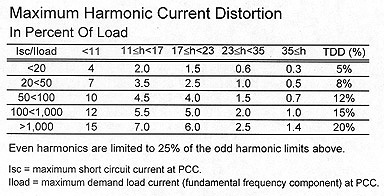
Table 1. Current distortion limits for general distribution systems (120 V through 69,000 V). From IEEE Std 519-1992, Table 10.3.
3. Iharm, total harmonic current load on the secondary transformer: This is usually a difficult number to obtain. Iharm can be estimated by multiplying the Ifund for the drive by the percentage given here: Six-pulse drive without a link choke — 80 percent to 120 percent; six-pulse drive with a link choke — 30 percent to 40 percent; 12-pulse drive — 8 percent to 15 percent; 18 pulse drive — 4 percent to 6 percent; and synchronous converter — 3 percent to 5 percent.

Take the ratio of Iharm/Ifund to obtain the current Total Demand Distortion (TDD). This is the harmonic current divided by the fundamental current or the total harmonic distortion at maximum load.

Next, find the Isc/Iload ratio by taking Isc/Ifund. Go to Table 1 and find the corresponding range in the left-hand column titled Isc/Iload. Then see if the calculated TDD is less than or equal to the right-hand column of the TDD values listed in that table for that Isc/Iload ratio. If the calculated TDD is less, than there should be no harmonic issues at that site.
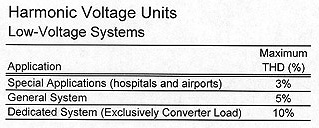
Table 2. From IEEE Std 519-1992, Table 10.2.

What Affects Harmonic Current

The harmonic current created by the drive can be affected by the presence of a DC link choke, the DC bus capacitance, and the line inductance between the drive input and its source of voltage (such as transformer inductance, cable inductance, and additional line reactors).

For example, the current harmonics created by the drive will flow through line inductors, creating voltage harmonic distortion. The closer you are to the drive, the greater the voltage harmonic distortion. This is why the voltage distortion is greater at the drive than at the transformer.

If other equipment needs to be connected to the same transformer as the drive, connect the other equipment as close to the transformer as possible. This will minimize the effect of current harmonics produced by the drive on the voltage waveform, which can cause problems with the other equipment.

There are several methods and products to reduce the line current harmonics created by drives. Cost is not the only factor that distinguishes one solution from another. Even though the addition of line reactors or passive filters can help reduce current harmonics, they also reduce the DC bus voltage within the drive at full-speed, full-load conditions. This prevents the drive from being able to provide full power to the motor, limiting the power out of the motor to about 95 percent of its nameplate rating.

Why would you install a 100-hp motor, only to have its capability limited to 95 hp, especially under peak demand conditions? This is why multipulse solutions are a better fit for most situations; no derating is necessary, and it is less expensive than other mitigation methods.

The goal for those specifying harmonic mitigation solutions is to combine the most cost-effective solution for the particular drive and power distribution system. Since several factors come into play in determining the harmonics in the drive system, you need to consider all factors before arriving at a final recommendation.

Rick Hoadley is the technical program manager in the Custom and Configured Drives Group at Rockwell Automation, Mequon, Wis. He has been active in the development and application of adjustable-speed drives for more than 28 years.

Publication date: 04/21/2003

Share This Story

Looking for a reprint of this article?
From high-res PDFs to custom plaques, order your copy today!


Recommended Content

JOIN TODAY
To unlock your recommendations.

Already have an account? Sign In

  • HVAC-enrollment

    The Trades Are Back: HVACR Programs See Nearly 30% Enrollment Spike

    A new wave of future technicians is entering the pipeline.  
    News
    By: Matt Jachman
  • 2025 Top 40 Under 40

    2025 Top 40 Under 40 HVACR Professionals List

    The 11th annual Top 40 Under 40 list highlights those...
    HVAC Residential Market
    By: Hannah Belloli-Oster
  • LG Ductless Mini-Split Systems

    The 9 Types of Heat Pumps

    As the U.S. moves toward electrification, heat pumps are...
    HVAC Residential Market
    By: Joanna R. Turpin
Subscription Center
  • Create an Account
  • Start a Subscription
  • Manage My Account
  • Sign Up for Newsletters
  • Visit Customer Service
  • Update Preferences

More Videos

Sponsored Content

Sponsored Content is a special paid section where industry companies provide high quality, objective, non-commercial content around topics of interest to The News audience. All Sponsored Content is supplied by the advertising company and any opinions expressed in this article are those of the author and not necessarily reflect the views of The News or its parent company, BNP Media. Interested in participating in our Sponsored Content section? Contact your local rep!

close
  • Piggy Bank
    Sponsored byWatercress Financial

    Energy Prices, Inflation, and HVAC: What Today’s Homeowners Care About

  • Refrigerated Food
    Sponsored bySolstice Advanced Materials

    R-455A Refrigeration: A Cold Storage Solution for the Future

  • Airex Rooftop Units
    Sponsored byAirex Manufacturing Inc

    Consolidating Roof Penetrations: A Growing Trend in Multifamily HVAC Design

Popular Stories

Refrigerants-and-gauge.jpg

HVAC Industry Warns of Counterfeit Refrigerants Entering U.S. Supply Chain

U.S. Supreme Court building

95% Furnace Efficiency Rule to Get New Hearing

Midea-training.jpg

HVAC Workforce Crisis Expands Beyond Technicians to Instructor Shortages

Data_Center_facility.jpg

HVAC Manufacturers Respond to Growing Data Center Backlash

HVAC Minute retail refrigeration system

EPA Final Rule’s Impact on R-410A Deadlines

View The ACHR NEWS
Centennial Anniversary Timeline

The ACHR News Timeline Chart
Submit a Letter
Submit a letter to our editors.

Events

November 6, 2025

Next-Gen Data Center Cooling: HVAC Innovation and Real-World Solutions

On Demand As AI workloads and high-density computing push traditional cooling methods to their limits, the data center industry is accelerating the adoption of next-generation HVAC technologies.

June 23, 2026

HVAC Duct Sealing Mastics: Why Selection Matters

In this webinar we will detail what HVAC material buyers and technicians need to know when selecting duct mastics, including matching mastic to substrate, alternatives to liquid mastic, and where UL 181 Listings fit into real world installations.

View All Submit An Event

Poll

Summer Staff

Are you fully staffed for the summer season?
View Results Poll Archive

Products

BNI Mechanical/Electrical Square Foot Costbook, 2026 Edition

BNI Mechanical/Electrical Square Foot Costbook, 2026 Edition

See More Products
HVAC Duct Sealing Mastics: Why Selection Matters - Free Webinar - 6/23/2026

Related Articles

  • AC Technology Corp.: AC DRIVES

    See More
  • AC Technology Corp.: AC DRIVES

    See More
  • Cerus Industrial: AC Drives

    See More

Related Products

See More Products
  • 0-88069-026-7-228x228.jpg

    Fans and V-belt Drives

  • Building Information Modeling: Planning and Managing Construction Projects with 4D CAD and Simulations

  • The ACHR News - September 22, 2025

    ACHR NEWS September 22, 2025, Issue

See More Products

Events

View AllSubmit An Event
  • April 24, 2014

    Motors, Variable Speed Drives and Energy Efficiency

    The introductory course on motors and variable-speed drives will give participants a better understanding of motors and the theory behind how they work.
View AllSubmit An Event

Related Directories

  • Danfoss Drives

    Leading manufacturer of VLT and VACON Variable Frequency Drives, Soft Starters and Panel solutions for HVAC applications.
  • Buffalo Air Handling

    Custom air handling units with aluminum construction and foam injected panels for new and retrofit applications ranging up to 150,000 cfm. ETL Listed.
×

Sign Up. Stay Informed.

The #1 trusted source for the HVACR industry since 1926

SUBSCRIBE
  • RESOURCES
    • Advertise
    • Contact Us
    • Advisory Board
    • Classifieds
    • Submit a Letter
    • Directories
    • Store
  • ACCOUNT CENTER
    • Create an Account
    • Start a Subscription
    • Manage My Account
    • Sign Up for Newsletters
    • Visit Customer Service
    • Update Preferences
  • SERVICES
    • Marketing Services
    • Reprints
    • Market Research
    • List Rental
    • Survey/Respondent Access
  • STAY CONNECTED
    • LinkedIn
    • Facebook
    • Instagram
    • YouTube
    • X (Twitter)
  • PRIVACY
    • PRIVACY POLICY
    • TERMS & CONDITIONS
    • DO NOT SELL MY PERSONAL INFORMATION
    • PRIVACY REQUEST
    • ACCESSIBILITY

Copyright ©2026. All Rights Reserved BNP Media, Inc. and BNP Media II, LLC.

Design, CMS, Hosting & Web Development :: ePublishing