ACHR News
search
Ask ACHR NEWS AI
cart
facebook twitter instagram linkedin youtube
  • Sign In
  • Subscribe
  • Sign Out
  • My Account
ACHR News
  • NEWS
    • Breaking News
    • New HVAC Products
    • Featured Products
    • Manufacturer Reports
    • HVAC Data
    • Legislation
    • ACHR NEWS Centennial
  • RESIDENTIAL
    • Air Conditioners
    • Furnaces
    • Residential Heat Pumps
    • Ductless
    • Residential IAQ
    • Testing, Monitoring, Tools
    • Components & Accessories
  • COMMERCIAL
    • Air Handlers
    • Rooftop Units
    • Chillers and Cooling Towers
    • Commercial Heat Pumps
    • Boilers and Hydronics
    • VRF/Ductless
    • Commercial IAQ
  • REFRIGERATION
    • Refrigerants
    • Refrigerant Regulations
    • Leak Management
  • CONTRACTOR PRO
    • Geothermal
    • Homeowner Study
    • VRF and VRV Ductless
    • Unitary Trends
  • EDUCATION
    • Training and Education
    • Business Management
    • Service and Maintenance
    • Continuing Education
    • Market Research >
      • HVAC Brand Awareness Report
      • VRV, VRF, VRVZ Report
      • Unitary Trends Report
      • Water Heat Professionals Report
    • Webinars
    • Sponsor Insights
    • eProducts Info
    • White Papers
  • EVENTS
    • HVAC Contractor Forum
    • Industry Events and Webinars
  • MEDIA
    • Videos
    • AHR Expo 2025 Videos
    • Podcasts >
      • ACHR News Podcast
      • HARDI Podcasts
      • AHR Expo Podcasts
      • ACCA Podcasts
    • Interactive Spotlights
    • Quizzes
    • eBooks
    • HVAC Talkback
  • HVAC GROUP
    • ACHR NEWS >
      • Current Issue
      • Digital Edition
      • Subscribe
    • Distribution Trends
    • SNIPS NEWS >
      • Join SNIPS NEWS
    • Engineered Systems News >
      • Join ES News
    • HVACR Directory
    • Contests
    • Newsletters
    • Contact
    • Advertise
    • My Account

EPA Amends Leak Rate Calculations

March 10, 2005
A new Clean Air Act amendment will likely cause owners and operators of equipment that contains ozone-depleting refrigerant charges in excess of 50 pounds to review and re-evaluate their leak rate calculation methods.

The actual impact of the Environmental Protection Agency's changes in Section 608 of the act, which are scheduled to become effective March 14, 2005, will not be known for some time. What is clear is the agency is making a significant attempt to address the growing number of new refrigerants that are entering the marketplace.

The EPA has made clarifications and reduced loopholes that have existed for more than a decade in the leak repair requirements of the regulations. The statute is much more specific in terms of enforcement and documenting the details of an event.

More than ever before, refrigerant record keeping that starts and ends with, "found leak, fixed same," won't be enough anymore. Neither will simply adding refrigerant to a system without calculating a leak rate and diligent efforts to locate and repair refrigerant leaks.

The rule changes affect all sectors that use refrigerants for comfort cooling, commercial refrigeration, industrial process refrigeration, or federally owned systems. It also affects appliances within each of these categories that contain CFC or HCFC refrigerant charges over 50 pounds and HFCs that have ozone-depleting components.

Included in the changes is a clause requiring HCFC blends, such has R-401A, to meet the same regulatory and recording requirements as CFCs. The amendment also adopts into regulation the leak rate calculation and requires that the leak rate be calculated each time refrigerant is added to an appliance.

Most of the changes deal with confirmation and clarification of existing requirements. However, within the amendment, there is a new provision that gives users the option of changing their leak rate calculation method.
More Changes Possible

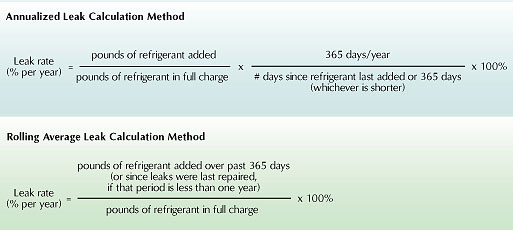
For 13 years, equipment owners and operators have been required to "calculate leak rates" with no regulatory method. Most owner operators chose the "annualized" leak rate calculation method discussed in the EPA and Chemical Manufacturers' Association (CMA) guide, Compliance Guidance for Industrial Process Refrigeration Leak Repair Regulations Under Section 608 of the Clean Air Act.

The guide mentions two methods for calculating leak rates. The "annualized" option detailed in the guide showed the calculation method. The second option, the "rolling average," was listed as an option, but no formula was given. That is, until now.

Looking for quick answers on air conditioning, heating and refrigeration topics? Try Ask ACHR NEWS, our new smart AI search tool. Ask ACHR NEWS →

The EPA's announcement of the changes in the Jan. 11, 2005, issue of the Federal Register said the agency believes the annualized method has the advantage of being familiar, while the rolling average catches certain leaks more quickly. The agency said its preferred approach at this point is to provide appliance owners and operators greater flexibility in calculating leak rates, rather than mandating the exclusive use of one method. "However, EPA is not opposed to considering additional methodologies for calculating or defining the leak rate, and may propose alternative methodologies in future rulemakings," said the announcement.

Of course, the impact of the rolling average method is something that owners and operators in every sector will have to determine before deciding whether to switch to the new formula. Other factors to be considered include the size of the cooling system and amount of refrigerant it contains.

Refrigerant Management

Switching formulas will also depend on how a facility is operated. For example, a larger business or organization that closely monitors its equipment may be more inclined to switch to the rolling average than the small grocery store that learns its unit has a problem when the ice cream starts to melt.

Owners or operators of refrigerant equipment who switch to the rolling average method must make sure the change coincides with the date of the rule change. Also, once chosen, the calculation method must be used consistently for the lifetime of all applicable equipment at an operating facility.

Determinations about the benefits of either method are going to have to be made on a case-by-case, facility-by-facility, basis. Owners/operators will need to make sure they have the necessary infrastructure in place to deal with the changes and the resulting documentation. They will need to have the capacity to promptly calculate leak rates and fix the problem within the allowable time frame.

Regardless of which method a facility or organization chooses to use, the fact remains that you need to have a refrigerant management system that starts with a clearly defined chain of command starting with upper management, the ultimate responsible party in the eyes of the law. The system would also include clear policies and work instructions, methods for consistent documentation, records routing and retention processes, and reporting capabilities.

It stands to reason that with new rules will come new enforcement, such as more frequent un-announced inspections of facilities, demands for records, and more whistleblowers seeking a piece of the action.

The rule changes are a wake-up call to facility owners and managers to initiate programs at their facilities, or to re-establish programs that have fallen by the wayside for reasons including downsizing and consolidation. They can either heed the wake-up call, or prepare for a rude awakening.

Mark Harbin is Refrigerant Software and Compliance Services manager at ESS, a provider of integrated software and services such as EH&S and Crisis Management. ESS' Essential Suiteâ„¢ and Compliance Suiteâ„¢ have helped more than 35,000 businesses, government agencies, and other organizations comply with international, federal, state, and local regulations, as well as industry standards. For more information, go to www.ess-home.com; or for compliance services, visit www.ess-home.com/content/services/default.asp.

Publication date: 03/14/2005

Share This Story

Looking for a reprint of this article?
From high-res PDFs to custom plaques, order your copy today!


Recommended Content

JOIN TODAY
To unlock your recommendations.

Already have an account? Sign In

  • HVAC-enrollment

    The Trades Are Back: HVACR Programs See Nearly 30% Enrollment Spike

    A new wave of future technicians is entering the pipeline.  
    News
    By: Matt Jachman
  • 2025 Top 40 Under 40

    2025 Top 40 Under 40 HVACR Professionals List

    The 11th annual Top 40 Under 40 list highlights those...
    HVAC Contracting
    By: Hannah Belloli-Oster
  • LG Ductless Mini-Split Systems

    The 9 Types of Heat Pumps

    As the U.S. moves toward electrification, heat pumps are...
    Ground Source Heat Pumps
    By: Joanna R. Turpin
Subscription Center
  • Create an Account
  • Start a Subscription
  • Manage My Account
  • Sign Up for Newsletters
  • Visit Customer Service
  • Update Preferences

More Videos

Sponsored Content

Sponsored Content is a special paid section where industry companies provide high quality, objective, non-commercial content around topics of interest to The News audience. All Sponsored Content is supplied by the advertising company and any opinions expressed in this article are those of the author and not necessarily reflect the views of The News or its parent company, BNP Media. Interested in participating in our Sponsored Content section? Contact your local rep!

close
  • Piggy Bank
    Sponsored byWatercress Financial

    Energy Prices, Inflation, and HVAC: What Today’s Homeowners Care About

  • Refrigerated Food
    Sponsored bySolstice Advanced Materials

    R-455A Refrigeration: A Cold Storage Solution for the Future

  • Airex Rooftop Units
    Sponsored byAirex Manufacturing Inc

    Consolidating Roof Penetrations: A Growing Trend in Multifamily HVAC Design

Popular Stories

Refrigerants-and-gauge.jpg

HVAC Industry Warns of Counterfeit Refrigerants Entering U.S. Supply Chain

U.S. Supreme Court building

95% Furnace Efficiency Rule to Get New Hearing

Data_Center_facility.jpg

HVAC Manufacturers Respond to Growing Data Center Backlash

Midea-training.jpg

HVAC Workforce Crisis Expands Beyond Technicians to Instructor Shortages

HVAC Minute retail refrigeration system

EPA Final Rule’s Impact on R-410A Deadlines

View The ACHR NEWS
Centennial Anniversary Timeline

The ACHR News Timeline Chart
Submit a Letter
Submit a letter to our editors.

Events

November 6, 2025

Next-Gen Data Center Cooling: HVAC Innovation and Real-World Solutions

On Demand As AI workloads and high-density computing push traditional cooling methods to their limits, the data center industry is accelerating the adoption of next-generation HVAC technologies.

June 23, 2026

HVAC Duct Sealing Mastics: Why Selection Matters

In this webinar we will detail what HVAC material buyers and technicians need to know when selecting duct mastics, including matching mastic to substrate, alternatives to liquid mastic, and where UL 181 Listings fit into real world installations.

View All Submit An Event

Poll

Summer Staff

Are you fully staffed for the summer season?
View Results Poll Archive

Products

BNI Mechanical/Electrical Square Foot Costbook, 2026 Edition

BNI Mechanical/Electrical Square Foot Costbook, 2026 Edition

See More Products
HVAC Duct Sealing Mastics: Why Selection Matters - Free Webinar - 6/23/2026

Related Articles

  • Feb. 7, 2005: EPA Amendment To Change Refrigerant Leak Rate Regulations

    See More
  • EPA Requirements for Leak Repair

    See More
  • AHRI program exceeds EPA compliance rate

    See More

Related Products

See More Products
  • ACCA Tech Guide_EPA 608_COVER_small.jpg

    Technician's Guide & Workbook for EPA 608 Test

See More Products

Events

View AllSubmit An Event
  • January 14, 2026

    Future-ready HVAC Systems: Transitioning to A2L with New Gas Leak Sensors

    On Demand This session will explore how emerging approaches to leak detection and system monitoring are meeting the demands of modern refrigeration and HVAC applications.
View AllSubmit An Event

Related Directories

  • Spectronics Corp./Spectroline Leak Detection

    Established in 1955, Spectronics Corporation is the inventor of UV fluorescent leak detection technology and manufacturer of leak detection tools for AC&R systems. Our fluorescent dyes and system additives are OEM-grade, universal (POE), co-solvent free, and NSF-certified.
  • The New Flat Rate (Manufacturer)

    We help residential service contractors nationwide by providing a menu pricing system for them to use with their customers. Available in printed book or digital iPad formats. When using menu pricing, technicians can easily present multiple options to their customers on every repair job. Thus, customers choose the level of service that best fits their budget.
×

Sign Up. Stay Informed.

The #1 trusted source for the HVACR industry since 1926

SUBSCRIBE
  • RESOURCES
    • Advertise
    • Contact Us
    • Advisory Board
    • Classifieds
    • Submit a Letter
    • Directories
    • Store
  • ACCOUNT CENTER
    • Create an Account
    • Start a Subscription
    • Manage My Account
    • Sign Up for Newsletters
    • Visit Customer Service
    • Update Preferences
  • SERVICES
    • Marketing Services
    • Reprints
    • Market Research
    • List Rental
    • Survey/Respondent Access
  • STAY CONNECTED
    • LinkedIn
    • Facebook
    • Instagram
    • YouTube
    • X (Twitter)
  • PRIVACY
    • PRIVACY POLICY
    • TERMS & CONDITIONS
    • DO NOT SELL MY PERSONAL INFORMATION
    • PRIVACY REQUEST
    • ACCESSIBILITY

Copyright ©2026. All Rights Reserved BNP Media, Inc. and BNP Media II, LLC.

Design, CMS, Hosting & Web Development :: ePublishing