ACHR News
search
Ask ACHR NEWS AI
cart
facebook twitter instagram linkedin youtube
  • Sign In
  • Subscribe
  • Sign Out
  • My Account
ACHR News
  • NEWS
    • Breaking News
    • New HVAC Products
    • Featured Products
    • Manufacturer Reports
    • HVAC Data
    • Legislation
    • ACHR NEWS Centennial
  • RESIDENTIAL
    • Air Conditioners
    • Furnaces
    • Residential Heat Pumps
    • Ductless
    • Residential IAQ
    • Testing, Monitoring, Tools
    • Components & Accessories
  • COMMERCIAL
    • Air Handlers
    • Rooftop Units
    • Chillers and Cooling Towers
    • Commercial Heat Pumps
    • Boilers and Hydronics
    • VRF/Ductless
    • Commercial IAQ
  • REFRIGERATION
    • Refrigerants
    • Refrigerant Regulations
    • Leak Management
  • CONTRACTOR PRO
    • Geothermal
    • Homeowner Study
    • VRF and VRV Ductless
    • Unitary Trends
  • EDUCATION
    • Training and Education
    • Business Management
    • Service and Maintenance
    • Continuing Education
    • Market Research >
      • HVAC Brand Awareness Report
      • VRV, VRF, VRVZ Report
      • Unitary Trends Report
      • Water Heat Professionals Report
    • Webinars
    • Sponsor Insights
    • eProducts Info
    • White Papers
  • EVENTS
    • HVAC Contractor Forum
    • Industry Events and Webinars
  • MEDIA
    • Videos
    • AHR Expo 2025 Videos
    • Podcasts >
      • ACHR News Podcast
      • HARDI Podcasts
      • AHR Expo Podcasts
      • ACCA Podcasts
    • Interactive Spotlights
    • Quizzes
    • eBooks
    • HVAC Talkback
  • HVAC GROUP
    • ACHR NEWS >
      • Current Issue
      • Digital Edition
      • Subscribe
    • Distribution Trends
    • SNIPS NEWS >
      • Join SNIPS NEWS
    • Engineered Systems News >
      • Join ES News
    • HVACR Directory
    • Contests
    • Newsletters
    • Contact
    • Advertise
    • My Account

Contingency Plans Should Include HVAC

By Joanna R. Turpin
February 3, 2004
It seems as if there aren't a lot of building owners out there who went through the Boy Scout program. If they were Scouts and they read the manual, they would know the motto: "Be prepared."

As a building owner, being prepared means having a contingency plan ready to implement in case things go wrong. For example, what would happen if a building's heating, ventilation, or air conditioning system were to break down for an extended period of time? In an office building, it would mean that tenants might have to leave due to uncomfortable temperatures. But in critical applications, such as computer rooms, laboratories, or health care facilities, it could be hazardous to be without part or all of the HVAC system.

Ideally, building owners who have taken the time to create a contingency plan would know exactly what to do in case of system failure. The plan would enable a quick and seamless response for system failures, resulting in little or no disruption to tenants or critical applications.

Plan Benefits

Things can happen that are out of our control, and it's almost impossible for building owners to prepare for every worst-case scenario. But building owners/operators can prepare for the basic disruptions, such as mechanical system failures, acts of nature, etc. The more work prepared in advance, the more likely an emergency plan will help save time and money.

A plan can help facilitate the quick and seamless response of all parties involved and enable building owners and managers to make decisions quickly in a potentially difficult situation. Having a plan already in place can also help with any liability issues resulting from injury, occupant health, or equipment/computer malfunction.

"We often work with building owners/operators to devise contingency plans so that everyone involved has a better understanding of their critical HVAC and power systems," said Nick Sickmen, marketing manager, HVAC Portable Systems Inc./Carrier Corp., Houston.

Abbreviated to HPSI, the company specializes in rental temperature control and electrical power equipment and provides temporary equipment including chillers, air conditioners, air handlers, cooling towers, boilers, heaters, dehumidifiers, and generators.

"In some cases, we have prearranged pricing [for portable equipment] because in the event of an emergency, the last thing the building owner/operator has time to do is find multiple vendors and try to sort through pricing quotes, etc.," said Sickmen.

Contractors should get involved with devising contingency plans for their commercial customers, he said, because in many cases, contractors know more about the facility than the owner/operator.

Looking for quick answers on air conditioning, heating and refrigeration topics? Try Ask ACHR NEWS, our new smart AI search tool. Ask ACHR NEWS →

"Contractors are an enormous asset for the building owner and HPSI," stated Sickmen. "They understand temporary system tie-ins, electrical disconnects and the general state of the equipment. Having them involved with the plan will help facilitate an effective response."
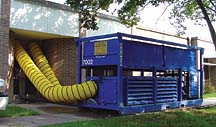
A contingency plan for HVAC failure should designate the portable equipment needed and provide the necessary piping, duct connections, and electrical disconnects.

Devising A Plan

When devising a contingency plan with building owners, Sickmen said his company identifies several steps to go through in order to identify major issues. The first step in developing an emergency response plan is to identify the facility's critical equipment.

"Begin this analysis by assuming the worse-case scenario - the HVAC system breaks down on the hottest day of the year," said Sickmen. "Any systems or equipment that are considered revenue producers or that have lives depending on them should be considered critical equipment."

The next step is to create a list detailing the portable equipment that would be required to replace the functions of the critical equipment identified. HPSI notes that the list should take into consideration the size of the space, the configuration of existing equipment, and other building-specific information, such as the water pressure and the type of structure.

The equipment list should also include any necessary accessories, including the water hoses, pumps, valves, fittings, and flexible ducts.

Along with the equipment list, a complete, detailed equipment layout with drawings and photographs should be developed to help facilitate quick installation and to make sure the necessary space is available and in the least obtrusive area.

A list of in-house emergency contacts and phone numbers should also be developed. The list should include building owners and managers, maintenance personnel, and anyone else who may be affected by a system breakdown.

After the equipment layout has been developed, it is necessary to provide the piping and duct connections and electrical disconnects needed for temporary equipment installation. Making changes before an emergency, such as adding access valves in large pipes, can save time and money.

"Many facilities were not designed with a temporary system in mind, and there may be obstacles such as space limitations for the equipment, the structure itself, water pressure, piping, duct connections, electrical disconnects, enough ‘house' power to run the system, and many more," noted Sickmen.

He pointed out that the benefits of creating a contingency plan can be readily found in the story of a 42-story office building that experienced a motor failure on one of its 1,200-ton chillers. Preliminary estimates concluded that the system would be down for six to eight weeks.

"Based on an earlier contingency plan with HPSI, access valves and piping had been added for a temporary system," said Sickmen. "The weather was still cool and HPSI designed a 500-ton water-cooled system that would later be expanded to 1,000 tons due to increasing hot weather."

The contingency plan helped the building owners recognize the obstacles that needed to be addressed for sizing and design of the system. Obstacles such as the building's tight spaces and 300-psig water pressure limited the type of equipment that could be used.

When properly prepared, a contingency plan can help building owners prepare for future events, saving them time, while reducing the expense and aggravation of an emergency situation.

Publication date: 02/09/2004

Share This Story

Looking for a reprint of this article?
From high-res PDFs to custom plaques, order your copy today!


Tn joanna 2017
Joanna Turpin is a Senior Editor at The ACHR NEWS. She can be contacted at 248-786-1707 or joannaturpin@achrnews.com. Joanna has been with BNP Media since 1991, first heading up the company’s technical book division before moving over to The ACHR NEWS, where she frequently writes about refrigerants and commercial refrigeration. She obtained her bachelor’s degree in English from the University of Washington and worked on her master’s degree in technical communication at Eastern Michigan University.

Recommended Content

JOIN TODAY
To unlock your recommendations.

Already have an account? Sign In

  • HVAC-enrollment

    The Trades Are Back: HVACR Programs See Nearly 30% Enrollment Spike

    A new wave of future technicians is entering the pipeline.  
    News
    By: Matt Jachman
  • 2025 Top 40 Under 40

    2025 Top 40 Under 40 HVACR Professionals List

    The 11th annual Top 40 Under 40 list highlights those...
    HVAC Contracting
    By: Hannah Belloli-Oster
  • LG Ductless Mini-Split Systems

    The 9 Types of Heat Pumps

    As the U.S. moves toward electrification, heat pumps are...
    HVAC Commercial Market
    By: Joanna R. Turpin
Subscription Center
  • Create an Account
  • Start a Subscription
  • Manage My Account
  • Sign Up for Newsletters
  • Visit Customer Service
  • Update Preferences

More Videos

Sponsored Content

Sponsored Content is a special paid section where industry companies provide high quality, objective, non-commercial content around topics of interest to The News audience. All Sponsored Content is supplied by the advertising company and any opinions expressed in this article are those of the author and not necessarily reflect the views of The News or its parent company, BNP Media. Interested in participating in our Sponsored Content section? Contact your local rep!

close
  • Piggy Bank
    Sponsored byWatercress Financial

    Energy Prices, Inflation, and HVAC: What Today’s Homeowners Care About

  • Refrigerated Food
    Sponsored bySolstice Advanced Materials

    R-455A Refrigeration: A Cold Storage Solution for the Future

  • Airex Rooftop Units
    Sponsored byAirex Manufacturing Inc

    Consolidating Roof Penetrations: A Growing Trend in Multifamily HVAC Design

Popular Stories

HVAC-Price-Increase-graphic

HVAC Price Increase List: June 2026

Trump-Section-232.jpg

Trump Reduces Section 232 Tariffs on HVAC Equipment to 15%

R410A-Refrigerant-Cylinder.jpg

Refrigerant Recovery is a Revenue Opportunity

Heat-pump-cutaway.jpg

PFAS Rules and A2L Building Codes Continue to Evolve

Midea-training.jpg

HVAC Workforce Crisis Expands Beyond Technicians to Instructor Shortages

View The ACHR NEWS
Centennial Anniversary Timeline

The ACHR News Timeline Chart
Submit a Letter
Submit a letter to our editors.

Events

November 6, 2025

Next-Gen Data Center Cooling: HVAC Innovation and Real-World Solutions

On Demand As AI workloads and high-density computing push traditional cooling methods to their limits, the data center industry is accelerating the adoption of next-generation HVAC technologies.

June 17, 2026

Decarbonization Without Disruption

This webinar will explore practical HVAC decarbonization strategies that minimize disruption while maximizing long-term performance and ROI.

View All Submit An Event

Poll

Summer Staff

Are you fully staffed for the summer season?
View Results Poll Archive

Products

BNI Mechanical/Electrical Square Foot Costbook, 2026 Edition

BNI Mechanical/Electrical Square Foot Costbook, 2026 Edition

See More Products
Decarbonization Without Disruption - Free Webinar - 6/17/2026

Related Articles

  • 10 Things Any Emergency Preparedness Plan Should Include

    See More
  • January: Plans Should Be In Place

    See More
  • Dec. 8, 2008: Top-10 Green Building Products Include HVAC

    See More

Related Products

See More Products
  • Top 100 HVAC/R Tips

  • Manual_SPS_new.jpg

    Manual SPS HVAC Design for Swimming Pools and Spas [ANSI/ACCA 10 Manual SPS - 2010 (RA 2017)]

See More Products

Related Directories

  • Samsung HVAC

    Samsung HVAC America is the North American headquarters for Samsung's heating and cooling products with distribution channels throughout the United States and Canada.
  • Maytag HVAC

    Maytag HVAC manufacturers heating and air conditioning products that distributors, contractors and homeowners can depend on.
×

Sign Up. Stay Informed.

The #1 trusted source for the HVACR industry since 1926

SUBSCRIBE
  • RESOURCES
    • Advertise
    • Contact Us
    • Advisory Board
    • Classifieds
    • Submit a Letter
    • Directories
    • Store
  • ACCOUNT CENTER
    • Create an Account
    • Start a Subscription
    • Manage My Account
    • Sign Up for Newsletters
    • Visit Customer Service
    • Update Preferences
  • SERVICES
    • Marketing Services
    • Reprints
    • Market Research
    • List Rental
    • Survey/Respondent Access
  • STAY CONNECTED
    • LinkedIn
    • Facebook
    • Instagram
    • YouTube
    • X (Twitter)
  • PRIVACY
    • PRIVACY POLICY
    • TERMS & CONDITIONS
    • DO NOT SELL MY PERSONAL INFORMATION
    • PRIVACY REQUEST
    • ACCESSIBILITY

Copyright ©2026. All Rights Reserved BNP Media, Inc. and BNP Media II, LLC.

Design, CMS, Hosting & Web Development :: ePublishing