ACHR News
search
Ask ACHR NEWS AI
cart
facebook twitter instagram linkedin youtube
  • Sign In
  • Subscribe
  • Sign Out
  • My Account
ACHR News
  • NEWS
    • Breaking News
    • New HVAC Products
    • Featured Products
    • Manufacturer Reports
    • HVAC Data
    • Legislation
    • ACHR NEWS Centennial
  • RESIDENTIAL
    • Air Conditioners
    • Furnaces
    • Residential Heat Pumps
    • Ductless
    • Residential IAQ
    • Testing, Monitoring, Tools
    • Components & Accessories
  • COMMERCIAL
    • Air Handlers
    • Rooftop Units
    • Chillers and Cooling Towers
    • Commercial Heat Pumps
    • Boilers and Hydronics
    • VRF/Ductless
    • Commercial IAQ
  • REFRIGERATION
    • Refrigerants
    • Refrigerant Regulations
    • Leak Management
  • CONTRACTOR PRO
    • Geothermal
    • Homeowner Study
    • VRF and VRV Ductless
    • Unitary Trends
  • EDUCATION
    • Training and Education
    • Business Management
    • Service and Maintenance
    • Continuing Education
    • Market Research >
      • HVAC Brand Awareness Report
      • VRV, VRF, VRVZ Report
      • Unitary Trends Report
      • Water Heat Professionals Report
    • Webinars
    • Sponsor Insights
    • eProducts Info
    • White Papers
  • EVENTS
    • HVAC Contractor Forum
    • Industry Events and Webinars
  • MEDIA
    • Videos
    • AHR Expo 2025 Videos
    • Podcasts >
      • ACHR News Podcast
      • HARDI Podcasts
      • AHR Expo Podcasts
      • ACCA Podcasts
    • Interactive Spotlights
    • Quizzes
    • eBooks
    • HVAC Talkback
  • HVAC GROUP
    • ACHR NEWS >
      • Current Issue
      • Digital Edition
      • Subscribe
    • Distribution Trends
    • SNIPS NEWS >
      • Join SNIPS NEWS
    • Engineered Systems News >
      • Join ES News
    • HVACR Directory
    • Contests
    • Newsletters
    • Contact
    • Advertise
    • My Account

Coatings Can Help Condensers Live Longer

By Joanna R. Turpin
February 13, 2002
The main reason why most condenser coils are coated is that they’re located in a harsh environment. These environments can be natural (saltwater) or manufactured (chemicals), but in either case, a coating will lead to increased unit longevity, maintained performance, and efficiency.

Nobody wants a corroded condenser coil. That situation leads to rapid losses in capacity, reduced efficiency, and increased energy consumption. In seaside locations especially, the operating performance of unprotected condenser coils may decrease over 50% in a single year.

Unit longevity can be a serious problem in harsh seaside or industrial environments: Coils installed in these environments have been known to fail in less than a year. The result is the costly replacement of the coil and/or the entire unit.

However, a coil properly coated with a quality corrosion protection system can withstand these harsh environments, providing long-term and cost-effective service.
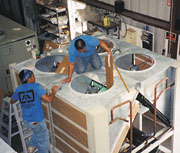
The unit shown here is being prepared to receive its coating.

PERFORMANCE TRADE-OFFS

The purpose of any protective coating is to insulate the material being coated from the environment. A potential disadvantage to coating condenser coils is that there may be a negative effect on the performance of the condensing unit when compared to the performance of the same unit with an uncoated coil. Consequently, there may be a bit of a trade-off between performance and protection.

This trade-off can be limited by selecting a coating that either enhances the coil’s ability to function, or that only affects it minimally.

If a coating is too thick, airflow over the coils will be restricted, affecting pressure drop. Coatings that are too thick or that contain organic pigments may also inhibit thermal transfer. The optimum coating is thin, so it does not significantly inhibit heat transfer.

There are two general categories of protective coatings, pre-coats and post-coats.

Pre-coat processes coat sheet aluminum before it is manufactured into coils. According to Richard Griffin, marketing manager, Blygold America, Stevensville, MD, pre-coats are not a very good long-term coating solution because the manufactured edges are not coated and are therefore exposed to corrosive forces. “This results in a rapid deterioration of the coil. In addition, the application of a pre-coat prior to manufacture precludes the effective application of any other type of coating to the coil.”

There are numerous types of post-coats available in the United States: polyurethane, epoxy poly-urethane, phenolic, epoxy phenolic, polyelastomer- and silica-based coatings, and many others. Each has its own strengths and weaknesses.

Looking for quick answers on air conditioning, heating and refrigeration topics? Try Ask ACHR NEWS, our new smart AI search tool. Ask ACHR NEWS →

The topcoat is applied to the coil. (Photos courtesy of Blygold America Inc.)

WHAT TO CONSIDER

When choosing a protective coating for condenser coils, the important points to remember (in addition to corrosion resistance and complete coverage of the coil), are that the coating should be thin, flexible, impact resistant, and UV resistant.

Thinness: As mentioned before, coating that is too thick restricts airflow over the condenser coil. As fin spacing on condenser coils gets denser, this becomes more important. Some coatings are so thick that fin bridging occurs, severely restricting the efficiency of a condensing unit.

Flexibility and impact resistance: A coating that is not flexible or impact resistant will crack or flake when the coils get hit or bent during normal operating conditions. Once any portion of uncoated metal is exposed, corrosion will form and begin to corrode the underlying metal. “I have had contractors tell me of coated coils that appeared to look fine from a distance, but upon closer inspection [they] had almost completely disintegrated, leaving only the exterior shell of the coating,” says Griffin.

UV resistance: Any condenser coil that will be exposed to sunlight should have a coating that is resistant to UV radiation. Several of the popular post-coats do not have inherent UV resistance and offer a polyurethane “topcoat” to prevent rapid deterioration of their base coating. Polyurethane is UV resistant. “A negative aspect is that the extra layer of polyurethane adds undesirable thickness to the coating,” notes Griffin.

DIP AND SPRAY

There are two methods for applying post-coat coatings: dipping or spraying.

All coatings applied by a dip process must be applied at a factory. Products are immersed into product baths a set number of times and for specific durations, then either baked or allowed to cure naturally.

Spray processes can be done either at the factory or in the field. Factory-applied processes are generally more reliable, since coils in field installations may present access problems. In addition, factory-applied spray processes use different methods of air-assisted spraying to guarantee penetration of the coil. Some processes have developed protocols to coat coils uniformly without removing them from the equipment, while others must have the coils removed.

There are advantages to the factory process that can coat the coil while it is in the unit. One is not having to cut and resolder tubes and remove/replace refrigerant. Obviously, the potential for damage to the integrity of the condenser unit is lessened if the coil does not have to be removed. Another advantage of in-place coil coating is quicker turnaround times. Contractors working on tight deadlines appreciate this.

Field-spray applications range from air-assisted product pumps producing high-pressure penetration to aerosol cans. These applications are popular, but have varying degrees of success in terms of coverage and penetration. The general opinion is that some protection is better than none; bare aluminum coils just don’t last long in corrosive environments.

As with any mechanical process, it is possible to perform a coating process incorrectly. Most coating failures are probably due to improper preparation of the substrate. The success of any coating depends heavily on good adhesion. If the condenser coil is not properly cleaned and prepared before coating, failure is likely to occur.

Contractors are a very important part of the protective coating-selection process, even though they may not always have a say in which type of coating is used.

“Contractors definitely have the local field experience to recommend to a customer whether or not a protective coating should be used,” says Griffin. “They can provide a valuable service by educating end users of protective coating options when it comes time to purchase a new unit or replace a coil.”

The first Blygold coating system was specifically designed to resist the corrosive attack on condenser coils by the combined marine and industrial environment found in the Netherlands. For more information, contact Blygold at 410-643-6080; 410-643-6092 (fax); or info@blygoldamerica.com (e-mail).

Publication date: 02/18/2002

Share This Story

Looking for a reprint of this article?
From high-res PDFs to custom plaques, order your copy today!


Tn joanna 2017
Joanna Turpin is a Senior Editor at The ACHR NEWS. She can be contacted at 248-786-1707 or joannaturpin@achrnews.com. Joanna has been with BNP Media since 1991, first heading up the company’s technical book division before moving over to The ACHR NEWS, where she frequently writes about refrigerants and commercial refrigeration. She obtained her bachelor’s degree in English from the University of Washington and worked on her master’s degree in technical communication at Eastern Michigan University.

Recommended Content

JOIN TODAY
To unlock your recommendations.

Already have an account? Sign In

  • HVAC-enrollment

    The Trades Are Back: HVACR Programs See Nearly 30% Enrollment Spike

    A new wave of future technicians is entering the pipeline.  
    News
    By: Matt Jachman
  • 2025 Top 40 Under 40

    2025 Top 40 Under 40 HVACR Professionals List

    The 11th annual Top 40 Under 40 list highlights those...
    HVAC Light Commercial Market
    By: Hannah Belloli-Oster
  • LG Ductless Mini-Split Systems

    The 9 Types of Heat Pumps

    As the U.S. moves toward electrification, heat pumps are...
    News
    By: Joanna R. Turpin
Subscription Center
  • Create an Account
  • Start a Subscription
  • Manage My Account
  • Sign Up for Newsletters
  • Visit Customer Service
  • Update Preferences

More Videos

Sponsored Content

Sponsored Content is a special paid section where industry companies provide high quality, objective, non-commercial content around topics of interest to The News audience. All Sponsored Content is supplied by the advertising company and any opinions expressed in this article are those of the author and not necessarily reflect the views of The News or its parent company, BNP Media. Interested in participating in our Sponsored Content section? Contact your local rep!

close
  • Piggy Bank
    Sponsored byWatercress Financial

    Energy Prices, Inflation, and HVAC: What Today’s Homeowners Care About

  • Refrigerated Food
    Sponsored bySolstice Advanced Materials

    R-455A Refrigeration: A Cold Storage Solution for the Future

  • Airex Rooftop Units
    Sponsored byAirex Manufacturing Inc

    Consolidating Roof Penetrations: A Growing Trend in Multifamily HVAC Design

Popular Stories

Refrigerants-and-gauge.jpg

HVAC Industry Warns of Counterfeit Refrigerants Entering U.S. Supply Chain

U.S. Supreme Court building

95% Furnace Efficiency Rule to Get New Hearing

Data_Center_facility.jpg

HVAC Manufacturers Respond to Growing Data Center Backlash

Midea-training.jpg

HVAC Workforce Crisis Expands Beyond Technicians to Instructor Shortages

HVAC Minute retail refrigeration system

EPA Final Rule’s Impact on R-410A Deadlines

View The ACHR NEWS
Centennial Anniversary Timeline

The ACHR News Timeline Chart
Submit a Letter
Submit a letter to our editors.

Events

November 6, 2025

Next-Gen Data Center Cooling: HVAC Innovation and Real-World Solutions

On Demand As AI workloads and high-density computing push traditional cooling methods to their limits, the data center industry is accelerating the adoption of next-generation HVAC technologies.

June 23, 2026

HVAC Duct Sealing Mastics: Why Selection Matters

In this webinar we will detail what HVAC material buyers and technicians need to know when selecting duct mastics, including matching mastic to substrate, alternatives to liquid mastic, and where UL 181 Listings fit into real world installations.

View All Submit An Event

Poll

Summer Staff

Are you fully staffed for the summer season?
View Results Poll Archive

Products

BNI Mechanical/Electrical Square Foot Costbook, 2026 Edition

BNI Mechanical/Electrical Square Foot Costbook, 2026 Edition

See More Products
HVAC Duct Sealing Mastics: Why Selection Matters - Free Webinar - 6/23/2026

Related Articles

  • Axiom Supermarket Coolers

    AI Can Help Solve Commercial Refrigeration Challenges

    See More
  • Training Can Help Curb Callbacks

    See More
  • Joanna's Point of View

    AI Can Be a Help and a Headache

    See More

Related Directories

  • Condenser and Chiller Services

    Offers in-field eddy current inspection, remote video inspection, protective epoxy coatings and complete retubing service with tubes in stock.
  • Modine Coatings

    Protect HVAC/R equipment from corrosion with factory-applied ElectroFin® E-coat, field-applied Insitu® Spray Coatings, or the GulfCoat® Contractor Series product line.
×

Sign Up. Stay Informed.

The #1 trusted source for the HVACR industry since 1926

SUBSCRIBE
  • RESOURCES
    • Advertise
    • Contact Us
    • Advisory Board
    • Classifieds
    • Submit a Letter
    • Directories
    • Store
  • ACCOUNT CENTER
    • Create an Account
    • Start a Subscription
    • Manage My Account
    • Sign Up for Newsletters
    • Visit Customer Service
    • Update Preferences
  • SERVICES
    • Marketing Services
    • Reprints
    • Market Research
    • List Rental
    • Survey/Respondent Access
  • STAY CONNECTED
    • LinkedIn
    • Facebook
    • Instagram
    • YouTube
    • X (Twitter)
  • PRIVACY
    • PRIVACY POLICY
    • TERMS & CONDITIONS
    • DO NOT SELL MY PERSONAL INFORMATION
    • PRIVACY REQUEST
    • ACCESSIBILITY

Copyright ©2026. All Rights Reserved BNP Media, Inc. and BNP Media II, LLC.

Design, CMS, Hosting & Web Development :: ePublishing