ACHR News
search
Ask ACHR NEWS AI
cart
facebook twitter instagram linkedin youtube
  • Sign In
  • Subscribe
  • Sign Out
  • My Account
ACHR News
  • NEWS
    • Breaking News
    • New HVAC Products
    • Featured Products
    • Manufacturer Reports
    • HVAC Data
    • Legislation
    • ACHR NEWS Centennial
  • RESIDENTIAL
    • Air Conditioners
    • Furnaces
    • Residential Heat Pumps
    • Ductless
    • Residential IAQ
    • Testing, Monitoring, Tools
    • Components & Accessories
  • COMMERCIAL
    • Air Handlers
    • Rooftop Units
    • Chillers and Cooling Towers
    • Commercial Heat Pumps
    • Boilers and Hydronics
    • VRF/Ductless
    • Commercial IAQ
  • REFRIGERATION
    • Refrigerants
    • Refrigerant Regulations
    • Leak Management
  • CONTRACTOR PRO
    • Geothermal
    • Homeowner Study
    • VRF and VRV Ductless
    • Unitary Trends
  • EDUCATION
    • Training and Education
    • Business Management
    • Service and Maintenance
    • Continuing Education
    • Market Research >
      • HVAC Brand Awareness Report
      • VRV, VRF, VRVZ Report
      • Unitary Trends Report
      • Water Heat Professionals Report
    • Webinars
    • Sponsor Insights
    • eProducts Info
    • White Papers
  • EVENTS
    • HVAC Contractor Forum
    • Industry Events and Webinars
  • MEDIA
    • Videos
    • AHR Expo 2025 Videos
    • Podcasts >
      • ACHR News Podcast
      • HARDI Podcasts
      • AHR Expo Podcasts
      • ACCA Podcasts
    • Interactive Spotlights
    • Quizzes
    • eBooks
    • HVAC Talkback
  • HVAC GROUP
    • ACHR NEWS >
      • Current Issue
      • Digital Edition
      • Subscribe
    • Distribution Trends
    • SNIPS NEWS >
      • Join SNIPS NEWS
    • Engineered Systems News >
      • Join ES News
    • HVACR Directory
    • Contests
    • Newsletters
    • Contact
    • Advertise
    • My Account
Service and MaintenanceTesting | Monitoring | ToolsMeters & Gauges

Checking The Charge Without Gauges
October 20, 2005
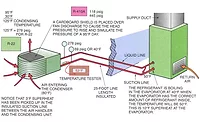
On this system equipped with a TXV, the suction line temperature should be measured at the outlet of the evaporator, and 8 degrees to 12 degrees of superheat added to the saturation temperature of the coil to calculate the required line temperature.
There is no reason to ever put gauges on an air conditioning or refrigeration system after the initial installation unless a problem with the mechanical refrigeration circuit is suspected. The refrigerant charge can be checked very accurately without gauges using a quality thermometer and manufacturer's charging chart.

The capacity in Btuh can be calculated, determining if the unit is working at or near capacity, with a psychrometric chart, digital thermometer, digital humidity stick, and an accurate method to calculate airflow.

The Air-Conditioning and Refrigeration Institute (ARI) defines the standards for air conditioning operational design. All equipment in the ARI directory is rated under the same conditions.

Design conditions are shown in Table 1.

At these conditions, almost all (there is always the one exception) standard efficiency air conditioners operate with a 40 degrees F evaporator coil and at 125 degrees condensing temperature. Information on other types of systems can be referenced in the equipment design section. Your distributor or the manufacturer can tell you at what conditions the equipment was rated. For the rest, physics is physics and the rules don't change.

Setting Airflow

Remember, temperature drop across a coil will vary with the latent load (humidity). The more humidity, the more cooling energy goes to converting water vapor to water. The drop can fall within a range of 16 degrees to 24 degrees with ease.

Airflow should never be set by measuring temperature drop across the evaporator coil. Setting the airflow is easy. There are several ways to do so. The easiest way is using the static pressure drop across the dry coil. Look in the coil manufacturer's literature. With a digital manometer and a chart, airflow can be set across a dry coil in a matter of minutes.

Airflow should be 400 cfm per ton:

  • 1 ton = 012 (12,000 Btuh) = 400 cfm

  • 1.5 ton = 018 (18,000 Btuh) = 600 cfm

  • 2 ton = 024 = (24,000 Btuh) 800 cfm

  • 2.5 ton = 030 = (30,000 Btuh) = 1,000 cfm

  • 3 ton = 036 = (36,000 Btuh) = 1,200 cfm

  • 3.5 ton = 042 = (42,000 Btuh) = 1,400 cfm

  • 4 ton = 048 = (48,000 Btuh) = 1,600 cfm

  • 5 ton = 060 = (60,000 Btuh) = 2,000 cfm

    Table 1. Design conditions vs. testing conditions for unitary HVAC products.

    Checking The Charge Sans Gauges

    If you check the refrigerant charge without gauges, you must understand the design operation of the equipment. Understanding this, you can calculate what the suction and liquid line temperatures should be just as accurately as if you used gauges. If you do not know how the system was designed to operate, there is no need to hook up gauges. The information you will get will have no more value than the line temperature alone.

    To further understand how to check the charge without gauges, let's work from design conditions. Say the indoor temperature is 75 degrees and the coil temperature is 40 degrees. The design temperature difference is 35 degrees. This temperature difference will stay the same under all load conditions at the rated cfm.

    The temperature difference is dependant upon the manufacturer's design. A high-efficiency evaporator is larger, and the refrigerant may boil at a temperature difference of 30 degrees, or a 45 degrees coil when the space temperature is 75 degrees. The design temperature difference, if not given by the manufacturer, can be calculated and recorded during the installation provided the airflow and charge are set correctly using the manufacturer's data. This is commonly called benchmarking. The exact boiling temperature depends upon the manufacturer and how large the evaporator coil is.

    Using a digital manifold set with data logging provides the additional value of having a permanent record of equipment operation and operating characteristics, allowing a future service person to determine if any operational changes occurred that could affect system performance. As SEER ratings change, we can expect to see the operation of the equipment change, and proper charging techniques will become more critical than ever. Keep this point in mind for later.

    A laminated psychrometric chart and dry erase markers allow for quick field calculation of the capacity of the system. In this case, 39975 Btuh or a little under 3.5 tons, this system would warrant further investigation because it is operating below its rating. With digital instrumentation we should be able to set up the equipment to the manufacturer’s specifications.

    Operating As Designed?

    For example, to determine if an R-22 split-system air conditioning or heat pump system is operating as designed, make and record the following measurements:

  • System return air (RA) wet bulb and dry bulb temperatures.

  • Outdoor air temperature (ODA).

  • Using a charging calculator or chart, determine the required superheat if the system has a fixed orifice or cap tube.

  • Measure supply air wet bulb and dry bulb temperatures. (Allow operation for 10 minutes or longer.)

    The RA dry bulb temperature minus the design temperature difference equals the saturation temperature of the evaporator coil. Add the required superheat and you have the required suction line temperature. If the temperature is ±2 degrees, the charge is OK.

    Measure the suction line temperature at the evaporator coil outlet.

    75 degrees RA – (35 degrees design temp difference) = 40 degrees evaporator coil.

    40 degrees + (8 degrees-10 degrees superheat) = 48 degrees-50 degrees suction line temperature.

    ±2 degrees = 46 degrees-52 degrees acceptable line temperature range.

    If the system falls outside of the 2 degree range, it's time for further investigation. It's probably time to hook up the gauges, but again, you need to know what the pressure should be.

    Troubleshooting The System

    In our example, the saturation temperature of the air conditioning evaporator coil is 40 degrees. This corresponds to a gauge pressure of 68.5 psig. The high-side pressure corresponds to 120 degrees saturation or 278 psig.

    Using a charging calculator, you can determine that the superheat should be 8 degrees to 10 degrees. If the metering device were fixed, the superheat would be 10 degrees, meaning the suction line temperature would be 48 degrees to 52 degrees. If the line is too cold or too hot, verify conditions that were used in the superheat calculation. If the humidity is low, the load will be low also.

    Make sure the system was installed with matched components. Cooling systems are designed to operate within design parameters, and to reach their rated efficiency, with matched components. A mismatched system may cool, but that doesn't mean it will cool efficiently or effectively.

    Look at the ARI equipment directory to see how the equipment was rated for the evaporator coil installed on it. This information is available from your distributor. Sometimes systems are designed specifically to remove latent or sensible heat, and the design temperature difference will change.

    Remember, 400 cfm/ton is the nominal airflow; lower airflow will give a higher temperature difference due to the colder coil temperature, and higher airflow the opposite. If you live in an area where the airflow is more or less than the nominal (e.g., Arizona systems require 450 cfm/ton due to the low humidity), you will use a different design temperature difference.

    Keep in mind that you will only have to do a lot of these things once. Airflows do not change substantially with proper maintenance; the components won't change; and the system is a sealed system. If this information is documented after the initial installation or service, it will become an invaluable record, and a documentation of proper performance for you and your customer.

    Manufacturing Differences

    I have found that almost all equipment manufacturers have identical evaporator operating characteristics depending on their classification. This is due to the design criteria governed by design conditions in the ARI procedures for testing.

    At a nominal cfm, all evaporators must have similar operating characteristics to remove the same amount of heat from the same amount of air under the same load conditions. It comes down to physics: time, temperature difference, and turbulence. In order to remove the same amount of heat, the refrigerant's boiling temperature must be the same across the board.

    Condensers, on the other hand, do not always follow conventions. Manufacturers will differ in the compressor selection, metering device, required subcooling, and temperature rise, according to their own design to meet capacity and energy use requirements. In practice it is best to benchmark condenser performance at installation if the manufacturer's information is not available, to make future evaluations of condenser performance.

    Keep It Sealed

    After initial installation and system commissioning, there is no reason to install gauges. It runs the risk of creating leaks, losing refrigerant from installing and removing hoses, or otherwise accessing the sealed system and violating system integrity.

    All information pertaining to the sealed system's performance can be accurately evaluated using temperatures alone with knowledge of design. A thorough understanding of system design and field practice of benchmarking systems will save time, increase equipment life, and reduce refrigerant emissions.

    Last but not least, if you are going to hook up gauges, consider going digital. A refrigeration analyzer (like the Testo 523), along with a few other digital tools, will not only allow you to set up equipment with laboratory accuracy, it will also decrease your time for service, reduce callbacks, increase professionalism, and provide a service to your customers that exceeds anything your competition is currently offering.

    As a service tech, manufacturer's rep, maintenance technician, or lab test technician, you will have a window into the system, allowing you to see what you haven't been able to see before. You will be able to more accurately diagnose problems, spot trends, and see what you have been missing. Technology can make your results better and your life easier.

    Publication date: 10/24/2005

  • Looking for quick answers on air conditioning, heating and refrigeration topics? Try Ask ACHR NEWS, our new smart AI search tool. Ask ACHR NEWS →

    Share This Story

    Looking for a reprint of this article?
    From high-res PDFs to custom plaques, order your copy today!


    Recommended Content

    JOIN TODAY
    To unlock your recommendations.

    Already have an account? Sign In

    • HVAC-enrollment

      The Trades Are Back: HVACR Programs See Nearly 30% Enrollment Spike

      A new wave of future technicians is entering the pipeline.  
      Training and Education
      By: Matt Jachman
    • 2025 Top 40 Under 40

      2025 Top 40 Under 40 HVACR Professionals List

      The 11th annual Top 40 Under 40 list highlights those...
      HVAC Contracting
      By: Hannah Belloli-Oster
    • LG Ductless Mini-Split Systems

      The 9 Types of Heat Pumps

      As the U.S. moves toward electrification, heat pumps are...
      Air Source Heat Pumps
      By: Joanna R. Turpin
    Subscription Center
    • Create an Account
    • Start a Subscription
    • Manage My Account
    • Sign Up for Newsletters
    • Visit Customer Service
    • Update Preferences

    More Videos

    Sponsored Content

    Sponsored Content is a special paid section where industry companies provide high quality, objective, non-commercial content around topics of interest to The News audience. All Sponsored Content is supplied by the advertising company and any opinions expressed in this article are those of the author and not necessarily reflect the views of The News or its parent company, BNP Media. Interested in participating in our Sponsored Content section? Contact your local rep!

    close
    • Piggy Bank
      Sponsored byWatercress Financial

      Energy Prices, Inflation, and HVAC: What Today’s Homeowners Care About

    • Refrigerated Food
      Sponsored bySolstice Advanced Materials

      R-455A Refrigeration: A Cold Storage Solution for the Future

    • Airex Rooftop Units
      Sponsored byAirex Manufacturing Inc

      Consolidating Roof Penetrations: A Growing Trend in Multifamily HVAC Design

    Popular Stories

    HVAC-Price-Increase-graphic

    HVAC Price Increase List: June 2026

    Trump-Section-232.jpg

    Trump Reduces Section 232 Tariffs on HVAC Equipment to 15%

    R410A-Refrigerant-Cylinder.jpg

    Refrigerant Recovery is a Revenue Opportunity

    Heat-pump-cutaway.jpg

    PFAS Rules and A2L Building Codes Continue to Evolve

    Midea-training.jpg

    HVAC Workforce Crisis Expands Beyond Technicians to Instructor Shortages

    View The ACHR NEWS
    Centennial Anniversary Timeline

    The ACHR News Timeline Chart
    Submit a Letter
    Submit a letter to our editors.

    Events

    November 6, 2025

    Next-Gen Data Center Cooling: HVAC Innovation and Real-World Solutions

    On Demand As AI workloads and high-density computing push traditional cooling methods to their limits, the data center industry is accelerating the adoption of next-generation HVAC technologies.

    June 17, 2026

    Decarbonization Without Disruption

    This webinar will explore practical HVAC decarbonization strategies that minimize disruption while maximizing long-term performance and ROI.

    View All Submit An Event

    Poll

    Summer Staff

    Are you fully staffed for the summer season?
    View Results Poll Archive

    Products

    BNI Mechanical/Electrical Square Foot Costbook, 2026 Edition

    BNI Mechanical/Electrical Square Foot Costbook, 2026 Edition

    See More Products
    Decarbonization Without Disruption - Free Webinar - 6/17/2026

    Related Articles

    • EE_Technical Bryan Orr_1

      Checking the Charge on a Heat Pump in the Winter

      See More
    • HVAC system with a 25 foot lineset

      Btu Buddy 158: Checking the Charge in Mild Weather

      See More
    • FROSTlines

      When Possible, Repair Reach-in Coolers Without Using Gauges

      See More

    Related Products

    See More Products
    • psywtpm.png

      Psychrometrics Without Tears Manual

    • pewtpm.png

      Pressure Enthalpy Without Tears Manual

    See More Products

    Events

    View AllSubmit An Event
    • June 17, 2026

      Decarbonization Without Disruption

      This webinar will explore practical HVAC decarbonization strategies that minimize disruption while maximizing long-term performance and ROI.
    • May 21, 2026

      The A2L Genie is Out of the Refrigerant Canister – What Now?

      On Demand Join this webinar to learn about key updates to refrigerant regulations. We will cover practical installation and servicing content gathered from thousands of our interactions with contractors across the US and Canada.
    View AllSubmit An Event

    Related Directories

    • The Energy Conservatory

      Manufacturer of the Minneapolis Blower Door and Minneapolis Duct Blaster and Blower Door, DG-1000 digital pressure and flow gauge, and TEC TrueFlow Meter.
    ×

    Sign Up. Stay Informed.

    The #1 trusted source for the HVACR industry since 1926

    SUBSCRIBE
    • RESOURCES
      • Advertise
      • Contact Us
      • Advisory Board
      • Classifieds
      • Submit a Letter
      • Directories
      • Store
    • ACCOUNT CENTER
      • Create an Account
      • Start a Subscription
      • Manage My Account
      • Sign Up for Newsletters
      • Visit Customer Service
      • Update Preferences
    • SERVICES
      • Marketing Services
      • Reprints
      • Market Research
      • List Rental
      • Survey/Respondent Access
    • STAY CONNECTED
      • LinkedIn
      • Facebook
      • Instagram
      • YouTube
      • X (Twitter)
    • PRIVACY
      • PRIVACY POLICY
      • TERMS & CONDITIONS
      • DO NOT SELL MY PERSONAL INFORMATION
      • PRIVACY REQUEST
      • ACCESSIBILITY

    Copyright ©2026. All Rights Reserved BNP Media, Inc. and BNP Media II, LLC.

    Design, CMS, Hosting & Web Development :: ePublishing