Troubleshooting With Jim Johnson: An Electric Heating System That's Not Heating Enough
In this column, Jim Johnson, director of training for Technical Training Associates, presents a specific HVACR equipment problem and invites readers to submit their diagnosis. From those who submit the correct answer by the stated deadline, there will be a prize drawing. The answer, and the prize winner, will be announced in the next column, along with another problem for you to solve.

The failed component was the transformer. A reading of 120 VAC at the PR-1 and PR-2 connections and a 0-VAC reading (which should have been 24 VAC) at SEC-1 and SEC-2 proved the component failure.
 In regard to the second part of our troubleshooting question, the reason the fan motor was running constantly was due to the loss of 24-VAC applied to the 2A coil (shown in the partial diagram of the control circuit in Figure A), which allowed the normally closed 2A contact (shown in the partial diagram of the operating voltage segment of the schematic in Figure B) to remain closed constantly. In an off cycle, the 24-VAC control system constantly complete to the 2A coil will keep the N.C. contacts open until a call for heat, which along with the time delay system breaks the 2A coil circuit, de-energizing the coil, and allowing the contacts to close and create the complete circuit to the low speed winding of the blower motor.
From those readers who sent in the correct diagnosis, the prize drawing winner is Ed Herget.
And, now on to this issue’s problem.

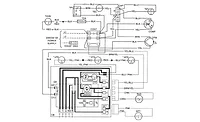
When you arrive, you note that the temperature in the building is mildly chilly, and that the air handler motor is operating on low speed. The thermostat is set to call for heat, but the temperature rise is insufficient. Removing the access panel of the unit, you locate the schematic diagram (shown in Figure 1) and begin your troubleshooting process with a voltmeter.
Noting that the three heating elements (HE1, HE2, and HE3) are controlled by two relays (HR1 and HR2), and that a limit control (LC1, LC2, and LC3) is wired in series with each element, you get the following readings:
1. 240 VAC at the terminal connections for HE1.
2. 240 VAC at the terminal connections for HE2.
3. 240 VAC at the terminal connections for HE3.
When testing the circuits with a clamp-on ammeter, you note:
1. 0 Amps on the wiring connection to HE2.
2. 0 Amps on the wiring connection to HE1.
3. The manufacturer’s listed current draw on the wiring to HE3.
And your troubleshooting question is: What needs to be done in order to get this unit operating normally again?
If you have the answer to this question, click on www.technicaltrainingassoc.com and submit your diagnosis via The NEWS link. All correct answers received by the deadline of Dec. 28, 2007 will be entered into a prize drawing for a Fieldpiece SC46 Clamp-on Digital Meter. The correct answer to this question, along with the results of the drawing, will be published in the Feb. 4, 2008 issue.
Publication date: 12/03/2007
Figure A. (Click on the diagram for an enlarged view.)
SOLUTION TO OUR LAST PROBLEM
We begin this edition with the answer to our “An Older Gas Furnace That’s Blowing Cool Air” problem presented in the Oct. 8, 2007 issue.The failed component was the transformer. A reading of 120 VAC at the PR-1 and PR-2 connections and a 0-VAC reading (which should have been 24 VAC) at SEC-1 and SEC-2 proved the component failure.
Figure B. (Click on the diagram for an enlarged view.)
From those readers who sent in the correct diagnosis, the prize drawing winner is Ed Herget.
And, now on to this issue’s problem.
Figure 1. (Click on the diagram for an enlarged view.)
AN ELECTRIC HEATING SYSTEM THAT'S NOT HEATING ENOUGH
In this troubleshooting scenario we’re dealing with a resistance heating system, and the customer has called to say that the unit is no longer keeping them warm “like it used to.” This particular unit, which can be used in conjunction with a heat pump, or only as an electric furnace, is not paired with a refrigeration system. It has been in service for several years with no previous service calls.When you arrive, you note that the temperature in the building is mildly chilly, and that the air handler motor is operating on low speed. The thermostat is set to call for heat, but the temperature rise is insufficient. Removing the access panel of the unit, you locate the schematic diagram (shown in Figure 1) and begin your troubleshooting process with a voltmeter.
Noting that the three heating elements (HE1, HE2, and HE3) are controlled by two relays (HR1 and HR2), and that a limit control (LC1, LC2, and LC3) is wired in series with each element, you get the following readings:
1. 240 VAC at the terminal connections for HE1.
2. 240 VAC at the terminal connections for HE2.
3. 240 VAC at the terminal connections for HE3.
When testing the circuits with a clamp-on ammeter, you note:
1. 0 Amps on the wiring connection to HE2.
2. 0 Amps on the wiring connection to HE1.
3. The manufacturer’s listed current draw on the wiring to HE3.
And your troubleshooting question is: What needs to be done in order to get this unit operating normally again?
If you have the answer to this question, click on www.technicaltrainingassoc.com and submit your diagnosis via The NEWS link. All correct answers received by the deadline of Dec. 28, 2007 will be entered into a prize drawing for a Fieldpiece SC46 Clamp-on Digital Meter. The correct answer to this question, along with the results of the drawing, will be published in the Feb. 4, 2008 issue.
Publication date: 12/03/2007
Looking for a reprint of this article?
From high-res PDFs to custom plaques, order your copy today!