ACHR News
search
Ask ACHR NEWS AI
cart
facebook twitter instagram linkedin youtube
  • Sign In
  • Subscribe
  • Sign Out
  • My Account
ACHR News
  • NEWS
    • Breaking News
    • New HVAC Products
    • Featured Products
    • Manufacturer Reports
    • HVAC Data
    • Legislation
    • ACHR NEWS Centennial
  • RESIDENTIAL
    • Air Conditioners
    • Furnaces
    • Residential Heat Pumps
    • Ductless
    • Residential IAQ
    • Testing, Monitoring, Tools
    • Components & Accessories
  • COMMERCIAL
    • Air Handlers
    • Rooftop Units
    • Chillers and Cooling Towers
    • Commercial Heat Pumps
    • Boilers and Hydronics
    • VRF/Ductless
    • Commercial IAQ
  • REFRIGERATION
    • Refrigerants
    • Refrigerant Regulations
    • Leak Management
  • CONTRACTOR PRO
    • Geothermal
    • Homeowner Study
    • VRF and VRV Ductless
    • Unitary Trends
  • EDUCATION
    • Training and Education
    • Business Management
    • Service and Maintenance
    • Continuing Education
    • Market Research >
      • HVAC Brand Awareness Report
      • VRV, VRF, VRVZ Report
      • Unitary Trends Report
      • Water Heat Professionals Report
    • Webinars
    • Sponsor Insights
    • eProducts Info
    • White Papers
  • EVENTS
    • HVAC Contractor Forum
    • Industry Events and Webinars
  • MEDIA
    • Videos
    • AHR Expo 2025 Videos
    • Podcasts >
      • ACHR News Podcast
      • HARDI Podcasts
      • AHR Expo Podcasts
      • ACCA Podcasts
    • Interactive Spotlights
    • Quizzes
    • eBooks
    • HVAC Talkback
  • HVAC GROUP
    • ACHR NEWS >
      • Current Issue
      • Digital Edition
      • Subscribe
    • Distribution Trends
    • SNIPS NEWS >
      • Join SNIPS NEWS
    • Engineered Systems News >
      • Join ES News
    • HVACR Directory
    • Contests
    • Newsletters
    • Contact
    • Advertise
    • My Account

HVAC Solutions For Schools

By Barbara A. Checket-Hanks
August 5, 2005
When the Carbon Hill Elementary School in Walker County, Ala., was rebuilt after a hurricane, the school district concluded Mat-Faced Micro-Aire Duct Board from Johns Manville would provide lower installation costs and long-term energy savings.
It's hardly news that America's school buildings are aging. In many areas of the country, school HVAC systems range from the inefficient to the decrepit. HVAC systems are now widely recognized as having a big impact on IAQ problems among students and faculty, and making smaller system changes is much preferred to building a new school.

According to Education Statistics Quarterly, "The median total expenditure by school district in the nation was $8,007 per student. This included current operating expenditures, capital outlays (for school construction and equipment), expenditures for programs other than elementary/secondary education (such as adult education and community service programs), interest payments on long-term debt, and payments to state and local governments."

The quarterly, a publication of the National Center for Education Statistics (NCES, www.nces.ed.gov), stated, "A major barrier to schools' improving their facilities is the substantial cost involved. If schools are unable to obtain the funding they need to perform maintenance or construct new buildings when necessary, facilities' problems multiply, which can result not only in health and safety problems, but also in increased costs of repairs."

Background Figures

According to the 1999 NCES survey:

  • HVAC systems were reported to be in less-than-adequate condition at 29 percent of schools.

  • Ventilation was the environmental condition most likely to be perceived as unsatisfactory (26 percent of schools).

    Each of the following environmental conditions was rated as unsatisfactory by about one-fifth of the schools: heating, IAQ, acoustics or noise control, and physical security. Twelve percent of schools reported unsatisfactory lighting.

  • About one-third of the schools reported unsatisfactory energy efficiency.

  • Three-quarters of schools reported that they needed to spend money on repairs, renovations, and modernizations to bring their onsite buildings into good overall condition.

    The total amount needed by schools was estimated at approximately $127 billion.

  • The average dollar amount for each school needing to spend on repairs/renovations was about $2.2 million. The average cost per student was $3,800.

  • Approximately one-fifth of the schools indicated that they had less-than-adequate conditions for life safety features, roofs, and electric power. About one-quarter reported less-than-adequate conditions for plumbing, exterior walls, finishes, windows, and doors.

    According to projections published by the NCES, "from 2000-01 to 2012-13, current expenditures in constant 2001-02 dollars per pupil in fall enrollment are projected to increase from 14 to 37 percent, depending on the alternatives schools choose to solve their particular problems." Table 1 shows which states are spending the most on their schools' capital outlays, where HVAC repairs/re-placement falls.

    The following cases demonstrate the kind of effect HVAC equipment selection can have on ventilation, IAQ, acoustics, and especially, the bottom line.
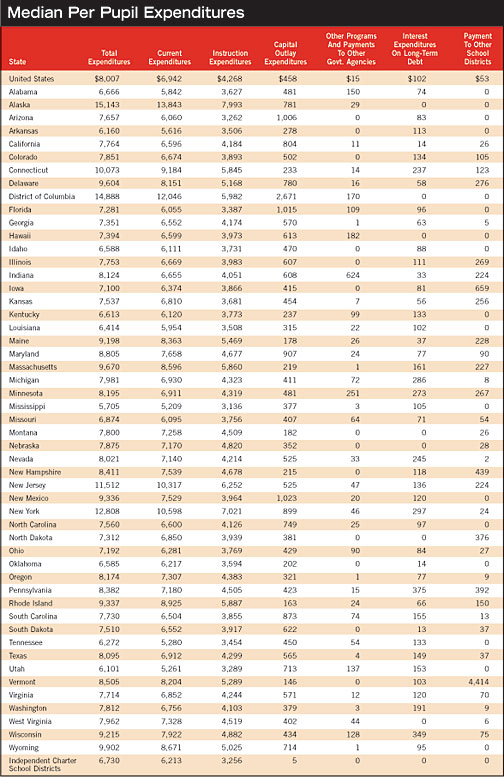
    Table 1. Median school district expenditures per student by type of expenditure, by state: School year 2000-01. (Courtesy of NCES.)

    Ventilation And Acoustics

    Alabama spends slightly more than the national average on school capital expenditures. However, repair budgets can be altered in an instant due to damage from a natural disaster.

    On Nov. 10, 2002, a tornado cut a 43-mile-long, 1,100-foot-wide swath of destruction through northwest Alabama. At 7:10 p.m., it reached the rural town of Carbon Hill and plowed through the town's elementary school. Because of the time of day, no children or teachers were on campus and no one was hurt, but the school building was destroyed. The Walker County School District organized a plan to rebuild. The new school is set to open this fall.

    With the perceived perception of ventilation being subpar in many schools, it's not surprising that the designers for the new school building paid close attention to the new ventilation system.

    The mechanical engineering firm, Edmonds Engineering (Birmingham, Ala.), requested estimates for lined sheet metal air ducts. Fluctuating sheet metal prices, however, raised the estimated cost higher than the district's budget could handle.

    "This school is a $15 million project, but we've had to work hard to stay within budget," said Dan Blackman, vice president of Edmonds Engineering. Changing to fiberglass duct board lowered the cost approximately $120,000, Blackman said.

    Operational efficiency, or sustainability as it is now called, was also part of the engineers' mandates. Mickey Barrentine, maintenance supervisor for Walker County Schools, explained, "We would not have installed it if it was only going to save money during construction and still cost us money down the road."

    According to manufacturer Johns Manville, Denver, fiberglass duct board delivers conditioned air at the desired temperatures, and reduces or eliminates condensation problems. Moreover, "standard fiberglass duct board installation methods provide extremely low system leakage, enhancing comfort and minimizing energy loss," the company said.

    The NCES survey also cited sound control as being critical. "Classrooms can be noisy places," pointed out architect Rick Lathan. "The duct board is going to do a lot to dampen the sound that travels through the duct system, including cross talk from other classrooms and air-handling noise."
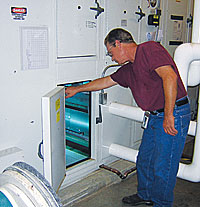
    Ron Bjorklund, district-wide maintenance supervisor at Robbinsdale (Minn.) Area School District 281, inspects one of the air-handling units. The school installed UVC lights to help prevent mold growth.

    The Efficiency Picture

    Ohio falls close to the middle of capital outlay expenditures, at $429 per student. Mason City Schools is one of Ohio's largest and fastest-growing school districts, serving more than 9,000 students in seven buildings. The school district recently held a competitive bid process for a $1.8 million contract to supply air-handling and climate control equipment.

    Construction will include the new Mason City Schools Early Childhood Center and an addition to the Intermediate Campus. Trane, Piscataway, N.J., will supply a 300-ton RTAC chiller, modular air-handling units, variable air volume (VAV) controllers, and its Tracer Summit building automation system.

    The chiller complies with standards for energy efficiency developed by the American Society of Heating, Refrigerating, and Air-Conditioning Engineers (ASHRAE).

    According to Shelly Benesh Hausman, public information officer, Mason City Schools, "This contract will allow us to integrate all of our different school buildings into one common system operated and maintained by Trane equipment and controls."

    "The chiller is engineered for lower life-cycle costs and reliability through design simplicity, which is particularly important for schools," said Gary Luepke, senior systems engineer, Trane.

    "Our building automation system combines hardware components and engineering applications into a single, logical, and efficient system that makes it ideal for customers who need to consolidate various processes, even across different buildings."

    The manufacturer has supplied Mason City Schools with HVAC equipment and controls since Mason Middle School was built 10 years ago. The district has had a maintenance contract with Trane since 1997.

    The cleanliness of the UVC-treated coils has been verified by petri dish testing of samples from coil surfaces (above and below).
    In 2002, Mason City Schools built a new high school and community center, and the manufacturer provided equipment, controls, and a daily on-site service technician throughout the first year for the construction project.

    "Education facilities across the country are looking for ways to improve learning environments for students and lower operating costs," commented Luepke.

    The company also will provide HVAC systems for New Bethel Middle School, Bryant, Ark., where capital outlay expenditures are only $278 per student.

    The school is looking to receive the title of "first high-performance and Leadership in Energy and Environmental Design for New Construction and Major Renovations (LEED-NC) Green Building Certified school to be constructed in Arkansas." LEED is the United States Green Building Council's (USGBC) voluntary standard for developing sustainable buildings.

    The company said its performance contract with New Bethel Middle School will guarantee more than $50,000 in energy savings and more than $38,000 in cost savings over 15 years.

    Trane is supplying two FAXA packaged fresh air units to provide humidity control of ventilation air; 50 Varitrane VAV units; 35 Varitrane VAV reheat units to control space temperature; 32 16-SEER XL16i two-stage, DX condensing units and variable-speed air handlers serving classrooms; four 14-SEER XL14i DX condensing units and air handlers for administration offices; and the Tracer Summit building automation system to control climate and lighting systems.

    Two different types of UVC Emitters™ have been used in the Robbinsdale Area School District: double-ended (DE) units (above) and single-ended (SE) units (below).

    IAQ And Energy Savings Go Hand In Hand

    Minnesota is tied with Alabama in its school capital outlay expenditures: $481 per student. In Robbinsdale Area School District 281, officials wanted to use some of that outlay to renovate HVAC equipment with an eye toward improved IAQ, sustainability, and maintenance savings. The district comprises 26 facilities on 422 acres, with a K-12 student population of 13,000.

    According to Ron Bjorklund, district-wide maintenance supervisor, an extensive renovation program is now under way. "We have gradually been replacing unit ventilators with central air-handling units [AHUs] that supply tempered air to fan coil units with a dedicated outdoor air path," he said.

    The systems combine CO monitoring, heat recovery wheels, and MERV 8 (30 percent efficiency) air filtration. Ultraviolet-C (UVC) lights were installed opposite the cooling coils in the AHUs to help prevent mold growth while killing bacteria and viruses, Bjorklund said.

    Approximately half of the district's 90 AHUs are equipped with UVC lights from Steril-Aire Inc., Burbank, Calif. Bjorklund said that the UVC-treated coils appear clean even after three years with no sign of mold growth - which was verified by testing petri dish samples from coil surfaces. Maintenance required on the UVC devices is the annual tube changeout.

    "Our indoor air quality is 100 percent better than what we had with unit ventilators," Bjorkland states. "In at least one facility, we believe there has been a decline in respiratory illnesses since the renovation. We will continue to monitor results."

    Publication date: 08/08/2005

  • Looking for quick answers on air conditioning, heating and refrigeration topics? Try Ask ACHR NEWS, our new smart AI search tool. Ask ACHR NEWS →

    Share This Story

    Looking for a reprint of this article?
    From high-res PDFs to custom plaques, order your copy today!


    Barbara Checket-Hanks is Service & Maintenance Editor. E-mail her at barbarachecket-hanks@achrnews.com.

    Recommended Content

    JOIN TODAY
    To unlock your recommendations.

    Already have an account? Sign In

    • HVAC-enrollment

      The Trades Are Back: HVACR Programs See Nearly 30% Enrollment Spike

      A new wave of future technicians is entering the pipeline.  
      News
      By: Matt Jachman
    • 2025 Top 40 Under 40

      2025 Top 40 Under 40 HVACR Professionals List

      The 11th annual Top 40 Under 40 list highlights those...
      News
      By: Hannah Belloli-Oster
    • LG Ductless Mini-Split Systems

      The 9 Types of Heat Pumps

      As the U.S. moves toward electrification, heat pumps are...
      HVAC Residential Market
      By: Joanna R. Turpin
    Subscription Center
    • Create an Account
    • Start a Subscription
    • Manage My Account
    • Sign Up for Newsletters
    • Visit Customer Service
    • Update Preferences

    More Videos

    Sponsored Content

    Sponsored Content is a special paid section where industry companies provide high quality, objective, non-commercial content around topics of interest to The News audience. All Sponsored Content is supplied by the advertising company and any opinions expressed in this article are those of the author and not necessarily reflect the views of The News or its parent company, BNP Media. Interested in participating in our Sponsored Content section? Contact your local rep!

    close
    • Piggy Bank
      Sponsored byWatercress Financial

      Energy Prices, Inflation, and HVAC: What Today’s Homeowners Care About

    • Refrigerated Food
      Sponsored bySolstice Advanced Materials

      R-455A Refrigeration: A Cold Storage Solution for the Future

    • Airex Rooftop Units
      Sponsored byAirex Manufacturing Inc

      Consolidating Roof Penetrations: A Growing Trend in Multifamily HVAC Design

    Popular Stories

    HVAC-Price-Increase-graphic

    HVAC Price Increase List: June 2026

    Trump-Section-232.jpg

    Trump Reduces Section 232 Tariffs on HVAC Equipment to 15%

    Refrigerants-and-gauge.jpg

    HVAC Industry Warns of Counterfeit Refrigerants Entering U.S. Supply Chain

    U.S. Supreme Court building

    95% Furnace Efficiency Rule to Get New Hearing

    Midea-training.jpg

    HVAC Workforce Crisis Expands Beyond Technicians to Instructor Shortages

    View The ACHR NEWS
    Centennial Anniversary Timeline

    The ACHR News Timeline Chart
    Submit a Letter
    Submit a letter to our editors.

    Events

    November 6, 2025

    Next-Gen Data Center Cooling: HVAC Innovation and Real-World Solutions

    On Demand As AI workloads and high-density computing push traditional cooling methods to their limits, the data center industry is accelerating the adoption of next-generation HVAC technologies.

    June 17, 2026

    Decarbonization Without Disruption

    This webinar will explore practical HVAC decarbonization strategies that minimize disruption while maximizing long-term performance and ROI.

    View All Submit An Event

    Poll

    Summer Staff

    Are you fully staffed for the summer season?
    View Results Poll Archive

    Products

    BNI Mechanical/Electrical Square Foot Costbook, 2026 Edition

    BNI Mechanical/Electrical Square Foot Costbook, 2026 Edition

    See More Products
    Decarbonization Without Disruption - Free Webinar - 6/17/2026

    Related Articles

    • Fujitsu-residential-multi-zone-system-ACHR-News.jpg

      Contractors Offer HVAC Solutions for Chronic Medical Conditions

      See More
    • Rodrigo Cedeno Chris Day

      Engineering HVAC Solutions for Efficiency and Connectivity

      See More
    • Homeowner

      A Rundown of HVAC Solutions for Your Residential Customer

      See More

    Related Products

    See More Products
    • Manual LLH Cover_Final.jpg

      Manual LLH - 2019 (HVAC System Design for Low Load Homes)

    • Digital Controls for HVAC Technicians

    • Electrical Fundamentals for HVAC/R Technicians

    See More Products
    ×

    Sign Up. Stay Informed.

    The #1 trusted source for the HVACR industry since 1926

    SUBSCRIBE
    • RESOURCES
      • Advertise
      • Contact Us
      • Advisory Board
      • Classifieds
      • Submit a Letter
      • Directories
      • Store
    • ACCOUNT CENTER
      • Create an Account
      • Start a Subscription
      • Manage My Account
      • Sign Up for Newsletters
      • Visit Customer Service
      • Update Preferences
    • SERVICES
      • Marketing Services
      • Reprints
      • Market Research
      • List Rental
      • Survey/Respondent Access
    • STAY CONNECTED
      • LinkedIn
      • Facebook
      • Instagram
      • YouTube
      • X (Twitter)
    • PRIVACY
      • PRIVACY POLICY
      • TERMS & CONDITIONS
      • DO NOT SELL MY PERSONAL INFORMATION
      • PRIVACY REQUEST
      • ACCESSIBILITY

    Copyright ©2026. All Rights Reserved BNP Media, Inc. and BNP Media II, LLC.

    Design, CMS, Hosting & Web Development :: ePublishing