Refrigeration Fault Detection and Diagnosis

In refrigeration control and monitoring, systems like the Danfoss Adap-Kool® have hundreds of sensors to collect performance and environmental data that we might need at any time tuning refrigeration equipment or satisfying health department requirements. Such systems also include alarms that warn of conditions that are or might be dangerous to the safety or healthfulness of stored products.
Research at the Danfoss refrigeration laboratories has led to new ways for analyzing and using sensor information, and we now have algorithms to predict with some certainty when a specific kind of equipment malfunction will occur.
Two steps are involved in the process. Fault detection is about sensing that something is not working according to design. Then, fault diagnosis begins, in much the same way as a health professional evaluates a collection of symptoms to diagnose and identify an illness. Once a correct diagnosis has been made, it is possible to take curative action specific to the problem.
FDD ALGORITHMS
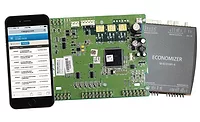
Danfoss calls its functional algorithms FDD (fault detection and diagnosis), and now includes the program modules in its controller software. FDD makes the control system aware of degraded equipment performance, enabling pinpoint intervention by service personnel before the refrigeration system fails to meet performance requirements.FDD can find degradations that will cause increased energy consumption or perhaps cause damage to equipment. FDD also enables "condition-based" maintenance as opposed to "preventive" maintenance and "fault-based" maintenance that are the current standard. "Preventive" is when you perform service in anticipation of a fault. "Fault-based" is when service is not performed until a fault has occurred.
In condition-based maintenance you perform service before the fault occurs, when FDD tells you one is about to occur. Condition-based maintenance avoids costly breakdowns, eliminates unnecessary maintenance, and allows the service provider to schedule work to his advantage.
The FDD software module can inform a monitoring center so that a dispatched service technician arrives with foreknowledge of the problem. Never was the expression "forewarned is forearmed" more true. Knowing the nature of the problem, the servicing organization can decide the priority of the call, and the technician can save time by being prepared with tools and spare parts to service the specific problem.
Algorithms pinpoint problems caused by dirty or blocked condensers. Also in development are modules that will point to icing evaporators, overloaded display fixtures, case airflow blockage, evaporator fan faults, and refrigerant loss. FDD algorithms are sophisticated, but they require only the usual sensors found in most supermarket systems. Most are based on computing energy balance with great precision, and by considering the energy levels in different ways to determine what situations probably exist. Then more data is considered to target the problem.
Looking for quick answers on air conditioning, heating and refrigeration topics? Try Ask ACHR NEWS, our new smart AI search tool. Ask ACHR NEWS
FDD started as an academic discipline based on the concept of analytical redundancy. It is another innovative solution that makes customers more secure and more able to enjoy their productive business life.
Publication date: 08/21/2006
Looking for a reprint of this article?
From high-res PDFs to custom plaques, order your copy today!