Noise Reduction
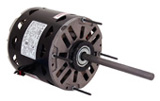
Here is an example of a PSC design that is more efficient than a previous design, and uses about 14 percent few amps. If the two motors were compared just based on amps, it might be incorrectly concluded that the previous design was a stronger motor, which is not the case.
Another frustration is that noise is not an easy condition to measure. Part of that difficulty goes back to the subjective perception of noise. A more technical reason is that noise is the perceived result of a complex interaction of sound waves. Measuring noise can be like measuring chaos.
All noise has a mechanical origin, which is to say it is the result of waves of pressure transmitted through air as the result of the mechanical movement of some object. In a motor, the sources of mechanical noise are numerous:
• So-called “electrical noise” is the result of mechanical pressure produced when the parts of a motor that can be magnetized are attracted and repelled from one another. This happens when the magnetic field that drives the motor alternates.
• Another source of noise is inherent in a motor’s relationship to both the mechanical and electrical effects of spinning parts moving through the air gap.
• Additionally, since the motor has a spinning internal part (namely, the rotor) imbalances are transferred to the frame of the motor as noise.
Noise inherent in a motor generally cannot be “cured” by the motor installer. But short of specifying a low-noise motor for the application, there are several things the savvy installer can do to minimize the effects of inherent motor noise.
The first course of action is fairly straightforward - isolation. Inherent noise is very efficiently transferred to the motor’s frame through its mechanical parts. Isolation breaks that efficient path to the motor-driven device. You can isolate the motor in several ways, such as using rubber motor pads, soft couplings, and/or resilient cradles.
There’s a second course of action that you need to consider when the first step fails to produce the desired result. This is based on the concept of harmonics. Harmonics are a set of specific frequencies that noisy mechanical equipment tends to favor as vibration frequencies. Unfortunately, harmonic frequencies are not easy to calculate, as they are the result of complex interactions of speed, mass, and separation (or the distance between moving assemblies).
Though difficult to calculate, you can deal with the effect of harmonic frequencies effectively by changing the speed, mass, or separation distance of the motor-driven apparatus. For example, in a belt-driven application, pulley diameters could be changed to vary the speed of the driven load. Slight increases or decreases in speed from the unit’s designed point could move the motor out of the harmonic frequency. Sometimes changing the density (hardness) of isolation devices, such as the rubber pads or resilient rings, is enough to move a mechanical assembly off a harmonic frequency. Where space and application permit, changing the length of the train of driven equipment can also move that equipment off a harmonic frequency.
Although subjective, motor noise is often the cause for callbacks by unhappy customers. Many times, you can solve the problem easily with isolation. But when the noise persists, a working knowledge of harmonic frequencies may mean the difference between a happy customer and an unhappy one.
Publication date: 03/10/2008
Links
Looking for a reprint of this article?
From high-res PDFs to custom plaques, order your copy today!